Electronic Arts closed BioWare in October 2026, ending a thirty-year run that fundamentally redefined roleplaying games across digital and physical tables. The studio’s closure marks a completed creative circle, as original lead designer James Ohlen returns to pen-and-paper publishing to launch Malborn: City of Masks alongside British author Adrian Tchaikovsky.

When Canadian medical doctors Ray Muzyka, Greg Zeschuk, and Augustine Yip founded BioWare in Edmonton in 1995, the acronym “RPG” referred almost exclusively to tabletop roleplaying games played with dice and paper sheets. Video game adaptations were called “CRPGs” to distinguish software from their tabletop originals. Over three decades, digital releases dominated the acronym, forcing tabletop games to adopt the retronym “TTRPG”. BioWare’s development history was not an attempt to replace tabletop gaming, but an extended exercise in translating kitchen-table rules into code and feeding mechanical lessons back into physical roleplaying games.
The Infinity Engine and AD&D 2e
BioWare moved away from medical training software and its 1996 mech combat title Shattered Steel because the studio wanted to adapt games its team actively played. When publisher Interplay secured the digital licence for TSR’s Dungeons & Dragons, BioWare modified Scott Greig’s real-time strategy prototype, Battleground Infinity, into the Infinity Engine. The resulting release, Baldur’s Gate (1998), solved the central problem of late-1990s digital roleplaying: how to adapt tabletop tactics to computer displays without grinding combat to a halt.
Advanced Dungeons & Dragons 2nd Edition relied on a sequential turn order. Combatants rolled a d10 initiative die modified by weapon speed factors or spell casting times, after which the Dungeon Master executed rounds in numerical sequence. BioWare replaced this with real-time with pause (RTwP).
| System Element | AD&D 2nd Edition Rules | BioWare Infinity Engine Translation |
| Initiative & Timing | 1d10 roll plus weapon speed factor; sequential execution | Simultaneous real-time flow partitioned into 6-second rounds |
| Tactical Command | Declared before initiative roll | Command queue and spell targeting managed via pause toggle |
| To Hit Metric | Manual THAC0 matrix subtraction against target Armour Class | Background algorithmic calculation resolved via simulated d20 |
| Resource Management | Vancian memorisation slots tracked on paper | Spells assigned to action hotbars; refreshed via in-game rest cycles |
Real-time with pause retained AD&D’s mathematical weight without stalling combat. Behind the graphics, the Infinity Engine calculated saving throws, armour modifiers, and damage ranges using virtual dice. The design introduced computer gamers to tabletop resource management: pre-combat buffing, party positioning, and protecting spellcasters.
The Edmonton kitchen table
Baldur’s Gate’s core originated in private campaign binders filled during an estimated 20,000 hours of D&D games James Ohlen ran while managing an Edmonton comic shop.
When production began, Ray Muzyka encouraged Ohlen to import his tabletop campaign materials directly into the Forgotten Realms setting. BioWare’s most recognised characters came straight from those homebrew sessions:
- Minsc and Boo: Played in Ohlen’s campaign by programmer Cameron Tofer. Tofer played Minsc as an erratic ranger, while Boo originated as an ordinary rodent sold to him by a swindling merchant NPC. Tofer declared the animal a “miniature giant space hamster” and spoke to it throughout the campaign, cementing the dynamic that reached the retail game.
- Boddyknock Glinkle: The gnome sorcerer in Neverwinter Nights was originally the player character played by executive producer Mark Darrah.
- Evangeline: The cleric who shaped key early dialogue scenarios was played by writer David Gaider.
- Davaeorn: The villainous wizard in the Cloakwood mines was named after Ray Muzyka’s tabletop character.
- Sarevok and Edwin Odesseiron: Created by Ohlen’s childhood friends Jeff Veitenheimer and Sean Carriere during early campaigns.
- Karzak and Gromnir Il-Khan: The half-orc fighter and iron-fisted warlord were taken directly from Ohlen’s tabletop character notes into the Sword Coast and Amn.
Because these characters originated at an active game table, their dialogue carried genuine personal histories, rivalries, and conflicting moral outlooks rather than generic quest-giver scripts. (sources: RockPaperShotgun, GamersWeb, DevGameClub)
Neverwinter Nights and virtual tabletop roots
Where Baldur’s Gate translated homebrew party dynamics into a single-player campaign, Neverwinter Nights (2002) codified the role of the Game Master in software. Built on third-edition D&D rules, the title’s primary contribution was the Aurora Toolset and its dedicated Dungeon Master Client.
BioWare created a system where a user could log into a server, control an omniscient avatar, spawn monsters, trigger environmental traps, possess NPCs to deliver unscripted dialogue, and adjudicate encounters in real time. Years before modern virtual tabletops gained broad adoption, Neverwinter Nights solved the practical hurdles of running remote tabletop roleplaying games, establishing conventions for persistent online worlds and modular adventure creation.
Green Ronin and the Dragon AGE Engine
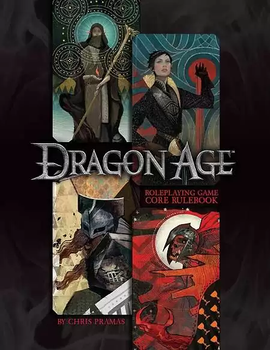
By 2009, BioWare moved away from licensed third-party properties to launch its proprietary fantasy setting with Dragon Age: Origins, designed by James Ohlen and David Gaider. Rather than using the Open Game Licence, the studio partnered with Green Ronin Publishing to adapt Thedas back into a physical tabletop game.
Green Ronin founder Chris Pramas designed a dedicated system tailored for players transitioning from console and PC games. Rejecting the standard d20 mechanic, the Dragon Age RPG line on DriveThruRPG runs on a 3d6 bell curve using the Adventure Game Engine (AGE):
- Action Resolution: Characters roll 3d6, adding an ability modifier and focus against a Target Number (TN).
- The Dragon Die: One of the three dice must be cast in a contrasting colour.
- Stunt Points (SP): When matching numbers appear on any two dice during a successful check, the face value of the contrasting Dragon Die awards that number of Stunt Points.
- Tactical Spend: Players spend SP immediately from menus covering combat manoeuvres (such as Skirmish, Mighty Blow, or Pierce Armour), spell enhancements, and social advantages.
Green Ronin initially released the line in boxed sets to teach the game in stages, beginning with Set 1 (levels 1–5) in 2010, expanding with Set 2 (levels 6–10) in 2011, and concluding the progression with Set 3 (levels 11–20) in 2014. These sets were later compiled into the 440-page Dragon Age RPG Core Rulebook in 2015, which won Gold for Game of the Year at the 2016 ENnie Awards.
Green Ronin subsequently decoupled the mechanics from the BioWare licence to create Fantasy AGE. That ruleset later powered Wil Wheaton’s Titansgrave: The Ashes of Valkana, Modern AGE, Blue Rose, and The Expanse RPG. BioWare’s video game combat logic directly spawned an entire family of standalone physical roleplaying games.
Star Wars, Mass Effect, and the sci-fi divide
BioWare’s science fiction projects saw differing degrees of tabletop integration.
In 2003, Wizards of the Coast adapted Star Wars: Knights of the Old Republic for the Odyssey Engine using its d20 Star Wars rules. Turn structures and feat progressions ran beneath real-time animations. The design came full circle in 2008 when Wizards of the Coast released the official Knights of the Old Republic Campaign Guide for the Star Wars Saga Edition roleplaying game, incorporating BioWare’s Old Republic lore, equipment, and prestige classes into the tabletop canon.
Mass Effect (2007) took a different path. Directed by Casey Hudson, the team focused on third-person shooter mechanics rather than tabletop rules. Electronic Arts’s commercial licensing restrictions prevented third-party tabletop publishers from acquiring the property. Fan projects filled the gap, most notably João Paulo da Vinha Santos’s Mass Effect d20 ruleset. Official physical media only arrived in 2024 through Modiphius Entertainment’s Mass Effect: The Board Game – Priority: Hagalaz, designed by Eric M. Lang and Calvin Wong Tze Loon as a tactical squad board game rather than an open roleplaying system.
Arcanum Worlds and the Modern TTRPG Return

Corporate growth under Electronic Arts eventually separated BioWare’s original leadership from direct world-building. In 2018, James Ohlen left after 22 years to co-found Arcanum Worlds with creative director Jesse Sky and writer Drew Karpyshyn.
Their debut 5th Edition campaign, Odyssey of the Dragonlords, integrated BioWare character design into 5e rules through “Epic Paths” that tied player backgrounds directly into the main plot. Ohlen later joined Wizards of the Coast’s Archetype Entertainment to work on the sci-fi project EXODUS, but stepped away from studio management to write tabletop adventure books full-time.
That return to pen and paper culminates in Malborn: City of Masks, an urban vigilante 5e setting co-written with Adrian Tchaikovsky. Thirty years after BioWare turned dice rolls and homebrew binders into digital hits, the studio’s key designers are back where they started: writing rules for physical gaming tables.
Independently covering Green Ronin Publishing since 2009. Our archive includes 143 entries connected to this topic.
Latest entry: October 2026


