Vampire fiction contains distinct subgenres of speculative worldbuilding that mainstream tabletop design has rarely adapted into dedicated, standalone roleplaying games. While Vampire: The Masquerade has defined gothic-punk roleplaying since 1991, its clan politics and personal-horror framework leave major literary traditions unserved.
Readers frequently encounter landmark novels that feel inherently gameable, only to discover no boxed set exists on hobby shelves. Rather than waiting for official licensing agreements, Game Masters can capture these settings right now by pairing each book’s core operational dilemma with established, combat-tested tabletop rules.
Literary vampire settings vs Tabletop rules
| Novel & Author | Setting Core | The Missing Tabletop Mechanic | Recommended System |
| Anno Dracula (Kim Newman) | 1888 alternate London; Count Dracula marries Queen Victoria, establishing vampirism as an overt social hierarchy. | Social leverage combat, parliamentary faction patronage, and class-based bloodline power. | Swords of the Serpentine (GUMSHOE) |
| Fevre Dream (George R.R. Martin) | 1857 Mississippi River; rational, biological vampires running competing steamboat lines. | Physical lethality, daylight paralysis, and claustrophobic transport management stripped of mysticism. | Basic Roleplaying (BRP) |
| The Keep (F. Paul Wilson) | 1941 Romanian fortress; trapped German soldiers awaken an ancient, parasitic entity. | Squad-level military attrition, tactical claustrophobia, and inescapable cosmic predation. | Delta Green |
| The Historian (Elizabeth Kostova) | Cold War archival research spanning libraries and crypts across Eastern Europe. | Academic research trails, epistolary clue analysis, and slow-burn travel logistics. | Trail of Cthulhu |
Kim Newman’s Anno Dracula: Social ascendancy and blood politics
Kim Newman’s 1992 novel Anno Dracula posits a Victorian Britain where Abraham Van Helsing failed, Dracula defeated his pursuers, married Queen Victoria, and turned the British Empire into an open haven for the undead. The tension stems not from hiding in the shadows, but from climbing the social ladder: mortal aristocrats volunteer to be turned to secure cabinet appointments, while the impoverished slums of Whitechapel rot with “new-born” fledglings.
Standard gothic RPGs struggle with this premise because their mechanics presume concealment and masquerades. In Newman’s setting, vampirism is an overt bureaucratic power.
To run Anno Dracula, use Pelgrane Press’s Swords of the Serpentine, powered by the GUMSHOE engine. The game features dedicated rules for Morale combat and social influence, letting investigators and social climbers destroy an elder’s political standing in an aristocratic salon as cleanly as decapitating them with silver. Point spends guarantee that forensic evidence collected in Whitechapel leads directly to political conspirators in Whitehall without dead-end investigative rolls.
George R.R. Martin’s Fevre Dream: Rational biology on the river
Set against the steamboat trade of 1857, George R.R. Martin’s Fevre Dream strips vampirism of all religious superstition and gothic melodrama. Martin’s vampires are an evolutionary branch of humanity, biologically immortal, fast, and physically lethal, yet completely immune to crosses, garlic, or holy water. Their only constraints are severe daylight paralysis and “the red thirst”, a consuming biological drive that demands human livestock.
The conflict between Abner Marsh’s steamship company and Damon Julian’s predatory retinue works because the setting feels grounded, hot, and muddy. Standard superheroic tabletop powers break that tension.
The ideal engine here is Chaosium’s Call of Cthulhu rules or the underlying Basic Roleplaying (BRP) system. Percentile combat treats firearms and environmental hazards with realistic lethality, ensuring human crewmen remain physically outmatched by vampires while keeping the fragile technology of an 1850s steam engine central to the operational stakes.
F. Paul Wilson’s The Keep: Military attrition against ancient parasites
F. Paul Wilson’s 1981 novel The Keep places a detachment of German soldiers inside a mysterious medieval fortress in Romania’s Dinu Pass. As soldiers begin dying night after night, the garrison descends into tactical panic, unwittingly unleashing Radu Molasar, a primaeval, shapeshifting parasite.
Tabletop systems built around monster hunting fail to capture The Keep because the human characters are entirely outclassed from scene one. The horror comes from watch rotations, failing supply lines, and the dawning realisation that military hardware cannot solve the problem.
Arc Dream Publishing’s Delta Green provides the operational rules required for this scenario. Its Lethality ratings, military skill sets, and Bonds mechanic model psychological unravelling under combat stress, forcing players to manage failing garrison morale while an ancient entity picks them off one by one in the dark.
Elizabeth Kostova’s The Historian: Archival horror across Europe
Elizabeth Kostova’s The Historian treats the vampire mythos as a terrifying academic exercise. Spanning decades and crossing borders between Oxford, Istanbul, and Sofia, the characters spend more time translating medieval manuscripts, cross-referencing letters, and tracking architectural footprints than firing weapons. The horror builds through historical evidence: discovering that Vlad the Impaler’s tomb is empty, or realising an archivist disappeared from an Ottoman library centuries ago.
Conventional roleplaying encounters turn an archival quest into a series of failed perception checks. To make library science mechanically engaging, run The Historian using Kenneth Hite and Robin D. Laws’s Trail of Cthulhu.
GUMSHOE’s investigative core ensures that if an investigator has the relevant academic skill, such as History, Cryptography, or Languages, they automatically receive the core information in a monastery archive. The challenge shifts from whether the characters find the old letter to what they choose to do once they decipher its coordinates.
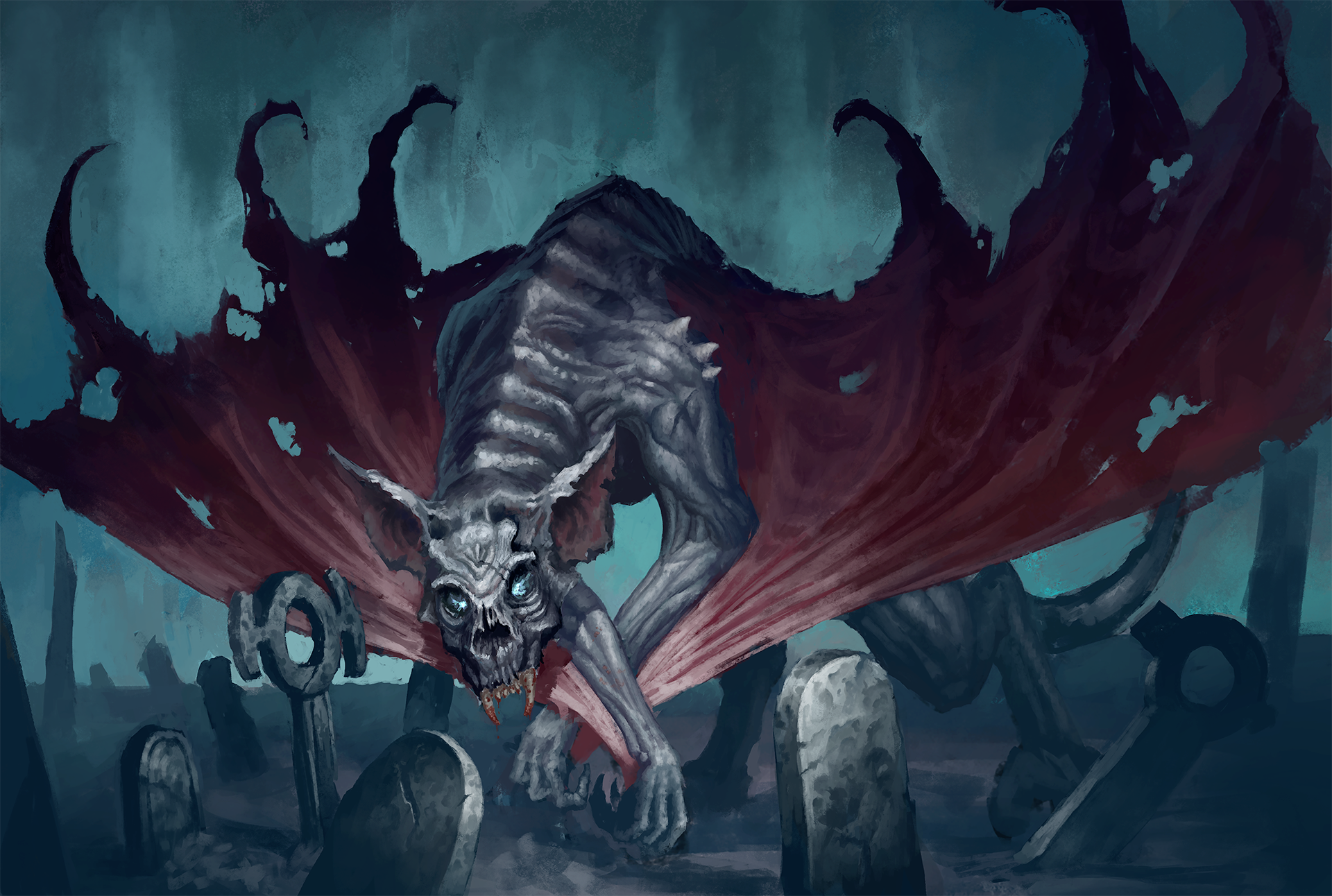
Creative Commons art credit: Primordial vampire by Istrandar.
Independently covering Vampire: The Masquerade since 2012. Our archive includes 121 entries connected to this topic.
Latest entry: October 2026


