ghost – end of night, directed by Shingo Natsume at Madhouse, screened at Scotland Loves Anime and arrives as a damp squib rather than the cerebral sci-fi showcase its premise promises. Following Neekei (voiced by Mayu Hotta) and Masu (or Mass?) (voiced by Issey Takahashi) through a near-future world powered by gravity tech where nobody has to work, the film turns what could have been sharp social drama into a slow, murky slog.
The premise sets up a post-scarcity society where basic needs and food are taken care of, yet happiness remains scarce and those outside the elite pass time with menial tasks like folding bright origami cranes. Even as a festival screening, it sets a low bar for the festival’s awards lineup, landing as a minimalist misfire despite big-name talent behind the camera.
Story and pacing in a post-scarcity world
ghost – end of night sets its sights on big questions about leisure, status, and what happens to human drive when work disappears, yet it rarely connects those ideas into a gripping story. Rather than building clear momentum or sharp stakes, the plot drifts through a low-key mood piece that struggles to explain its own mechanics or justify its length.
Neekei, a programming prodigy who deals with the system’s clutter by drawing a transparent sword to slice away what feels like cancerous code decorations, tries to navigate her senses in this world while believing in a strange afterlife myth about becoming a star after death. Alongside her is Masu, an unplugged outsider with an intricate tattoo who rejects the uniform bright colours worn by people folding origami paper, and who is referred to in-world in ways that feel like an awkward jab at “idiots” rather than earned character tension.
Their bond forms the emotional spine, yet the drama stays stubbornly muted. Ideas that look academic on paper end up grinding slowly into sludge, leaving the film’s central conflict feeling distant even when the characters are right in front of you.
Visual direction and screening atmosphere
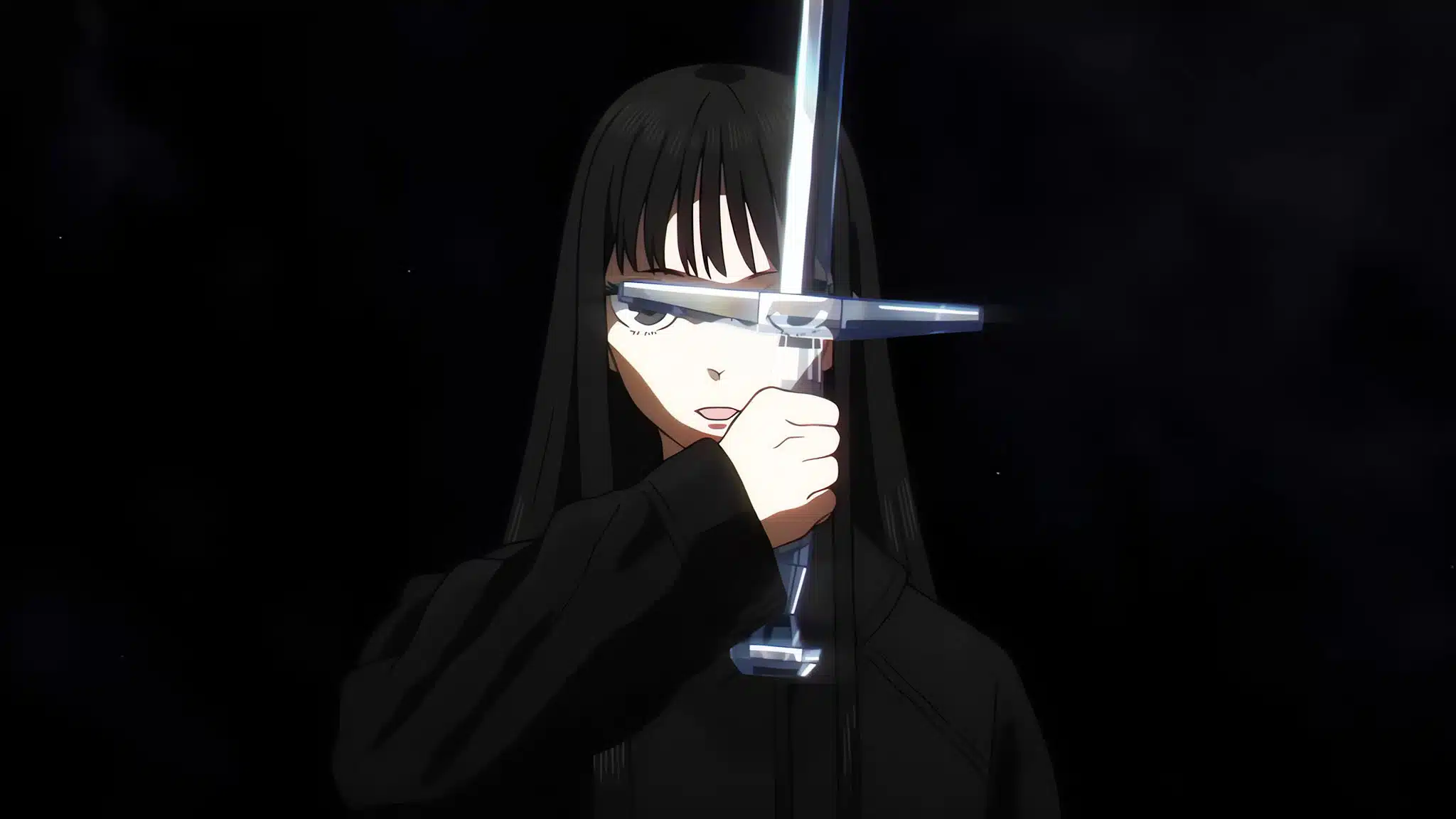
Visually, the film plays with striking contrasts, blending what appears to be live-action style real-world backgrounds into animated scenes so seamlessly that you can momentarily question what is drawn and what is photographed. Background characters who are not central to a scene often appear without eyes, a visual shorthand for people spending their lives plugged into an unseen online experience.
One specific visual touch stands out: when background figures lose their eyes as a sign of detachment, the contrast against foreground details like intricate skin tattoos or bright folded paper highlights the film’s interest in surface versus substance. For viewers drawn to Shingo Natsume‘s prior work on Sonny Boy or studio Madhouse’s pedigree, the craft is evident in flashes, yet the slow rhythm blunts the impact.
In the screening room, the mood matched the material’s restraint. Regular host Jonathan Clements introduced the film without gushing praise, and the slow burn left little room for crowd momentum. Fans of cerebral sci-fi dramas like Sonny Boy or Serial Experiments Lain may still want to check out the festival page for ghost – end of night, watch the official teaser trailer on YouTube, or share their verdict in the unofficial SLA-ED poll.

