Dragon Ball: Multiverse Chronicles – TTRPG is an unofficial, fan-made supplement designed to transplant the high-flying martial arts battles of Akira Toriyama’s universe into modern tabletop gaming. The document (Google Doc) sets up a custom setting called Elementaria, providing character sheets, transformation ranks, and campaign outlines for tables looking to recreate the anime’s escalating duels.
While the concept shows promise, the book functions purely as an overlay. Anyone coming to this title expecting a complete game will quickly hit a wall.
System
The supplement is built entirely on the Marvel Multiverse RPG rules engine, meaning you cannot play it on its own. The text makes no attempt whatsoever to explain core resolution mechanics, dice pools, or combat turns. Instead, it assumes total fluency with the official rules and immediately launches into custom adjustments.
The design modifies character Ranks, setting Rank 3 caps for base-form Saiyans while allowing non-transforming races to train up to Rank 6. Saiyan power progression requires juggling distinct character sheets for each transformation, from Oozaru to Super Saiyan and God forms. Focus drain per round acts as the balancing tether for these heightened forms. For stats, the author links directly to character profiles hosted on Demiplane rather than formatting full stat blocks in the text.
Setting and story
The action takes place on Planet Elementaria, a tidally locked world split between four peaceful elemental tribes in the light and a hostile realm known as the Kingdom of the Night. The premise follows Korn, a reincarnated Saiyan secretly harboured by the angel Whis.
Despite five distinct sagas listed across the campaign section, the game presents a setting implied entirely by its characters. The storyline reads as a fixed sequence of tournament bouts, sudden invasions, and escalating battles against rivals like Princess Umbra, Agent Argent, and Goddess Cero. Much like the source anime, there is very little plot or open narrative direction outside the fights. Groups are largely left to stage one duel after another without deeper roleplaying guidance.
Races and special techniques
Player options centre on Saiyans and Namekians, adapting classic anime abilities into power trees. Saiyans receive innate tails, Great Ape transformations, and Zenkai boosts when recovering from critical injuries. Namekians branch into Warrior and Dragon clans, offering innate regeneration, Namekian fusion, and healing abilities.
Iconic powers receive explicit operational translations. The Spirit Bomb requires uninterrupted focus and scales its damage multiplier based on whether it draws energy from a planet, solar system, or universe. Both Metamoran dance fusions and Potara earrings appear as distinct mechanics, yielding separate fused character sheets with strict time limits or stat sums.

Art style
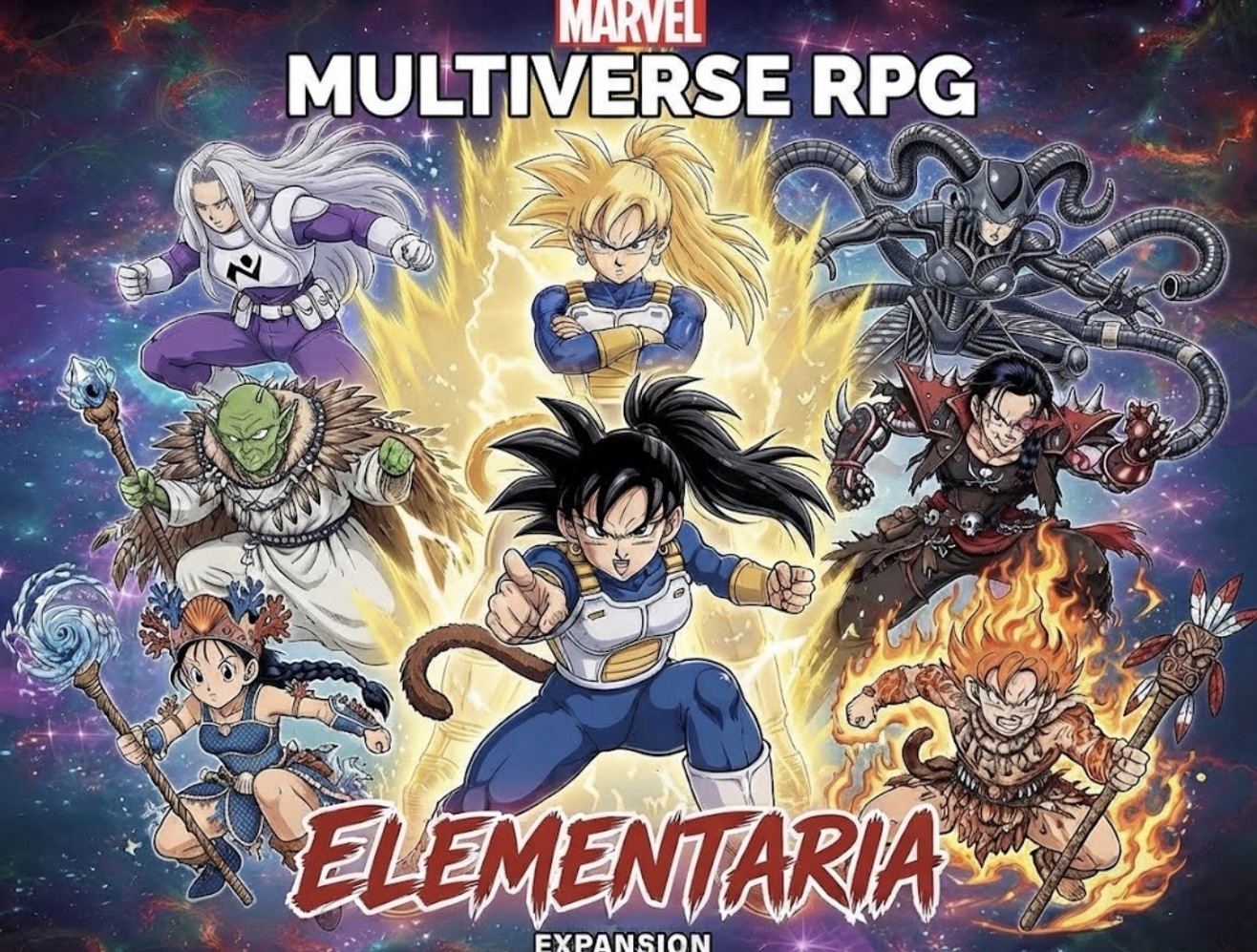
Visually, the production stands out immediately. The character designs, map illustrations, and transformation splash pages look great, matching the classic Toriyama aesthetic with vibrant colours and clean linework.
The missing element is provenance. No human illustrator credits appear anywhere in the credits or legal notices. Without clear artist attribution, the persistent worry is that the imagery is all generative AI rather than commissioned craft. Knowing that the creator's passion project extended to human-crafted illustrations would make a genuine difference to the final presentation. Itch now demands provenance.
If you already own the necessary core books and enjoy anime combat, the digital character files give you immediate arena fighters. For tabletop groups needing actual plot structure or standalone rules, it remains an incomplete toolkit.
To run this supplement, players must pick up the official rules via the Marvel Multiverse RPG Core Rule Book. Digital character templates are available to inspect on the official Demiplane Character Sheet. Alternatively, if you're in the market for free anime melee, there's always the equally unofficial Naruto 5e/Shinobi Handbook.


