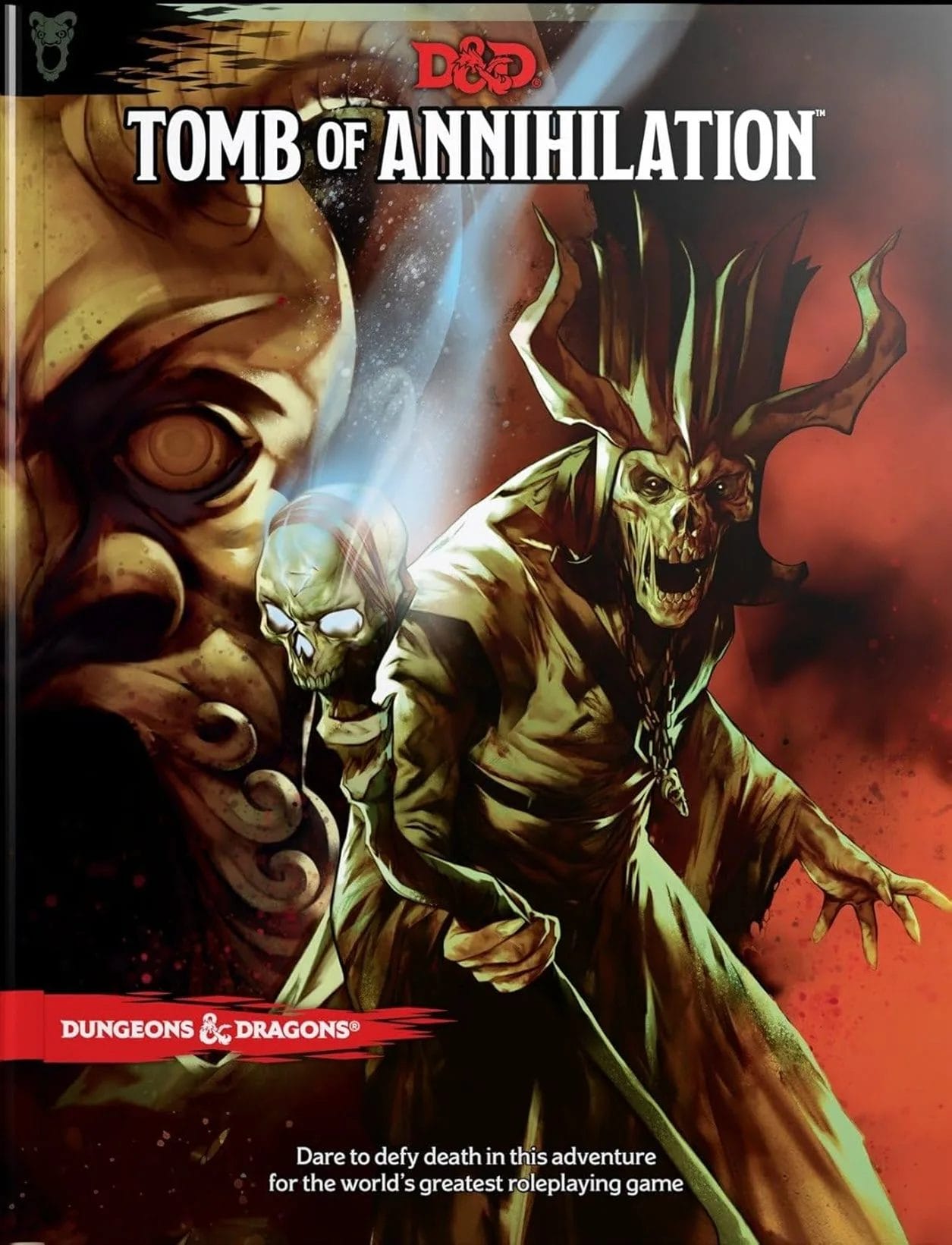
Here’s an interesting question. Would you let someone play in your Tomb of Annihilation campaign if they’d played the adventure all the way through before? If they knew every twist and turn from a previous game? Up until last night, I pretty much thought the answer to this would have been ‘no’, but now I’m not so sure.
I was having a totally different discussion about book spoilers because someone nearly spoiled City Of Brass for me (sidenote: if you like fantasy series and haven’t checked out the works of S.A. Chakraborty, go and get some really unique worldbuilding) this lead to a discussion about spoilers in general and how I could not understand how people enjoy a film if they’ve read the synopsis beforehand. This led to me being widely decried as people tried to explain to me that in a busy world, the synopsis is a vetting process for them because they don’t have time to watch a film they don’t like.
I mean, I don’t agree with this. Plot is one reason you might enjoy a film but it’s hardly the only reason. But I digress.
Setting aside the sadness about the pace of the modern world that this sentence triggers in me, I then went on to use the comparison of RPGs to try to demonstrate my argument. I said to my partner “We’ve just finished Call Of Cthulhu’s A Time To Harvest, would you play that again now all the secrets are spoiled and the plot is done?”. And she looked at me and said “Yes”.
I totally freaked. Like I couldn’t understand. My brain broke. And to be clear, this wasn’t about me losing an argument or being wrong. I just did not understand. It took me a while to properly formulate thoughts about that. Things like “Why am I bothering coming up with original content if I could just rerun the same game over and over?” and “Maybe I should just cancel all my interconnected plotting because clearly no one enjoys putting the pieces to together”. I was broken.
So What Is Going On Here?
As I have written before, I have a touch of ‘thee old neurospice’ and couldn’t leave it there. I had this worldview, alien to mine, right in my vision, like someone reading all my adventure prompts over my shoulder. I couldn’t let it lie. Our dinner table became a massive discussion about all kinds of media and games that involved both my partners and our kids.
It ranged from adaptations of books to films, to Curse of Strahd’s replayability to rewatching the same media several times. Luckily, the discussion wasn’t heated, just stimulating. By the time the dust had settled, I think I had a handle on it. Maybe.
So I have in the past talked about rerunning a game as a GM. And I think that’s the experience this sort of player has. They’re looking for the variation. The people they play with is important. Watching how they respond to a thing. The player who would answer yes to this conversation puts the group connectivity as high in their list of priorities over investing in the actual story of the game. They still might like how it all goes to together but the part of the tale they’re interested is the bit that concerns themselves and their friends, who are making the story inside the framework you provide. They have total faith that with a different group, the outcome would be completely different.

Which, on one level…maybe. Like I think if I ran A Time To Harvest again, the result would look similar. Because I’m trying to tell a story about something, so I’d go back to reinforcing the themes. But I should take this veiwpoint as a complement too, right? It means that my partner, in making this statement believes that in my games, character agency is foremost. That she and her friends have the power to do anything, and therefore the possibilities inside a game are endless, dictated only by the whims of the group. How true that is, I’ll never reveal (actually that’s a lie, I just thought of an article about this) but it’s nice that people can feel this way.
The enjoyment here for the player is in seeing the mix of players but also sharing something with someone, in the way a GM might easily do. I mostly run games from my own mind, unless I read a scenario that hooks me and I find a thing in it where I think “This Specific Player would love that. I’m going to get this to their table”. My daughter took this moment to explain that playing a previously played campaign with a new group would feel like rewatching a run of modern Doctor Who, as I am doing with her at the moment, because she wasn’t alive when the Eccleston-Tennant-Smith doctors existed. I’m taking joy in her seeing of it.
That’s the same for a player doing a rerun. They’re sharing a story they enjoyed with friends. I might not ever want to do it, but who am I to say it’s wrong? You’d have to be able to trust the player not to metagame and they might not get the fun of plot twists, but you never know.
Making This Work
This made me think about predeterminism in games. Like there are games where you can see things coming. Games like Heart and Spire have you going in knowing that tragedy is coming but you’ll also get something specific that you want out of the game. And you get to pick the finale of your character. Masks has a playbook called ‘The Doomed’ where you know that eventually your character us going to have to face an ending of sorts, you are just charting the journey there. Slugblaster has advancements which mean you can dictate as a player certain plot points are/are not going to come up during the game. And they all have a really interesting affect on play because the destination suddenly matters less than the journey. It refocuses the players agency from outcomes to the personal story. One player in my Masks game couldn’t wait for their doom to arrive, the other really struggled with it, feeling it eclipsed their agency. But in the end both told interesting stories that resulted in an ending. Of Sorts.

So I think this has highlighted to me that maybe while I don’t need to throw the baby out with the bathwater, maybe we need to remember that people are interested in the elements of the story that live, not the future or past of games. They’re in the here and now. And that’s about sharing a space with people, not plot or mechanics, or even character but the flesh and blood people they play with.
It’s also made me realise I might have become disconnected from the player experience. Maybe I need to find a way to invest in a short run of playing, so I can actually experience what it’s like to play with my friends without also managing a story. If you’re the forever GM try to remember that you don’t have that viewpoint any more.
And finally, it made work out a new way I can torture players in a horror game. Watching as one of your friends does a thing you know will be fatal, but being unable to say anything because you’ll be using meta-knowledge. That’s not just in-game survivor’s guilt. You’ll have actually killed someone’s character through inaction because you had to hang on to your integrity. Holy hades that is a powerful tool to hand to someone who runs horror.
Oh yes, I think I can find a few uses for this idea after all…anyone who played it before up for taking some newbies through Tomb Of Annihilation?