Ashfall Chronicles has launched a modular crowdfunding project offering 154 digital STL files designed to construct an arid, hostile desert settlement for tabletop roleplaying games. Titled Glass Choir: Namar, the digital collection has comfortably outpaced its modest £1,703 goal on Kickstarter, securing £4,018 from 90 backers with three days remaining in its funding cycle.
Led by principal creator Sergey Rassolov alongside an independent studio team, Ashfall Chronicles expands the post-cataclysm landscape established in its earlier Black Water releases. The project operates strictly as a digital asset suite for 3D printing hobbyists, combining FDM-oriented buildings and road networks with high-detail resin sculpts engineered for grim skirmishes and survival scenarios.
The Lore of Namar: Life Under the Second Sun
Namar functions as a standalone micro-setting designed around environmental hazards, resource scarcity, and drama. In background notes provided exclusively to Geek Native, the studio detailed the harsh realities facing the settlement:
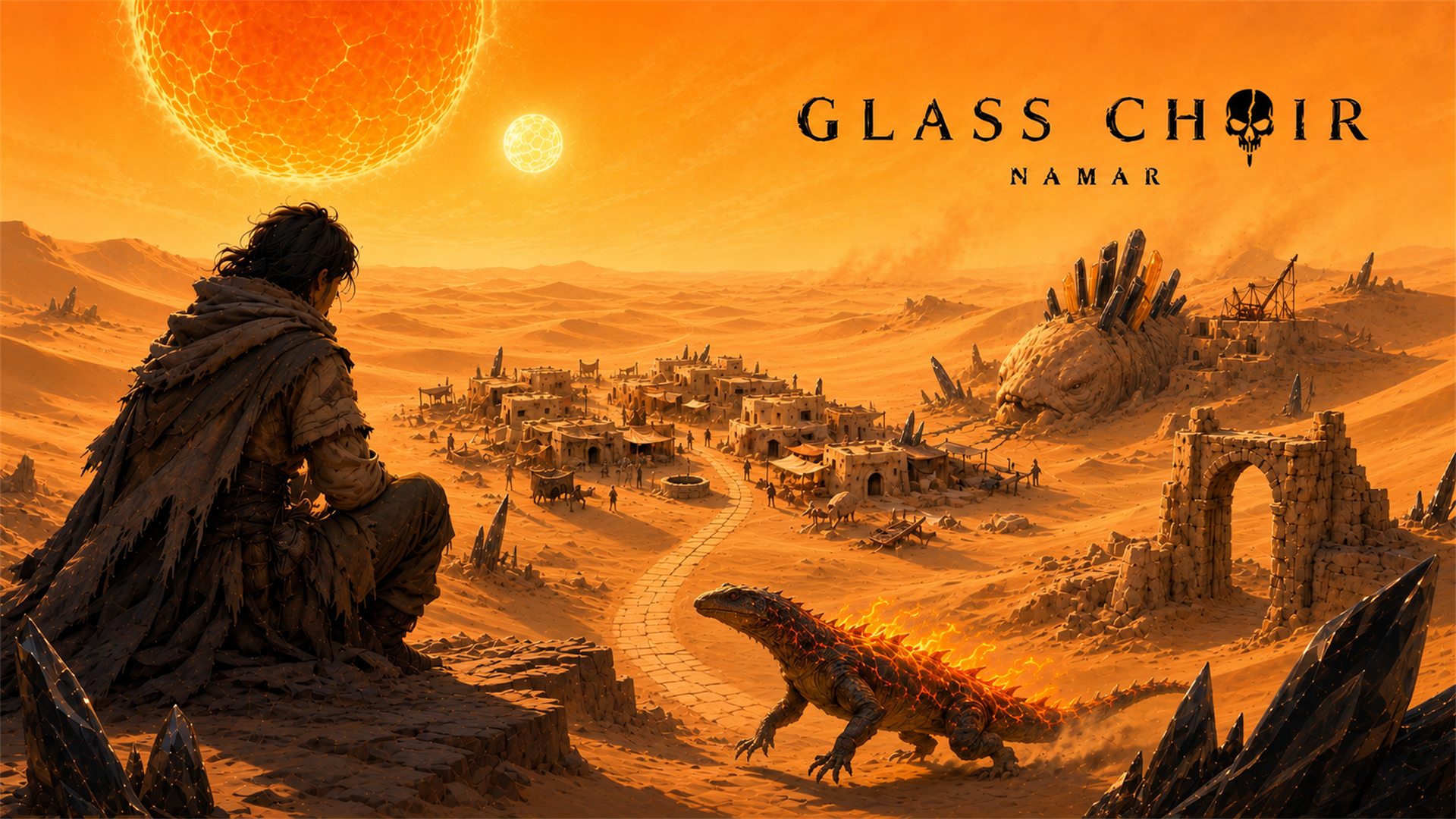
Most of Namar’s life takes place at night. The market opens, neighbours gather at the well, and the wardens check the stone paths and warning lines. By day, people shelter behind walls, shields and heavy awnings. The Second Sun burns skin, damages eyesight and bakes the sand into a crust of glass. Night offers relief from the light, but the desert remains dangerous. Beyond the last houses, even a heavy footstep can draw the creatures moving beneath the ground.
Namar is one of the settlements isolated by the Ashfall in the shared setting developed by Ashfall Chronicles. The catastrophe severed old connections, changed the wildlife and left dangerous lands between the surviving refuges. Namar once stood where three caravan roads met. Those roads now lie buried beneath the dunes, while the small trading post endures around its well, night market and sheltered courtyards. Players do not need to know the history of any other settlement to find stories here. Namar has its own people, conflicts and looming threat.
Survival in Namar hinges on weather anomalies and volatile physical laws that force parties to rethink standard wilderness expeditions:
There are two suns in this world. The Second appeared after the Ashfall, and ordinary clothing or a patch of open shade offers little protection from its light. On the worst days, it can set fabric alight, blind someone through a reflection and leave glassy marks on the ground. Usually, the people of Namar can venture outside after sunset. Old star charts, however, warn of the Seven Blind Days, a week when the Second Sun will not fade even at night. For Namar, that means shuttered homes, dwindling supplies and perilous journeys to reach water or anyone stranded without shelter.
The glass left by the catastrophe is more than part of the landscape. It can conduct Resonance, a rare interaction between light, stone, glass, ash and living memory. Tuned crystals and shards can warn of movement under the sand, soften the force of sunlight for a short time or preserve a voice. Resonance creates nothing from nothing. It redirects light, heat, sound or motion that is already there. The conductor must be tuned precisely, and a mistake can shatter it, burn its user or cost someone a memory. In Namar, even a useful tool carries a price.
Sleeping Terrors and Competing Factions
The ecological fallout of the Ashfall presents immediate threats to anyone stepping away from the town’s reinforced flagstones:
The desert’s creatures have changed too. Some sense vibration through the glass sand; others ignite in direct sunlight. A small burning lizard can turn a dry courtyard into a trap in seconds, while an altered desert monitor can enter an unquenchable state. People injured by the sun remain human. Their burdens are burns, blindness and the daily search for protection, not a transformation into monsters.
Another danger lies beneath the settlement. Local accounts say that the giant Undersinger appeared near Namar soon after the catastrophe. After its first rampage, it fell quiet deep below the old road. Hollow glass pipes along its back sometimes break through the sand. While it sleeps, residents tread carefully and listen to their warning shards. When those pipes begin to hum, Resonance carries the sound across the glass fields and calls other creatures towards Namar. Keeping the Undersinger asleep is a matter of survival.
The Guardians of the Veil and the Way repair the roads, ration water and protect residents from the light. The Choir of the Second Sun wants to understand the changed world and work with Resonance, even when an experiment might bring new danger. Both groups care about Namar, but they disagree about which risks are worth taking. That gives players meaningful choices: close the route towards the hum, help workers reach safety, or assist those trying to learn what is waking the Undersinger.
Modular Scenery, Miniatures, and Production Workflow
Rather than confining its sculpts to a proprietary rulebook, the campaign supplies an encounter-ready sandbox suitable for modern fantasy, grimdark, or post-apocalyptic roleplaying games:
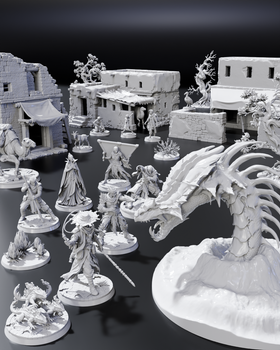
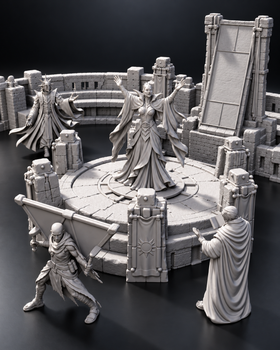
Glass Choir: Namar is built for encounters like these. Its digital models of residents, creatures, animals, buildings, props and modular roads can form a market after sunset, the courtyard around the well, or a passage through glass dunes. The same road might begin as a safe route and become an escape path when something vast starts to sing beneath it. The collection gives game masters a place for their own stories. The Kickstarter does not include a prewritten adventure or a ruleset.
The Kickstarter offers digital models for 3D printing. Renders show what the models look like, while photographs of selected test prints show physical results for those particular models. The aim is to give game masters a coherent place for their own encounters, from a quiet conversation at the well to a desperate retreat from the desert.
We print and check some models ourselves. We also share selected digital models with creators on Instagram who test print miniatures, offer practical feedback and help us improve the files. Some paint their prints and show them on their own accounts. We work with around ten ambassadors, five of whom help us regularly.
To ensure functional reliability on the hobby bench, the studio logged more than 100 hours of test printing before launch. Miniatures and organic components are pre-supported for resin SLA hardware, while structural architecture and modular streets are sliced and keyed to print reliably on standard FDM build plates without requiring support material.
Model Manifest and Asset Breakdown


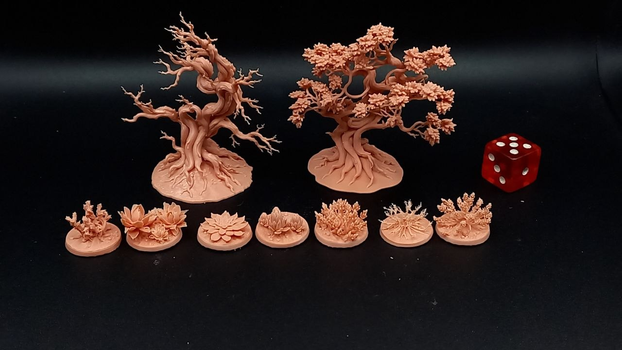
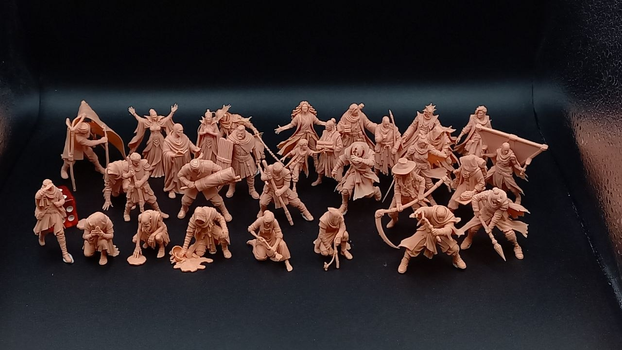
The 154-piece range covers every structural and narrative element needed to set an entire desert campaign on the table.
| Asset Category | Total Count | Included Key Pieces |
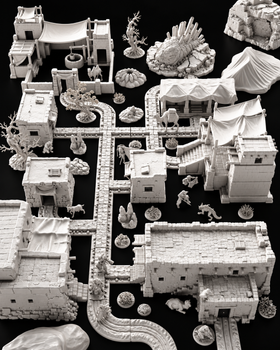
| Buildings & Locations | 15 Models | Three Roads Caravanserai, Sand-Swallowed Old House, Gallery of the Departed, Sealed Chamber of the White Cut |
| Relief & Modular Roads | 27 Models | Interlocking stone streets, sand-swept buried road segments, White Cut rock ledges, desert glass fields, resonance breaches |
| People of Namar | 33 Models | Marshal Idra Vane, First Cantor Essara, Deacon Zir, drovers, porters, water carriers, night market merchants |
| Monsters & Threats | 27 Models | Ring Maw, Six-Stepper, Hollow Saint, Mirror Widow, Sun Asp, dorsal resonance pipes of the Undersinger |
| Desert Animals | 7 Models | Loaded pack camels, bonebeaks, desert goats, glass-fused camel skeletons |
| Flora & Scatter Props | 38 Models | Salt fig trees, night rosettes, ground listening frames, modular market stalls, sealed sarcophagi, resonance beacons |
| Themed Bases | 7 Designs | Mosaic tiles, dune wave crests, resonance bursts (scaled across 15 mm, 20 mm, 25 mm, 40 mm, and 60 mm) |
Pledge Tiers and Commercial Licenses
Backers can choose between entry-level sample encounters, targeted model bundles, or comprehensive town-building sets:
- Pledge €1 (approx. £1): Trial Set. Includes five sample models designed to test slice settings across both print formats: the Guardian of the Last Post, an Echo Eater, the Listening Post, a Field Resonance Beacon, and a Resonance Breach tile.
- Pledge €35 (approx. £30): Characters & Horrors. Unlocks all 33 character models, 27 desert monsters, seven animal sculpts, and seven themed base designs in multiple diameters, supplied with pre-supported and unsupported resin files.
- Pledge €45 (approx. £39): Village & Desert. Includes the complete environmental suite: 15 buildings, 27 relief and roadway segments, 29 interior props, nine desert plants, and seven themed bases, engineered primarily for support-free FDM printing.
- Pledge €69 (approx. £59): Complete World. Unlocks the full 154-model catalogue across all eight asset categories under a personal-use license, including all subsequent campaign additions.
- Pledge €79 (approx. £68): Characters & Horrors – Merchant. Grants a perpetual commercial printing license to produce and sell physical resin prints of the 33 characters, 27 monsters, seven animals, and themed bases.
- Pledge €89 (approx. £76): Village & Desert – Merchant. Supplies a perpetual commercial license to sell physical prints of the 15 buildings, 27 modular roadway tiles, 29 scatter props, and terrain foliage.
- Pledge €129 (approx. £110): Complete World – Merchant. Provides a lifetime commercial license to sell physical prints of every model across the entire 154-piece Namar range, with file ownership remaining with Ashfall Chronicles.
Funding Deadline and Fulfilment
The campaign operates under an all-or-nothing funding deadline, concluding on Kickstarter in three days. File distribution will take place digitally via MyMiniFactory libraries, with Ashfall Chronicles estimating fulfilment delivery in October 2026 once final folder structuring, geometry checks, and ambassador print validations are completed.


