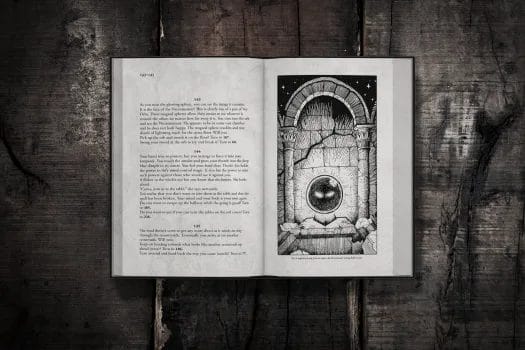
For many, the golden age of roleplaying games wasn’t spent around a table, but curled up with a book, a pencil, and a pair of dice. The Fighting Fantasy series, created by Steve Jackson and Ian Livingstone, defined a generation of solo adventures, and its influence is still felt today.
Now, two lifelong fans aim to recapture that classic magic with a dark, modern twist in Legion of the Necromancer, a new fantasy gamebook that evokes the familiar feel of the originals while charting its own grim path.
The project, from writer James Gill and illustrator James Isaacs, is a deliberate homage to the greats, yet it maintains its own unique identity. Set in the Tolkien-esque world of Aelrathia, the adventure injects a dose of Lovecraftian horror into the classic fantasy setting.
A key feature is Isaacs’ intricate, hand-drawn pen-and-ink artwork, a staunchly traditional approach in an age of AI generation. The trailer showcases a world of macabre beasts, shadowy towers, and a palpable sense of dread, promising a quest that is both nostalgic and refreshingly new.
Created by a pair of Warhammer fans who met working at a heavy metal magazine, Legion of the Necromancer is steeped in a grimdark aesthetic. The creators promise a challenge worthy of the genre, stating that players will not complete the quest on their first attempt, requiring careful mapping and intelligence gathering to succeed. The project alert page is now live on Kickstarter for those wishing to back it and secure a copy ahead of its planned Christmas 2025 release. To delve deeper into the mechanics, the world, and the heavy metal DNA of the gamebook, Geek Native spoke with both Jameses about their epic undertaking.
Hammerforge Chronicles interview
We have both James Gill and James Isaacs kind enough to donate their time.
You mention being inspired by the classic Fighting Fantasy books. Beyond the general format, were there any specific mechanics or narrative tricks from Ian Livingstone or Steve Jackson’s work that you consciously decided to either emulate or deliberately subvert in Legion of the Necromancer?
James Gill: Our aim was to make people feel like they’re reading a 1990 FF gamebook and, from early feedback, we’ve achieved that. Which feels great. But we also feel like we have introduced elements (large and small) that fans will not have seen in any of the 80s/90s books.
Full disclosure, I never did the combat properly when I was younger. I just loved the puzzles and codes and exploring the world of Allansia and beyond – and mapping it. So, while we have the basic FF fighting mechanic, we have focused on equipment and intelligence gathering.
As a writer I also focused on the narrative arc: eking out the discovery of facts to help readers understand what they need to do – how to defeat your nemesis when you meet him. We wanted a ‘peeling back the onion layers’ feel, so you feel like the plot is unfolding as you go.
This is only our first book and we have ideas to develop the fighting system and introduce elements of ‘luck’ and other mechanics (like ‘Fear’ in House of Hell, or gathering the letters of the word DEAD in Trial of Champions).
The project blends a Tolkien-esque world with Lovecraftian horror. How do you manage that tonal balance? Is the horror a subtle, creeping element, or does it take centre stage, and how do the game’s mechanics reflect that contrast?
James Gill: As a writer it’s a little hard to describe HOW the tonal balance is reached, other than ‘I write it how it feels like it works’. But to try and answer the question a little more satisfactorily, I will say this: the creeping, claustrophobic, gothic-ness of Lovecraft is amped up in the monster interactions and in describing the world, while still letting the gameplay breath. This is not unlike Tolkien’s own writing – though his tone is generally lighter.
It was important that the book remain a gamebook with a gothic feel, not a gothic novel with a few choices. So to concisely answer your latter question, the horror tone is in the background, rising to a climax at key points, but not stealing the show from the game.
For example:
“You walk stealthily along the wall towards the tower. Suddenly you are aware of a presence behind you, emerging from a niche in the wall. You turn to see a huge, horrific monster! You breathe a sigh of relief as you realise that it is only a statue. You inspect this gruesome effigy. It is Cthulhu, the terrifying, hideous and most ancient of beings. A god of gods from the time before time. It has the body of some misshapen demon from unknown depths. It has a huge bulbous head like a squid, its tentacles forming a beard and cape, and dramatic dragon-like wings. Its enigmatic dead eyes stare through the millennia, its purpose obscured by fathomless ages. Legend has it that Cthulhu is more ancient than the world itself, that it was the dream that created the gods. Wait, did it just move? It couldn’t have. It is clearly made of stone, covered in moss and lichen, the mould of rainwater casting long black stains down its contours. You’re not sure whether it’s moving or you’re moving. You feel more disorientated than ever. Then you hear a voice coming from deep inside yourself. It is Cthulhu speaking from beyond this world. It is telling you to submit to its power and join its ancient cult. The voice is getting louder and louder and you feel as if you might go mad as it rings in your head. Do you:
Attack Cthulhu? Turn to 78.
Try to escape? Turn to 107.
Try to respond to the voice that’s coming from inside you? Turn to 274.
The commitment to hand-drawn, pen-and-ink illustrations is a significant feature. For James Isaacs, could you talk about your artistic process?
James Isaacs: I’ve always been inspired by the Fighting Fantasy greats like Russ Nicholson and Bob Harvey as I found all their illustrations to be overflowing with narrative and personality and I’ve tried to inject a bit of that into the images for Legion of the Necromancer. And I think a big part of that is the use of pen and ink. The imperfections and roughness add so much tone, especially in a world where AI seems to be flooding in, we thought that creating a traditional gamebook was far more valuable and enjoyable to the reader. So far every image, I would talk to Gill about what he saw in his head when he was writing the scene and I would go away and sketch out options, show him and we would agree on the best way to go. I would then hone the image and start to ink it with brushes, pens and a traditional Tachikawa dip pen.
Could you give our readers a brief introduction to the world of Legion of the Necromancer? What makes this fantasy universe distinct from the classic settings it draws inspiration from, and what core conflict will players be stepping into?
James Gill: An evil Necromancer has found a once-hidden method of raising not just individuals from the dead, but thousands at once! He just needs a few tools first… Readers must stop him by gathering those tools and potentially come face to face with the evil being themselves.
And this is set in the land of Aelrathia.
Aelrathia is not so different from Middle Earth – with many similar beasts and aspects of magic, though it also introduces novel beasts and those from other ‘universes’. Readers will travel through open countryside, dense forest, dark mountain tunnels and, finally, the Necromancer’s tower – with its many hazards. While Aelrathia will feel familiar to readers of Fighting Fantasy, Tolkien, Rothfuss and Feist, it also has unique ideas: aspects of equipment, magic and codes that I haven’t seen in the 40-or-so FFs I’ve read over the years.
The night-ghast is a huge, tall thin humanoid beast with a face like a banshee and limbs like a mantis.
Illusive creatures that appear to be one thing, but are in fact another, or have psychic powers.
The ghost-hunter is a shapeshifting being that seems to come in and out of existence as it attacks.
A marketing person might call it: Familiar but fresh.
A key distinction is also James’ amazing illustrations: familiar yet all his own. And of course, the illustrations are not only the first thing readers will encounter, but they help to set the visual tone – as well as the narrative tone – of the world.
You confidently state that players won’t complete the book on their first attempt. What’s your design philosophy behind the challenge? Are you aiming for a puzzle-like “golden path” that players must discover, or is it more about resource management and surviving a brutal, unforgiving world?
James Gill: The book is more ‘golden path’: there are things you MUST learn and objects you MUST gather. However, readers will also have to manage money/spells/equipment to succeed.
I was always obsessed with mapping FF books and I wanted to create a world that would be fun to map – multiple pathways and hidden elements – so that not only would you not complete it first time, but it would feel exciting to explore again, not annoying to repeat it.
You might describe the game design philosophy as being more narrative led than combat/dice led. We wanted as many interactions as possible to be relevant later on, with intel, items or advice, rather than just a sequence of obstacles to traverse before getting to ‘the boss’.
You both met while working on a heavy metal magazine and are Warhammer fans. How has that shared aesthetic and background shaped the tone, art, and narrative of the gamebook? Is there a bit of heavy metal and grimdark in Legion of the Necromancer’s DNA?
James Isaacs: I think being raised on Games Workshop products in the ‘90s certainly imbued me the darker side of fantasy art. Looking at old school copies of White Dwarf and seeing the art of John Blanche, the godfather of grimdark, certainly had an influence on what I gravitated towards. From the art of Russ Nicholson and Bob Harvey on the classic Fighting Fantasy books or Derek Riggs’ work on classic Iron Maiden album covers, if it didn’t give me the shivers… I wasn’t interested.
James Gill: I got into Warhammer and heavy metal at the same time. They were all part and parcel. Painting space orks and listening to D-Rok (on White Dwarf records, no less) and Iron Maiden. I’ve always liked dark and I’ve always liked weird. The two worlds have informed each other for 60 years – Tolkien to Led Zep, Hammer Horror to Black Sabbath, Space Hulk to Boltthrower and so on.
And I couldn’t resist putting a few in-joke/Easter egg/references in the book, so rock and metal fans will no doubt spot those as they go…
Advertising Disclaimer: As an Amazon Associate I earn from qualifying purchases. Geek Native also earns money through DriveThruRPG and Skimlinks. Find out how.
To provide the best experiences, we and our partners use technologies like cookies to store and/or access device information. Consenting to these technologies will allow us and our partners to process personal data such as browsing behavior or unique IDs on this site and show (non-) personalized ads. Not consenting or withdrawing consent, may adversely affect certain features and functions.
Click below to consent to the above or make granular choices. Your choices will be applied to this site only. You can change your settings at any time, including withdrawing your consent, by using the toggles on the Cookie Policy, or by clicking on the manage consent button at the bottom of the screen.
Functional
Always active
The technical storage or access is strictly necessary for the legitimate purpose of enabling the use of a specific service explicitly requested by the subscriber or user, or for the sole purpose of carrying out the transmission of a communication over an electronic communications network.
Preferences
The technical storage or access is necessary for the legitimate purpose of storing preferences that are not requested by the subscriber or user.
Statistics
The technical storage or access that is used exclusively for statistical purposes.The technical storage or access that is used exclusively for anonymous statistical purposes. Without a subpoena, voluntary compliance on the part of your Internet Service Provider, or additional records from a third party, information stored or retrieved for this purpose alone cannot usually be used to identify you.
Marketing
The technical storage or access is required to create user profiles to send advertising, or to track the user on a website or across several websites for similar marketing purposes.