When running a monster in any game, but particularly in a horror game, there’s a piece of advice that you’ll hear a lot: don’t name the monster. Create a sense of mystery around what stalks the player characters, we say. Just let this thing dwell in their mind, only half describe it, give no clue as to what it is, we say. It’s good advice, sometimes leading to players going ‘what is this thing?’ in a desperate panic as it eats their flesh.
But in a recent game of Call of Cthulhu, I was running a scenario where the group are confronted by a creature from the game that is essentially a writhing mass of sentient hungry mouths in the form of a walking tree. I had it smash through the undergrowth and come at them, killing left and right. It was tense, and we actually left the game on a cliffhanger, with the beast smashing into the house where the players were hiding. So far, so terrifying.
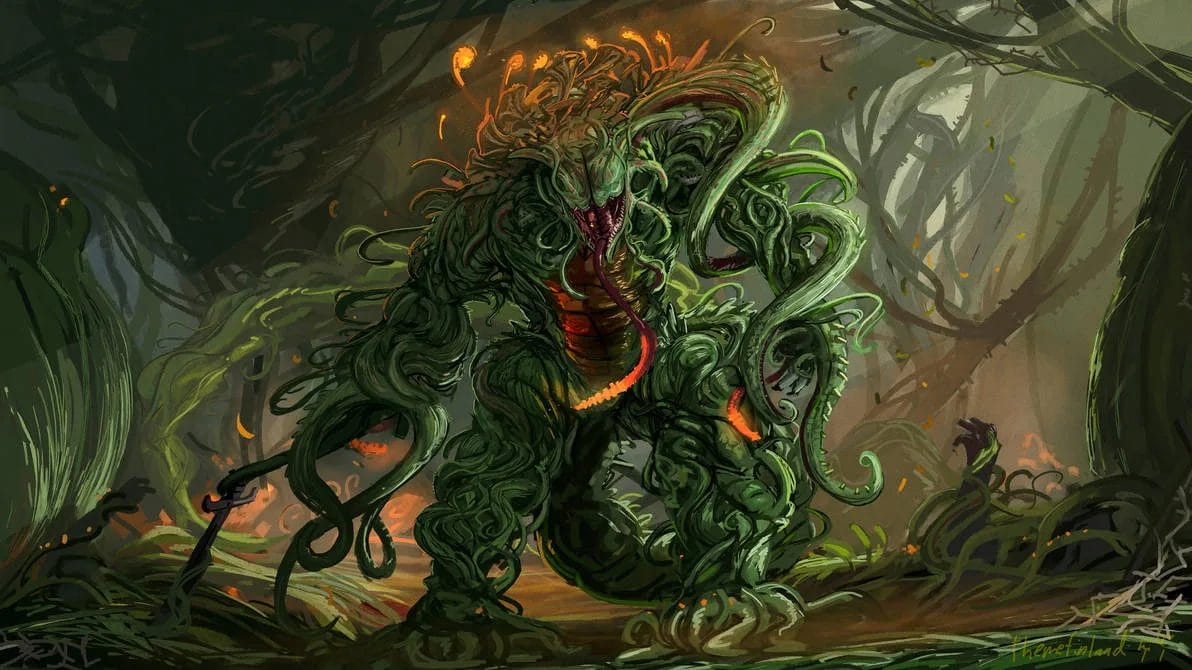
But then…. we came back to the recap, done by a member of the group. As she was reading back her notes from the last session, she said ‘and then the Murder-Ents come out of the treeline’ and I realised that, while I hadn’t chosen to name these creatures out of creating a sense of the unknown, instead I’d just given the players a chance to pick a name, and they’d chosen something that if I wasn’t careful would strip the beast of all its terror. Sometimes, I guess, it’s best to name your creature before the players give it a daft name. Luckily for me, the players couldn’t justify using the term ‘Murder-Ent’ in character because it’s set in 1930, 24 years before The Lord Of The Rings made the term even slightly parsed by most. So my game survived the ‘March Of The Murder-Ents’.
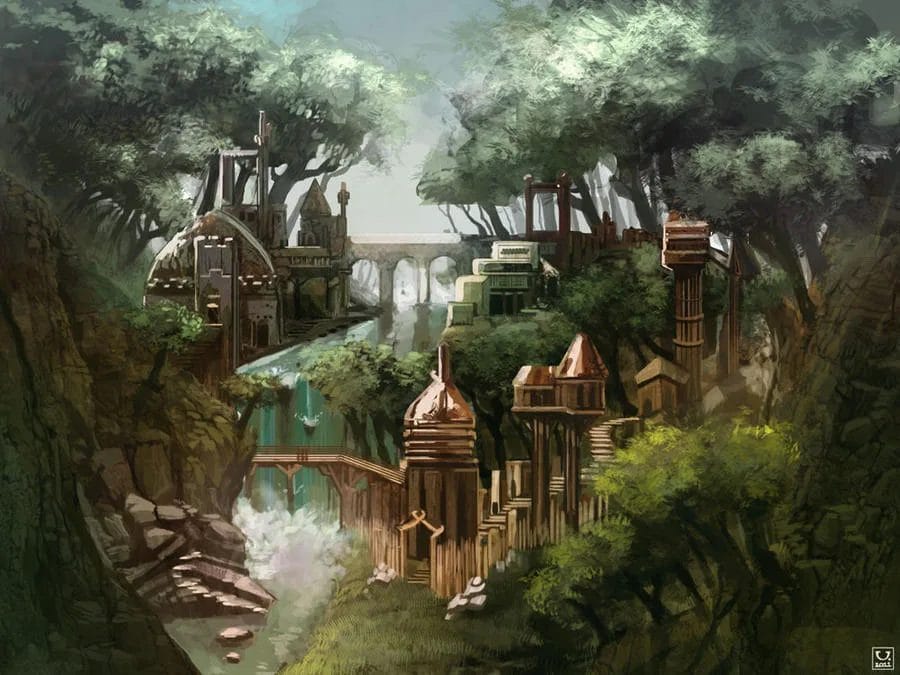
The whole experience got me thinking about nomenclature and description in games. How our description shapes the world that we lay out for players. And how it is a trap and blessing at the same. When we use description, we are often trying to paint the picture in our heads, but we’re also interacting with other people’s already composed thoughts. Each word or description we choose to use can trigger an associated image or semiotic response. If I were to say ‘elven village’ or ‘dwarven mine’, you, as player, already might have an idea of how that looks. I can use those expectations to help me paint a picture. People sometimes smile at me when I describe because I pick very real-world parallels and examples to describe what I’m thinking of. It’s because I want them to think of a place in a way that is different to the way they might be used to thinking about. It’s an attempt to break them out of an assumed mental state. Because those locks we get into can be restrictive.
This is because as human beings, we like to be able to shorthand and categorise. It helps us work through the world we live in. We also have brains that do pattern recognition as a survival technique, so it’s an easy thing to do in a game. ‘All these creatures are fey’ for example, means certain things in the rules but also in the game world. Things function in certain ways and we label them and give them rules about what is supposed to happen. Once we start naming and categorising things the world we are creating starts to harden. It becomes solid and dependable. But also a little bit dead.
Author China Mielville once explained that despite the success of their Bas-Lag trilogy of fantasy books, he’d never consider licensing the game out as an RPG because once people start categorising and defining that world, they’d have to stick to those rules and that the world would feel less fantastical, robbed of its potential to be anything because it was already something. Now that’s quite an involved way of thinking about fiction but anyone who has ever had a player say something like ‘that doesn’t make sense, it can’t happen’ about something happening in the plot and you then realise you didn’t notice that inconsistency and now need to explain it away at a later date has felt this pain. Every time we add categorisation or a fact to our world, we have taken a potential and turned it into a truth. And that truth now prevents any other possibility from manifesting. All creatures called ‘dwarves’ in this setting look like bearded short people. Luck is controlled by the God of Fate. Vampires need to be invited in and have no souls.
As someone who ended up spending three months of a weekly supers game delivering a complex time travel adventure to explain one narrative inconsistency, I can definitely see how sometimes it’s easier to wave our hands a bit. So why name or codify anything in a setting at all? Why not just constantly change expectations?
Well, sometimes it’s about making sure we have an agreed reality we all settle on. If I decided dwarves don’t look like traditional dwarves in my setting, then I better know what they do look like if someone wants to play one or I want to put one in, because keeping track of all the things a dwarf can be if it’s different every time is exhausting. Sometimes we can’t avoid naming or defining something. Doing so is an act of creation; choosing to paint a definitive fact into a made-up world is a good thing. Knowing in a supers game, there’s only one way to get powers is pretty important.

But also, there’s a level of control going on. If you define a part of the setting to a player, name something, then you’ve told them ‘my role is to do this’. And it’s then creating a clear dynamic of creation. In some games, this is appropriate. The GM is the person creating the world, painting the picture, defining what ‘is’ in the setting. But the truth as to who gets the power to ‘name’ things is flexible. The answer is up to you. When I was running World Wide Wrestling, I used to go round the table at the start of the every session and ask the players ‘what state are we in today?’, then the next player ‘where is out wrestling ring set up? What structure surrounds it?’ and ‘what unexpected thing are we dealing with?’ and we had some amazing responses as players painted the world around us. Sometimes it was a cramped club, others it was a stadium, one wrestling program took place in a Texas farm in the open air and later someone interrupted a match by elbow dropping out of passing helicopter. All I did was allow players to define the world for themselves, create truths about the world I couldn’t imagine.
I’m aware this article is a little more esoteric than a few of my previous entries, but I wanted us to just take a minute to think about the power we have. Our entire game worlds are defined by language exchange, so it’s worth taking a minute to just bore down to acknowledging that every time we make a choice to define and decide, we are purposefully crystallising something we later have to be careful not to smash.
Creative Commons credits: Plant mutant by Theme Finland, Elven Village by Carloscara and House of the Dead Portraits by Multifreak99.