Mantic Games is set to release The Ghost in the Shell: Tabletop Roleplaying Game this summer, strategically timed to coincide with a brand-new anime series hitting Amazon Prime on July 7th.
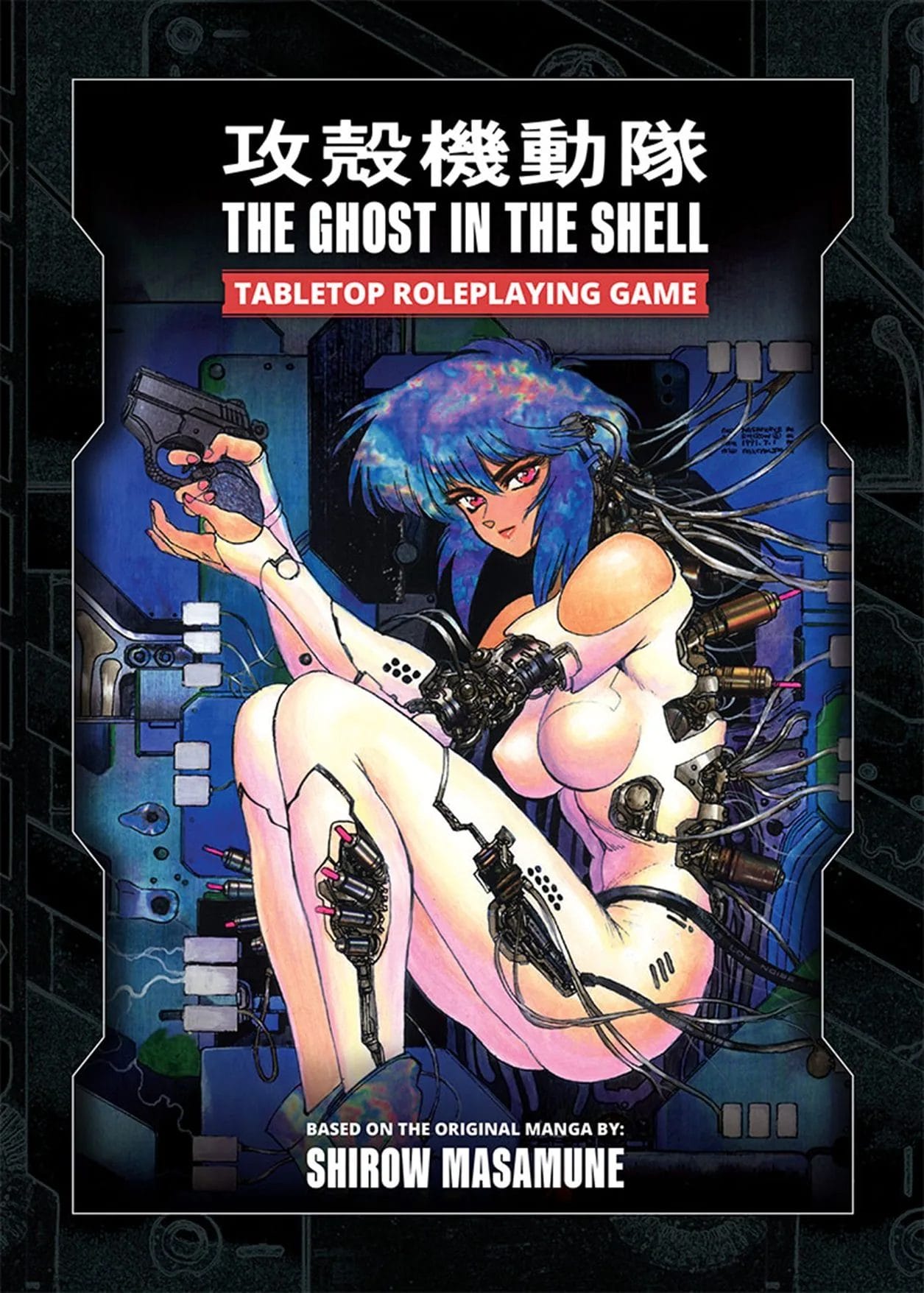
Designed by tabletop veterans Alessio Cavatore and Zak Barouh, this system is a bespoke, deeply faithful adaptation of Shirow Masamune‘s original manga, rather than a translation of the various anime iterations. This explicitly differentiates Mantic’s project from other titles in the market, such as Mana Project’s ARISE-licensed game, focusing instead on the gritty, philosophical origins of Section 9.
To give players a taste of the mechanics, a free rulebook teaser is already live and circulating online. Anticipation for the TTRPG’s unique “Synthesis Conflict” and highly lethal combat is building quickly. With Mantic Games confirmed to exhibit at the UK Games Expo in Birmingham between 29 and 31 May, the timing feels ripe for early reveals. Ahead of the convention, Geek Native caught up with Cavatore and Barouh to dissect the challenges of turning identity, hacking, and cybernetics into tangible gameplay.
With the launch scheduled for Summer 2026, the anticipation is hitting a fever pitch. Does this timeline mean we might see early looks at prototypes or public playtests at this year’s major tabletop conventions?
Alessio: Ooooohhh, not sure how much we can say yet, but if you are curious, I suggest coming to see us at the Mantic stand of the UK Game Expo!
You have been very specific about this being an “authentic and deeply faithful” adaptation of the original Shirow Masamune manga rather than the various anime iterations. How does the tone of the roleplaying game reflect the manga’s unique blend of gritty urban espionage and the dense, philosophical visual flair that defines the source material?
Alessio: In a graphic sense, the rulebook alternates black and white sections to full colour sections, exactly like the original manga, and 99% of the pages include artwork by Masamune Shirow taken right out of the original manga. This artwork has been carefully chosen and placed in ‘the right spot’ of the rulebook, illustrating the rules or background being described. This has been a very involved process, but has led to a hugely immersive experience, and if you, like us, are a fan of the manga, a very, very exciting one!
Speaking of game design, we have tried to allow the players to recreate and emulate all of the characters they loved reading the manga, as well as interacting with all of the in-world pieces of equipment, politics, and sense of camaraderie and inner struggle (more on this detail in answer 4 below). And we have also tried to capture one fundamental difference between the manga and the anime version – its quirky sense of humour.
From a business and design perspective, how do you differentiate Mantic’s “definitive tabletop experience” from other Ghost in the Shell products currently in the marketplace?
Alessio: Aside from the already-mentioned vast use of Masamune Shirow’s art, which makes the book absolutely gorgeous and immersive, I think that the key difference is that we have designed a bespoke system for the IP, instead of adapting an existing one.
This is, of course, harder work, but we thought that it ultimately pays off, as it allowed us, the designers, to pour all of our love (obsession!?) for the subject matter into the rules and mission. I’m sure readers will get exactly what I mean.
Another detail you will notice after trying our game is that, like some early reviewers are telling us, we managed to keep the rules tight and simple, minimalistic even, and yet they capture the essence of The Ghost in the Shell and allow you to explore its world in so much depth. That has also been hard work. You see, complexity is easy, simplicity is difficult. Or, to quote Mark Twain: “I didn’t have time to write a short letter, so I wrote a long one instead.” We’ve taken the time to write a short letter.
Finally, from a business perspective, we have started designing a range of collectors’ miniatures of the main characters, which I’m sure the players will not be able to stop using to recreate the action scenes in the RPG’s missions!
The “Synthesis Conflict” is one of the most intriguing mechanics mentioned on the character sheet. How does this mechanic translate the philosophical struggle of the “Ghost” (soul) versus the “Shell” (cybernetics) into a tangible gameplay constraint for a Section 9 operative?
Zac: Your Synthesis Conflict is defined by two Aspects, parts of your character’s life which are contradictory or conflicting. For the Major herself, we might list that as ‘humanity vs. technology’, or even ‘ghost vs. shell’, and as the story progresses, these Aspects vie for influence over the character’s life, represented by two gradually increasing bars on the Synthesis Gauge. Crucially, though, the result of this inner conflict is not always one side winning over the other. Though that can happen (a ‘Crisis’ in our game terms), depending on how the Player chooses to play their character, it’s also possible for the Aspects to ‘Resolve’ and become something new, in much the same way as the Major’s journey results in a synthesis and transformation with the Puppet Master.
The Aspects you choose for your Synthesis Conflict act like extra stats. They can be ‘Invoked’ to contribute dice to rolls when that Aspect is relevant, helping you succeed when you draw deeper from that well. On the other hand, the Aspects can also be ‘Compelled’ by the GM to cause trouble for your character. In either case, that Aspect’s gauge fills up as it becomes more influential. When the gauge is full on one side, your character has a critical moment of Crisis where the conflict between Aspects comes to a head. Once the Crisis resolves, the gauges reset, but with a permanent point on the side of the Crisis Aspect. In this way, throughout the course of a campaign, your character can have these gradually intensifying moments of personal conflict, eventually resulting in character-defining story beats when the gauges fill up permanently.
Because the Player chooses their own Aspects, and because it is all tracked openly in the middle of the character sheet, it’s really easy for Players to see how their characters are being influenced by the story, and react and guide that as they please, so you end up with a satisfying and organic sense of character development. It empowers Players to revel in the messy complexities of their characters, while the rules remain clear and simple!
Your rules for combat are described as “highly lethal”. In a genre where players often expect to play as “super-soldiers,” how did you balance that lethality so that players feel empowered as Section 9 agents but never truly safe?
Alessio: As a rookie in Section 9, you definitely should not feel safe! The system is definitely lethal. To give you an example, your head location has 2 hit points, your arm has 3… and the average, normal handgun causes D6 points of damage. Of course, armour and cyberisation will make you more durable, but then again the weaponry of the opposition is often far more deadly than a normal handgun…
The one element that makes the PCs superior to (and more survivable than) their opponents is the Ghost Whispers points system. This is a classic mechanic of ‘plot points currency’, which the players can earn by ‘doing cool stuff’ and spend to modify dice rolls and even the plot of the mission itself. In-world, they represent the mysterious ‘Ghost Whispers’ that the Major occasionally speaks of. Are they just a synonym for ‘intuition’ or ‘experience’, or are they whispers from some internet-born new form of self-awareness, or even are they direct messages from agents of the Imperial Household Psychic Agency or the Channeling Agency?
Hacking is notoriously difficult to get right in roleplaying games without isolating the “hacker” player for an hour. How does your bespoke system keep hacking “fast-paced” and narrative-driven while maintaining the technical depth fans expect?
Alessio: Hacking is indeed a very powerful weapon in a squad’s arsenal. In a way, we found hacking to be similar to magic in fantasy settings. It’s easy to get it too powerful. Luckily, this danger is balanced by the fact that the PC’s opponents can access that too, so both the players and the GM are aware not to go overboard with it. It reminded me of the Mutually Assured Destruction equilibrium that exists with nuclear weapons.
Mantic is synonymous with high-quality miniatures and tactical skirmish games like Halo: Flashpoint. Is this project primarily a “theatre of the mind” experience, or should players expect the heavy integration of grids and tactical combat that mirrors your studio’s wargaming pedigree?
Alessio: This is definitely a more traditional RPG experience, with a bunch of players gathered around a table (or their computers), and a GM narrating the exciting events of a dangerous mission in Masamune Shirow’s cyberpunk world. Though of course we often used maps and miniatures to recreate the firefights that do happen quite often in these missions, this is by no means a miniatures skirmish system.
Though of course, if this tabletop RPG project proves successful, who knows what could follow it, right?
Instead of starting as the legendary Major Kusanagi, players begin as trainee agents. Was this a decision made to facilitate traditional roleplaying game progression, or to better explore the “outsider” perspective of Newport City?
Zak: From my perspective, a sense of progression was certainly desirable, though much of this is not simply stats getting bigger. Your body becomes more cyberised, and as you prove yourself useful to Section 9, you get access to a wider range of gadgets and gear. But as you get deeper in, you become more and more entangled with Section 9 – they likely even own parts of your body, because few individuals could afford the military-grade cybernetics they provide. For me, I think the most important thing is that it allows each character (and their Players) to build their relationship with Section 9, New Port City, and the setting at large, from the ground up.
At the end of the first Mission, Lost Patriot, there’s a paragraph in the epilogue which gets to the heart of how I was thinking about it:
“This mission has given the PCs the opportunity to see the sort of people they must contend with—those with enough power to act above the law. Even Section 9, acting supposedly without oversight, is not immune to the corrupt interests of those in power. If they are to do good, to deal justice, they must neither abuse their position, nor become unthinking executioners for the government. How long can they balance their sense of morality with the reality of their work in Section 9?
This is a very complex world, and the characters are constantly challenged to find meaning and clarity within it. I think starting that journey from the perspective of a rookie makes it easy to onboard. It provides the framework of a narrative character progression as much as a mechanical one.
Cyberpunk often focuses on “style over substance,” but Ghost in the Shell is fundamentally about identity. What was the single most difficult philosophical concept from the manga to turn into a playable, mechanical rule?
Zak: For my part, designing the Synthesis Conflict and baking it centrally into the Player Character was done to highlight and respect those elements of Ghost in the Shell, which I’m certain fans would be expecting. The system is inspired by Hegelian dialectic, which has been discussed in relation to Ghost in the Shell many, many times by people far more equipped to explain it than me, no doubt. In essence, the Synthesis Conflict presents a simple mechanic of stats and dice, but in a way that is constantly prompting the Player to think about their character’s inner struggles. On a surface level, the Player Characters may be government agents carrying out missions, but that’s not ultimately what Ghost in the Shell’s stories are about. They’re about characters overcoming contradictions, both internal and those present in the setting, and finding parts of a greater truth about themselves and the world (or failing to find them) and dealing with the consequences. It was very important to me that these philosophical and introspective parts of the series be present at the forefront of the game – though yes, trying to express philosophical ideas through the listing of a stat on a page feels pretty tricky! Ultimately of course, I’m simply hoping to give Players tools and prompts to help engage with and explore those themes themselves.
The rulebook includes the mission “Lost Patriot”. Does Mantic intend for this to be a standalone entry point, or the beginning of a long-term “living campaign” supported by future modules?
Alessio: We already have a number of mission synopsises approved and in the process of being written. How many more (and what additional products) will be published will definitely be a consequence of how successful the launch of the core rulebook is. I cannot wait to see more.
Thanks, Alessio, thanks, Zak!
It is clear that Mantic’s approach to The Ghost in the Shell prioritises the dense, philosophical dialectics of the original manga just as heavily as the high-stakes tactical gunfights. By framing the players as vulnerable Section 9 trainees rather than as an untouchable Major Kusanagi, the system promises a grounded, dangerous introduction to Newport City, underpinned by mechanics such as the Hegelian-inspired Synthesis Conflict.
The success of the core rulebook will ultimately dictate the expansion of future mission modules, but the foundation for a long-term campaign is evidently built into the design. Fans eager to interrogate the system further before the summer launch can dig into the rules right now or seek out the Mantic Games team on the show floor at the UK Games Expo.
Quick Links:
- Download: The Ghost in the Shell Tabletop Roleplaying Game Rulebook Teaser
- Event: Mantic Games at UK Games Expo
- Watch: New trailer for Ghost in the Shell anime
Independently covering river horse since 2016. Our archive includes 24 entries connected to this topic.
Latest entry: May 2026
Want to be part of the buzz? You can sponsor Geek Native's coverage of several significant geeky events in the UK this year.