Thistle Tavern, a prominent name in the Scottish tabletop scene, has announced a significant expansion that includes a new flagship store in Edinburgh and a record-breaking turnover milestone of £2 million.
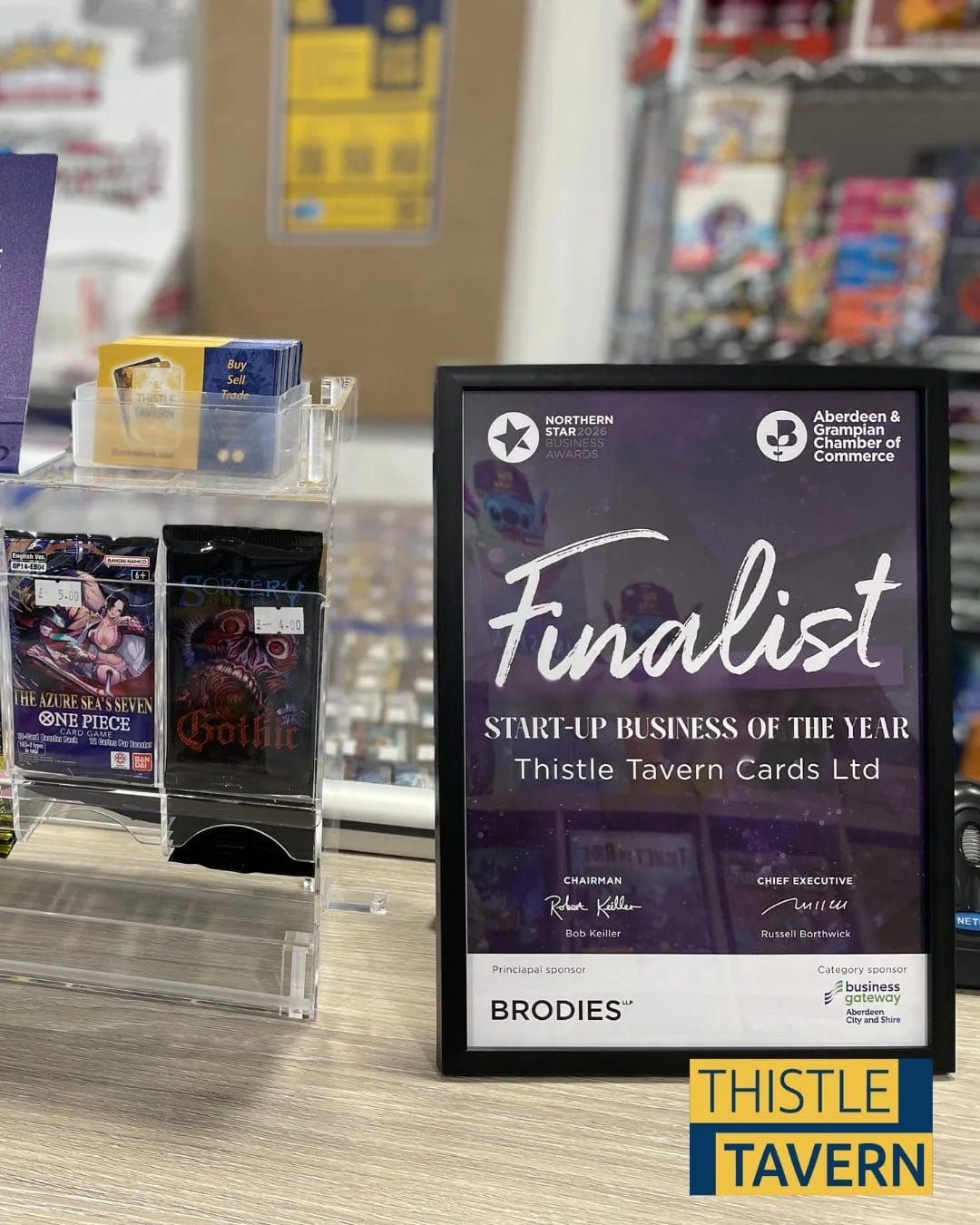
Following a successful residency on Union Street in Aberdeen, the business is set to become the largest dedicated tabletop event space in Scotland by player capacity, with the ability to host over 150 players across two floors. This growth comes at a time when city centre revitalisation is a priority, with the Tavern working alongside local bodies to drive evening footfall back to the “Granite Mile”.
The expansion is not limited to the north; a second flagship store is scheduled to open in late May on Shandwick Place in Edinburgh. Positioned near Haymarket Station, this new venue will mirror the Aberdeen model and introduce a “Stock Rotation” service, allowing rare cards for games like Pokémon and Magic: The Gathering to be swapped weekly between the two cities. We sat down with Stuart Robb, Director of Thistle Tavern, to discuss the logistics of scaling an independent hobby business, the technology behind their inventory management, and their commitment to supporting roleplaying games alongside competitive trading card tournaments.
You are set to become Scotland’s largest dedicated tabletop event space by player capacity. Beyond just “more seats,” what specific infrastructure requirements did you have to solve to handle 150+ players simultaneously, particularly regarding logistics like ventilation, acoustics, and tournament software?
Fortunately, many of the major TCG publishers provide bespoke software that makes sign-ups and pairing management much easier for us as retailers. We are currently looking to upgrade our audio/visual offering for Edinburgh, as it won’t have the advantage of partitioned spaces that we have in Aberdeen. This upgrade will allow us to control multiple round timers and pairing announcements in open play areas. We will also have modern air conditioning and heating throughout the playspace to ensure a comfortable gaming experience for everyone in attendance.
Edinburgh’s Shandwick Place is a high-traffic, high-rent area. Given the proximity to established gaming venues in the capital, what did your market research suggest was the specific “gap” in the Edinburgh scene that Thistle Tavern is designed to fill?
What initially drew us to Edinburgh was noticing that certain games were only getting one night of organised play, which, for a city the size of Edinburgh, was surprising. After speaking with local players, many of whom said they would appreciate more opportunities to play, we decided to expand into Edinburgh rather than risk a town or city without an established community.
Your “Stock Rotation” service for Pokémon and Magic: The Gathering singles is a bold logistical move. How will you manage the data syncing and physical transport of hundreds of high-value rare cards weekly without impacting the availability of your online inventory?
This is what will drive people to visit us: for the most part, our in-store singles are not available online. By keeping these offline, we can offer a better buying and selling experience. When you come in, you’ll be offered the most up-to-date prices based on Cardmarket or TCGplayer, and thanks to regular stock rotation, you’ll continually be surprised by new and notable cards to discover and add to your deck or collection.
You’ve attributed your rapid scale to a blend of expert knowledge and “proprietary pricing and inventory technology”. In an industry where many stores rely on standard POS systems, what specific problem did you need to code a custom solution for that wasn’t available on the market?
Andrew and I both come from technology backgrounds rather than retail or business management. When we started out online, we relied on off-the-shelf products, but once we opened the store, it gave us the opportunity to streamline our shipping operations through careful use of scripting and spreadsheets. As a result, even as our online orders have scaled dramatically over the past two years, we haven’t missed a beat and continue to offer same-day shipping on orders placed up until 4 p.m., 99% of the time, despite holding over 150,000 singles in stock. I’ve only recently moved from my previous full-time role to working within Thistle Tavern full-time, and I’m excited about the prospect of continuing to add unique value to our offering—for example, the FaBrary deck importer, which easily adds a full, ready-to-play deck to your cart from one of the most popular Flesh and Blood deck builder websites.
Most Local Game Stores (LGS) struggle to balance their digital and physical presence, often favouring one at the expense of the other. How do you prevent your online sales from “cannibalising” the rare stock that local players expect to find on your shelves in Aberdeen or Edinburgh?
This has been a challenge for us. As I’m sure everyone within the TCG space is aware, publisher stock availability has struggled to keep up with demand across many games. While we prioritise in-store sales of sealed products and favour attendees of organised play events, we recognise that the singles market is much larger online. By cultivating strong communities for every game we support, we’re able to offer a robust selection of singles online, fuelled by trade-ins from our local players.
How do you prepare your staff for the pace and complexity of larger regional events?
All of our staff bring strong knowledge of at least one TCG, and their regular training in hosting weekly events prepares them well for the pace and complexity of larger regional events. Our Aberdeen staff received a lot of positive feedback for our recent Yu-Gi-Oh! Regional tournament, large Disney Lorcana Set Championships, and multiple sell-out Magic: The Gathering prereleases, and that organisational experience will be passed on to the Edinburgh team. We also want to take this opportunity to reach out to local judges and invite them to introduce themselves to our Edinburgh team, as we would love to partner with them when larger organised play events arise.
You’ve worked closely with “Our Union Street” and local regeneration bodies. As a business that has successfully revitalised a former bank building, what is the one “hidden” cost or hurdle of city-centre regeneration that other independent gaming entrepreneurs should be aware of?
City centre locations do come with higher premiums, rent, and business rates, but many of your other costs, such as utilities, staffing, and planning applications, remain relatively fixed. Our decision to invest in these locations is driven by our belief that if you create a community hub that is easy to access and genuinely enticing, people will come.
You are moving early on titles like Cyberpunk TCG, Neuroscape, and Palworld. In a market often dominated by the “Big Three,” how do you evaluate the long-term viability of a new TCG before committing significant shelf space and event nights to it?
All we need to start supporting a game is a commitment from at least two players to turn up regularly each week. The real sense of community begins at four players, as even if one person can’t attend, you can still get a couple of games in against different opponents. From there, we believe in supporting the singles market for any new game. This is how we can really help a TCG thrive – by ensuring players have access to the cards they need, especially while sealed product remains a limited resource. An example of where we recently saw validation of this thought process was with Altered TCG, where we had a few players show interest, but due to the nature of that game’s collectability, we couldn’t offer singles, which I believe had a significant impact on the game’s overall success and eventual demise.

While TCGs often drive the most frequent footfall, roleplaying games are the heart of community building. With the expansion into upper-floor spaces, how are you designing the environment to ensure that the noise and energy of a 100-person TCG tournament don’t disrupt the immersive atmosphere required for roleplaying games?
Our Games Hub in Aberdeen benefits from being housed in a former bank building, which gives us four individually partitioned rooms that each seat up to eight people. While we had to scale back TTRPGs due to space constraints created by the popularity of TCGs, our hope with the new space is that we’ll be able to support more board gamers and tabletop miniature players, and also reintroduce our ground-floor room booking system. This will allow private groups to enjoy our gaming space with the freedom and privacy of their own room.
We’ve seen various “printing crises” affect the tabletop industry recently. How has your £2 million milestone changed your relationship with distributors, and are you now able to bypass some of the supply issues that plague smaller independent retailers?
Unfortunately, £2 million is still only a drop in the ocean when it comes to the tabletop industry, so we don’t yet benefit from any special partnerships or deals. What we continue to invest in, however, is our personal relationships – Andrew and I make a point of speaking to our suppliers and distributors in person whenever the opportunity arises at industry or game-specific events. We will keep striving to be one of the best-stocked LGSs in the industry, while also working with local publishers and designers to bring a level of uniqueness to our offering that big-box retailers simply can’t match.
In your 2024 interview with Scottish Financial News, you mentioned knowing there was an “active” community in Aberdeen. How has that community’s feedback directly influenced the architectural layout of the new Edinburgh flagship?
Our entire team has experience travelling to the capital to play TCGs, and we also had the benefit of attending Tabletop Scotland last year as a vendor, as it moved to its new location at the Royal Highland Centre. This connection allowed us to gauge local community interest before committing to Edinburgh, particularly regarding the space we’d need to support all the games we plan to offer organised play for.
You’ve mentioned building spaces where people can “compete, trade, and connect”. As you scale to a multi-city operation, how do you plan to maintain that “local tavern” feel without the brand starting to feel like a sterile corporate chain?
Our aversion to franchising means customers know exactly what to expect when they visit either Thistle Tavern location, and customer satisfaction ultimately rests with Andrew and me. At the same time, our focus on recruiting staff who are active members of the community helps maintain that true FLGS feel in Edinburgh, just as it has in Aberdeen. Locals can expect to be challenged week in, week out by staff at their favourite games; and that’s what makes Thistle Tavern a fun and competitive place to hang out.
You are doubling your team from five to ten members. When hiring for the Edinburgh launch, are you prioritising retail experience, or is “deep-dive” technical knowledge of obscure roleplaying games and TCG mechanics a non-negotiable requirement?
With our store manager Matty, we’re bringing in someone who is already a respected member of the TCG community, and many players will already recognise his face and trust his qualifications to manage what will be a busy games store. The wider team will also feature familiar faces from the local scene, as well as the strongest candidates from what was a very large and competitive pool during our initial recruitment drive.
Beyond the Edinburgh opening in late May 2026, where can the Scottish gaming community find Thistle Tavern next—perhaps a move into publishing or further regional flagships?
I’m always a little apprehensive about answering the ‘what comes next’ question, but our outlook is positive. While our long-term plans will naturally evolve based on where we are once the Edinburgh store is running smoothly, future locations, and continued expansion of our online singles offering, are both very much on our roadmap.
The expansion of Thistle Tavern is a testament to the growing demand for dedicated tabletop spaces that bridge the gap between retail and community hubs. You can find more details about their stock and events at the Thistle Tavern website or join the discussion with their local community via the Thistle Tavern Discord.
As the capital prepares for this new addition, the broader Scottish gaming scene remains vibrant. This news follows a series of developments in local hospitality and retail, reinforcing Edinburgh’s status as a central destination for enthusiasts. For those looking to see the community in full force, remember that Tabletop Scotland returns to the Royal Highland Centre in Edinburgh later in 2026, promising another massive celebration of the hobby.
Independently covering tabletop scotland since 2020. Our archive includes 88 entries connected to this topic.
Latest entry: September 2026
Want to be part of the buzz? You can sponsor Geek Native's coverage of several significant geeky events in the UK this year.



