I much prefer worldbuilding to running in pre-created settings, and I find D&D’s default class names come laden with too much high fantasy.
As a project this year, I’ve been trying to rename D&D classes until they’re both low-key sinister and fit a theme. As it’s nearly the end of the year, let me share the three themes I’ve managed. I was hoping to do more, but I’ve found it taxing! In each case, I started with the Wizard as I found that class was the easiest to do and set the tone.
Theme 1: The Bureaucracy of Erasure
This theme is for a party that serves a cold, legalistic authority. They treat reality as a document that must be managed, filed, or redacted.
- Wizard: The Censor (One who removes “incorrect” magic or reality)
- Barbarian: The Respondent (A reflexive tool used for immediate physical containment)
- Bard: The Orator (Specialist in propaganda and public consensus)
- Cleric: The Adherent (A rigid follower of celestial protocol)
- Druid: The Land-Steward (Managing nature as a resource, not a sanctuary)
- Fighter: The Operative (A personality-free asset used for removal tasks)
- Monk: The Quietist (Enforcer of absolute, eerie compliance)
- Paladin: The Inquisitor (Identifying and purging internal inconsistencies)
- Ranger: The Warden (Ensuring the wild remains a controlled prison)
- Rogue: The Auditor (Entering secure spaces to settle outstanding debts)
- Sorcerer: The Non-Standard (A deviation from the norm being monitored)
- Warlock: The Client (A soul bound by a predatory, legalistic contract)
Theme 2: The Clinical Laboratory
In this theme, the world is a series of specimens. The party doesn’t explore; they conduct field research with zero empathy for the subjects.
- Wizard: The Academic (One who views the horror of warping reality as data points)
- Barbarian: The Outlier (A biological anomaly used for stress testing)
- Bard: The Harmonic (Testing the psychological effects of frequency and sound)
- Cleric: The Vicar (A hollow placeholder for a distant, experimental power)
- Druid: The Taxonomist (Categorising and dissecting the natural world)
- Fighter: The Combatant (A sterile term for a unit of lethal force)
- Monk: The Ascetic (A body refined into a machine through ego-death)
- Paladin: The Votary (Bound by an oath that functions like a biological directive)
- Ranger: The Surveyor (Measuring the unknown so it may be conquered)
- Rogue: The Collector (Gathering specimens regardless of their consent)
- Sorcerer: The Carrier (A host for an innate, potentially infectious power)
- Warlock: The Debtor (A subject whose essence is being slowly repossessed)
Theme 3: The Archival Void
This theme focuses on the weight of forbidden knowledge. The party members are keepers of the “true” meaning of things, often at the cost of their own humanity.
- Wizard: The Glossarist (Defining reality through sinister footnotes)
- Barbarian: The Errata (An error in the natural order that creates violence)
- Bard: The Polemicist (A specialist in the aggressive breakdown of truth)
- Cleric: The Supplicant (One who begs an uncaring void for scraps of power)
- Druid: The Naturalist (Obsessed with the preservation of death and decay)
- Fighter: The Vanguard (The expendable first line of a forgotten cause)
- Monk: The Cenobite (A member of a secluded, incomprehensible order)
- Paladin: The Legate (A messenger for a law that no longer considers people)
- Ranger: The Scout (A clinical unit sent to watch the edges of the map)
- Rogue: The Fixer (Editing the world by removing problematic individuals)
- Sorcerer: The Conduit (A mere pipe for power that does not belong to them)
- Warlock: The Liaison (The only point of contact for a terrifying entity)
I’m sure you can do better!
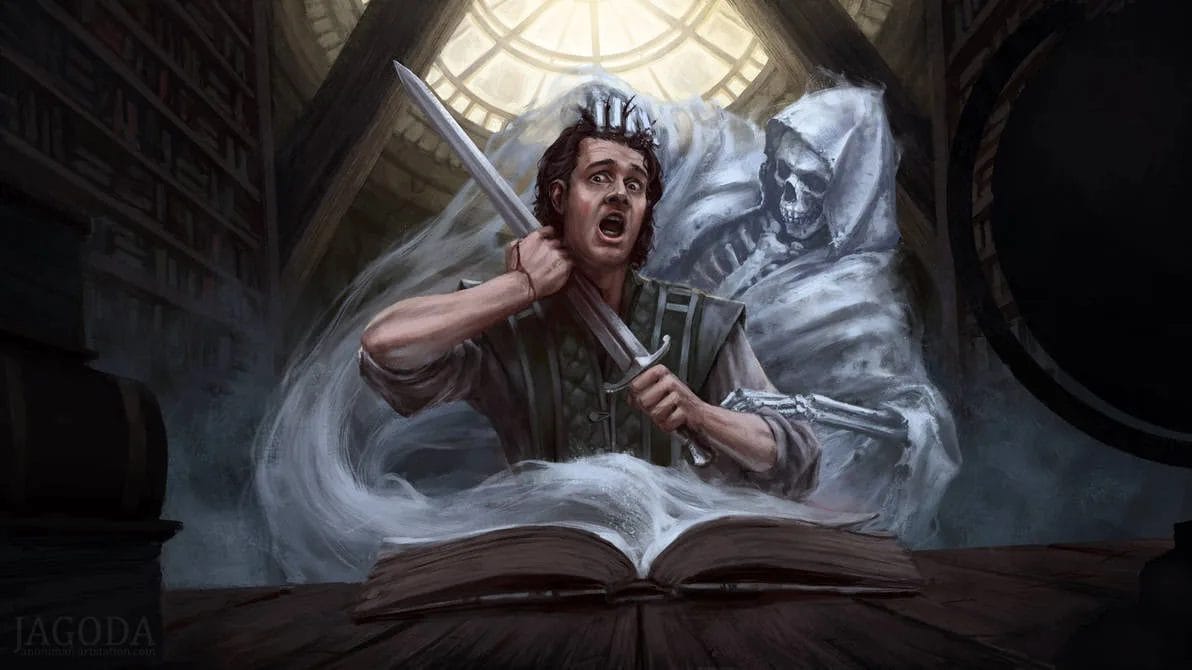
Creative Commons art: The Curse by JakubJagoda.