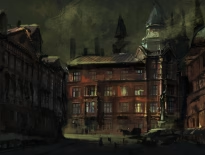
Theater of the mind was originally coined to characterize the way classic radio drama invited the listeners imagination into the story. It exploits our mind versatile ability to invoke imagery from an audio-only input. Are there any useable learnings to be found in Old-Time Radio (OTR)?

OTR experimented with keeping listeners maximally engaged, immersed and to suspend disbelief – and it was damn effective. A few people reportedly believed Martians attacked when ‘The War of the Worlds’ was narrated in 19381,2. Because OTR is a blind media and we are deprived of visual input; agency and participation is invoked when our own imagination mentally constructs scenes from sounds and the spoken words – a concept very familiar to roleplaying game participants. So, can we use OTR techniques to enhance immersion and structure the emotional response in gameplay? I suggest five things to play around with. 1) audio position, 2) verbal techniques, 3) external sound, 4) rule of three, and 5) sound science.
Audio position
OTR used various audio positions with great effect for converting listeners to participants3. The intimate audio position is where one person’s view guides the narrative, and we experience the world through that person eyes (or rather ears). This is established in gameplay as the PCs experience the world through personal audio input from the Referee. The soundscape here approaches and recedes as the Referee takes our character from one imaginative place to the next. Another audio position is to convey the setting through a more kaleidosonic formula, where fragmented patterns of the setting are experienced through several unconnected sounds or words. This can be used in gameplay through dreams or magic such as ESP, contact other planes, commune but also through the voices of NPCs and ambience. Disconnected inputs from kaleidosonic audio positions – which can even be temporally isolated – coalesce to from a collected mental picture of a scene.
Audio position and how sound affect us physiologically, psychologically, and cognitively will ultimately affect behavior and actions taken in the game. If a tranquil and comforting atmosphere is intended the audio environment should mimic a slow heart beat and calm breathing rhythm. The emotional state of participants can be manipulated by audio when the normative expectations suddenly and rapidly change, and we can cognitively promote ill-conceived actions when attention-focus plummets in a chaotic and urgent sound environment. There should be some alignment between game events, narrative beats and the audio environment.
Verbal techniques
Independent of the audio position the narrating voice was also an obvious focus point in OTR. Maybe we don’t have to all be voice-actors, but a few tricks can still go a long way. Where we put emphasis and how we articulate words send strong auditory signals. The rhythm, pace and tone of the spoken words are strongly correlated to how we create an immersive game, where a fast pace as example introduce excitement or anger, in contrast to a slow pace which convey sadness or serenity. And if brave enough one can try accents, dialects or projections, but often changing small things in one’s normal voice would still be impactful. Expression of the emotional state (worried, fear, sadness, anxiety, joyful, calm etc.) influence player engagement and game actions. Even non-dialogue vocal effects such as moans, grunts, and sounds from objects can be put into good use.
Another laureled OTR technique was the use of silence. A pause suggests uncertainty, embarrassment or reluctance, whereas a longer silent break allows emotions to resonate. Silence before a sudden change in audio signal (whether from external sources or from a different voice) are very effective. Keeping the players in doubt and guessing while waiting for the next auditory key keeps maximum engagement. It is also worth considering how your voice overlays with other sounds such as background music or effects – and how the dominating effect or interruption by one or the other drives the emotional direction.
External sound

The purpose of external sounds in OTR was to convey action, to establish the setting in time and place, and to frame the imaginary space such as entrances or exits. A plethora of computer programs can supply external sounds but the balance one needs to strike is prior to professional equipment and with a focus on useability. If it bogs down the flow of the game it’s better to focus solely on voice elements. The most successful programs – such as Syrinscape, Tabletop audio or Ambient mixer – are trying to hit that useability-sweet spot. In OTR external sounds were used in different ways and for different purposes. For example, interspersed sounds were used to indicate a change of scenery and motivationally move attention to a new place or to a new moment in the narrative. One could consider a catchy keynote or short section of music to align everybody’s attention, but also between narrative beats for refocusing or to accentuate someone’s internal emotions. Action based external sounds, such as clashing swords or the sound of the exploding fireball adds something but can be difficult to align in real time for the strained Referee. Perhaps it can move into the background?
External sound consisting of ambient background provides an audio-rich texture effective in mentally constructing a setting – such as church bells, crowds in the streets, or dripping water as one example of nature ambience. In addition to ambience one can consider sound effects purposely inserted for specific effects; the classic footsteps on a wooden floor, rattling chains, the screechy door or screams that indicates exploratory space beyond the PCs immediate surroundings. And there is no more effective method to evoke genuine emotions than music. All of these external sounds are nonverbal audio codes that heightens the attention and strengthen the imagery created by the games participants. But there is also something to be said about when enough is enough.
Rule of three
A good rule of thumb is that effective audio communication is best done with three sound descriptors4. To engage and compel the players to mentally construct an imaginary scene, one needs to combine three descriptors; seagulls, waves, and buoy bell as an example of an ocean scene. Adding more than three risks being counterproductive, and fewer might not do the trick. You can think of this also in terms of how radio commercials work where background sounds (the sizzling of the steak, scrambling cutlery, background laughter) are overlaid with the narrating voice. Take this into account if you create your own ambient sound, but also when describing audio input verbally.
Consider the outcome effect you desire, i.e., the physiological and psychological response you seek to summon and then design sound descriptors to have that effect. With limited cognitive bandwidth to process inputs it is better to use the right amount of audio details and use the three scene-creating framework to reliably induce theater of the mind. Of course, the imagery created are not only reliant on sound, but also on visual cues, so the Rule of three could also be considered more broadly for random tables and dungeon descriptions as well.
Sound science
As online gaming is gaining traction the interface between players and the Referee is mediated through computers, but this serendipitously offer us the possibility to reconsider some OTR techniques. We do not need professional sound equipment to play with our friends, but one could consider how sound is propagated from your position, and what other sounds are unintentionally also transmitted. OTR used reverb effects where sound reflects of surfaces in space and become a complex pattern of reflection and diffusion, primarily to create the illusion of an enclosed space such as a deep cave. Some computer programs have digital reverb effects built in. Sounds that oscillate can be used to invoke feebleness, the feeling of seasickness or magical effects. But even without digital alterations we can still modulate the pitch and amplitude of the sound we use, and as example play around with increased intensity, barely perceptible sounds, contrasting sharp sounds etc. all to manipulate the emotional response.
Another thing heavily used in OTR was of course the microphone polar pattern, especially if you simultaneously broadcast external sound through the same microphone. Most microphones can switch between polar patterns, where omnidirectionality allows sound to be transmitted equally well from all directions. To create muffled sounds, you can cleverly use a bidirectional polar pattern if you simply turn your microphone 90 degrees. Sounds from behind a closed door could be tried by speaking into a cigar box from the dead zone. A cardioid polar pattern would be useful for a very intimate voice centric effects, and perhaps even emulate internal or ethereal voices.
In OTR and the radio dramas of the past5 – as in roleplaying games – the theater of the mind is communicated with primarily sound. So, let’s think about sound when we create our magical worlds.
- The Invasion from Mars: A study in the psychology of panic. Hadley Cantril. 1966. New York Harper and Row, 130.
- The hyped panic over War of the Worlds. Michael J. Socolow. 2008. The Chronicle Review55(9), B16.
- Theater of the Mind. Neil Verma. 2012. The University of Chicago Press.
- Differential engagement of brain regions within a ‘core’ network during scene construction. Summerfield J.J. et al. 2010. Neuropsychologia, 48: 1501-1509.
- Such as ‘The Late Late Horror Show’ channel and ‘Old Time Radio Archive’ both on youtube.
Creative Commons credits: Listening music by PeaceFistArtist and Sound Scape by Tzinakantli.