Last article, I was looking at different types of rules, why they exist and what to consider when hacking and homebrewing a system. I covered why it’s important to look at why a rule exists and talked about rules of consistency, agency and theme.

Today, I’m going to finish that process by looking at four more different types of rules to see if we can learn to think more holistically about games and the process of creating our own rulesets. Let’s take a look at why some rules exist.
Maintaining Balance
Balance rules are about keeping the play experience ‘fair’ to all concerned. The school of thought on them is reasonably clear. Most games have mechanisms of keeping the ‘balance’ between the players and the GM, with most systems being weighted in favour of the players. Some have rules that state how much is deadly for the players to encounter at a given time. Some rules also manage balance between players, using rules like character levels to try to keep everyone at a similar mechanical threat level, while also keeping characters in a recognisable ‘niche’ so that each player gets a time in the story where they feel like the game leans towards their expertise.
Balance is an interesting thing to mess with. There’s a school of thought, formulated through D&D and its descendants, that prizes it above all things, and it has become a cornerstone of lots of games. Even point-buy systems still strive to balance characters. Some games jump through hoops all over the place to make it work. Anyone who has ever been in a session of Mutants & Masterminds where one person is building a Green Arrow and the player next to them is building Superman with the same amount of points understands how deep balance is going to be restructured both in the rules and the upcoming game.
So what happens if we throw caution to the wind and hack/changes rules so we care less about player versus player balance? Well, we’d need to look at games that rely heavily of randomised tables. Games like Mork Borg lean into a real randomised character creation process where one person can start as a feral berserker with a mouth full of teeth and a poisonous foul-blade, and another person can be a weak disinherited noble who just has a horse that hates them. But then the game is doing something else.
Games that mess with balance are trusting the players to be more invested in playing their character as they find it, rather than being worried about how they compare to other parts of the play experience. They’re also upping the active play experience of players – the game isn’t going to save you; if you stop concentrating on it, it will kill you. And there’s some merit to that idea for some players and GMs. Just bear in mind that if you start hacking these parts out of a ruleset, it’s very quickly going to upset people who aren’t looking for either of these play experiences.
Generator Rules
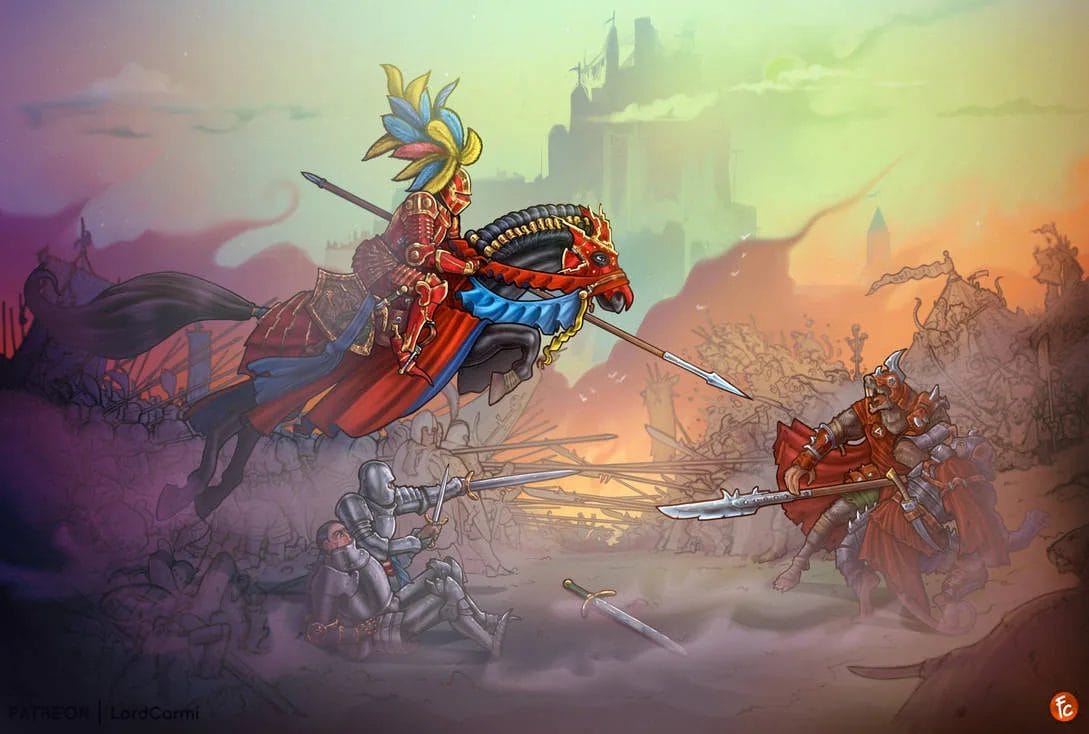
Generator rules move a story forward or generate content for the game. A randomised table that is full of loot that could change the game in strange ways. Psychological rules that dictate to players certain states. There’s some overlap here with thematic rulings from the first article, but these rules are more specifically designed to make story happen rather than reinforce theme. Anything that creates something you have to improv around as a GM is likely a generator rule. It’s forcing you, as the narrator, to go to a place where you have ideas you wouldn’t normally have.
Generator rules become more useful the longer you’ve been playing, I think. When you start out, they sort of get in the way of an idea you are having and you haven’t yet worked out how to improv around them. But as you become experienced and more stayed in your ways, you’ll start to see patterns in your games emerge. I hate everytime I look back at a session and think ‘I did another fight at a dock area?’ or ‘that NPC did things in a way that are predictable if you know how I run a game’ and mean, it”s understandable – I’ve run around 1,300 game sessions in the last 5 years – but it can still feel like I failed to deliver nothing new. So generator rules then break me out of cycles of thought or tropes common to my specific storytelling.
From a hacking perspective, generator rules are perhaps the easiest thing to move out of a game without affecting the experience (if they aren’t also thematic). Something like the virtues of Pendragon generate fresh action but are also the heart of the game. But deciding you aren’t going to roll on a random loot table and instead picking something off it to give players or making your own loot is fairly straightforward. Just make sure if you’re cutting them it is because your idea already feels fresh.
Meta-Rules
Meta-rules are rules of behaviour that address players and the GM. Not all games have these, but they are interesting. In PBTA games, often there’s a set of rules for the GM like ‘be a fan of the player characters’, ‘when in doubt, introduce an explosion’. These rules seem like the most flimsy things and easy to avoid, but you really shouldn’t. This is the game telling you the sort of stories it wants to tell. If you use the set of GM rules from Apocalypse World and use them in Masks, you aren’t playing either game correctly. While they have no mechanical weight, they inform every narrative decision you will ever make.
To some extent, any consent rules or player etiquette rules you have at your table also fit this category. This makes this a difficult category to talk about hacking because often we make these rules ourselves and set them for each table. But when a game has them and we are choosing to cut them, we need to ask, ‘what part of the game experience am I editing?’
Have-to-be-rule

We often don’t think about have-to-be rules. They’re usually a rule that exists in a game that is there because we have to have them because people expect them. Objects have to have a weight, people expect falling and jumping and distance to have an effect on the physical environment. They exist because it’s more work not to include them.
These are often the first rules to be messed with because they aren’t often given the best of systems by the developer – they have to be in the game, but they aren’t the ‘rock star’ part of the game. No one these days feels like they are jonesing for complex encumbrance rules. But when a game does take a moment to really think differently about these concepts – like how Mausritter treats its item carrying like a cute reverse tetris-like game or how Feng Shui remodels initiative, movement and how much you can do in your turn, it does become exciting from a game perspective.
So when we are hacking Have-to-be-rules, we often are messing with something fundamental and necessary in the game. Try not to get rid of them entirely, but look at if you can make them more fun.
I hope that’s been a helpful look at hacking rules, why they might exist and what we can learn from a rule section as we read a game’s core rulebook. Next time, we’ll focus on something that is less inside baseball and more play advice as we steer into a mistake I made and how not to run a mega dungeon.
Image credits: Sentry marvel by LeeRoyalink, Red Knight by LordCarmi and Willow and Wummy kick by KrimaDraws.



