The dust has settled on the UK Games Expo 2026, but unexpected discoveries from the show floor are still coming to light. Tucked away on the edge of the bustling exhibition hall, situated just past the sprawling footprint where industry heavyweight Paizo was showing off its Pathfinder and Starfinder lines alongside the 13 Omens display, independent publisher Thieves of Time quietly showcased an unannounced prototype from acclaimed designer Graham Walmsley.

The surprise project, titled The Cthulhu Conspiracy: The Dunwich Horror, marks a significant evolution for the creator. Walmsley is widely known across the tabletop hobby for Cthulhu Dark, a critically acclaimed, rules-light system focused on the crushing inevitability of cosmic dread. With this new project, however, the design focus shifts away from traditional sanity attrition and steps into the high-tension space of psychological paranoia, procedural deduction, and interconnected institutional secrets.
The physical display at the booth highlighted Walmsley’s current publishing ecosystem, showcasing his recently launched sci-fi space horror title Cosmic Dark and the latest edition of Play Unsafe, his highly regarded design manifesto on how to make roleplaying games less like rigid work and more about collaborative, additive play. Yet it was the loose-leaf, neon-yellow draft pages of The Cthulhu Conspiracy that offered a glimpse into a completely fresh mechanical direction. Attendees could peruse a layout primer dedicated to the game’s central engine: “The Board.”
Mechanically, the game discards the traditional roleplaying game structure where a gamemaster holds all the answers behind a screen. Instead, players collaborate to construct a literal “web of conspiracy” using dedicated Lead cards, drawing physical or visual links between different nodes as the narrative unfolds. The process intentionally evokes the imagery of a classic detective wall or an X-Files-style corkboard, where photographs, field notes, and official documents are pinned and tethered together with string to track hidden patterns.
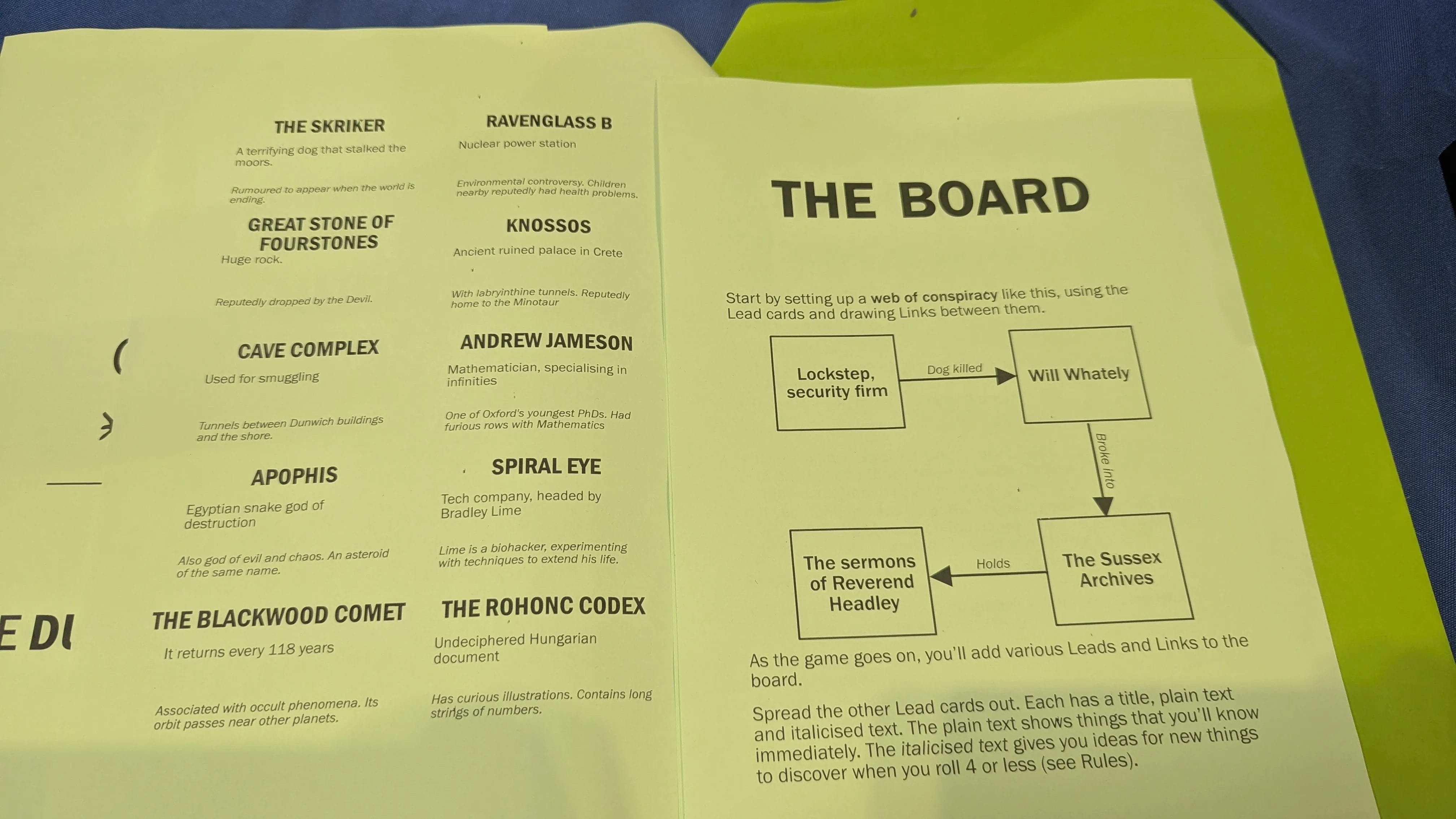
The preview sheets revealed a stark, modern occult landscape populated by specific historical anomalies and corporate anomalies. Sample Lead cards set out on the playtest table included The Skriker (a terrifying hound rumoured to appear when the world is ending), Ravenglass B (a nuclear power station plagued by environmental controversies), The Blackwood Comet, and Andrew Jameson (an Oxford PhD mathematician specialising in infinities). Other interconnected threads featured Spiral Eye, a tech corporation led by a life-extending biohacker named Bradley Lime, and The Rohonc Codex, an undeciphered Hungarian text filled with long strings of numbers. Players interact with these leads by rolling dice; rolling a 4 or less allows investigators to discover hidden truths printed directly on the card, advancing the web.
Finding a direct mechanical equivalent for this style of play highlights just how innovative the system promises to be. While traditional investigative roleplaying games rely on a pre-authored trail of clues, The Cthulhu Conspiracy acts as a dynamic world-mapping engine. The closest structural neighbour in indie design is Ben Robbins’ collaborative history-building game Microscope, though even that remains a distant relation to the specific strategies and deductive pacing Walmsley is engineering here.
There is currently no official release window, retail price point, or virtual tabletop compatibility confirmed for The Cthulhu Conspiracy. The game is in the early stages of active development, and the printed layout sheets at the convention served as an early proof of concept. For players looking to track its progress, Walmsley is providing regular design updates and development insights on his Patreon creator page. Given his stellar reputation for subverting traditional horror tropes, this web-driven engine will be a project to watch closely as it heads toward an anticipated showcase at UK Games Expo 2027.



