TORN has officially defied the trend of graphical “live service” churn. The long-running text-based crime roleplaying game announced this week that it has surpassed 100,000 daily active players for the first time in its 22-year history.
In a quirky press release marking the milestone, Joe Chedburn, the founder of TORN, reflected on the game’s humble beginnings as a “bedroom PHP experiment” while he was a 16-year-old college dropout working part-time at Greggs. The announcement makes the bold, humorous claim that many of its 30,000 newest citizens “now likely find themselves on several government watchlists.”
From Pastry to Powerhouse
The rise of TORN is a masterclass in independent longevity. While modern roleplaying games often crumble under the weight of shareholder expectations, Chedburn and his global team of 50 have maintained a strictly independent path. According to the studio, the game’s daily active player count stood at roughly 48,515 in early 2024; that figure has more than doubled in just over two years following infrastructure optimisations and a pivot in PR strategy.
Joe Chedburn, Founder of TORN, said in a statement.
Breaking the five-digit barrier on the login page counter has been a dream of mine for a very long time, one I genuinely never thought was possible. … TORN is faster than it has ever been, despite the vast increase in our playerbase.”
Oh, that watchlist joke
While the press release treats the “government watchlist” idea as a badge of honour for its crime-focused community, the reality of life in Torn City often involves genuine real-world friction. The game is a descendant of the MUSH and MOO (Multi-User Shared Hallucination/Object-Oriented) tradition, where the narrative is driven entirely by player interaction – and player betrayal.
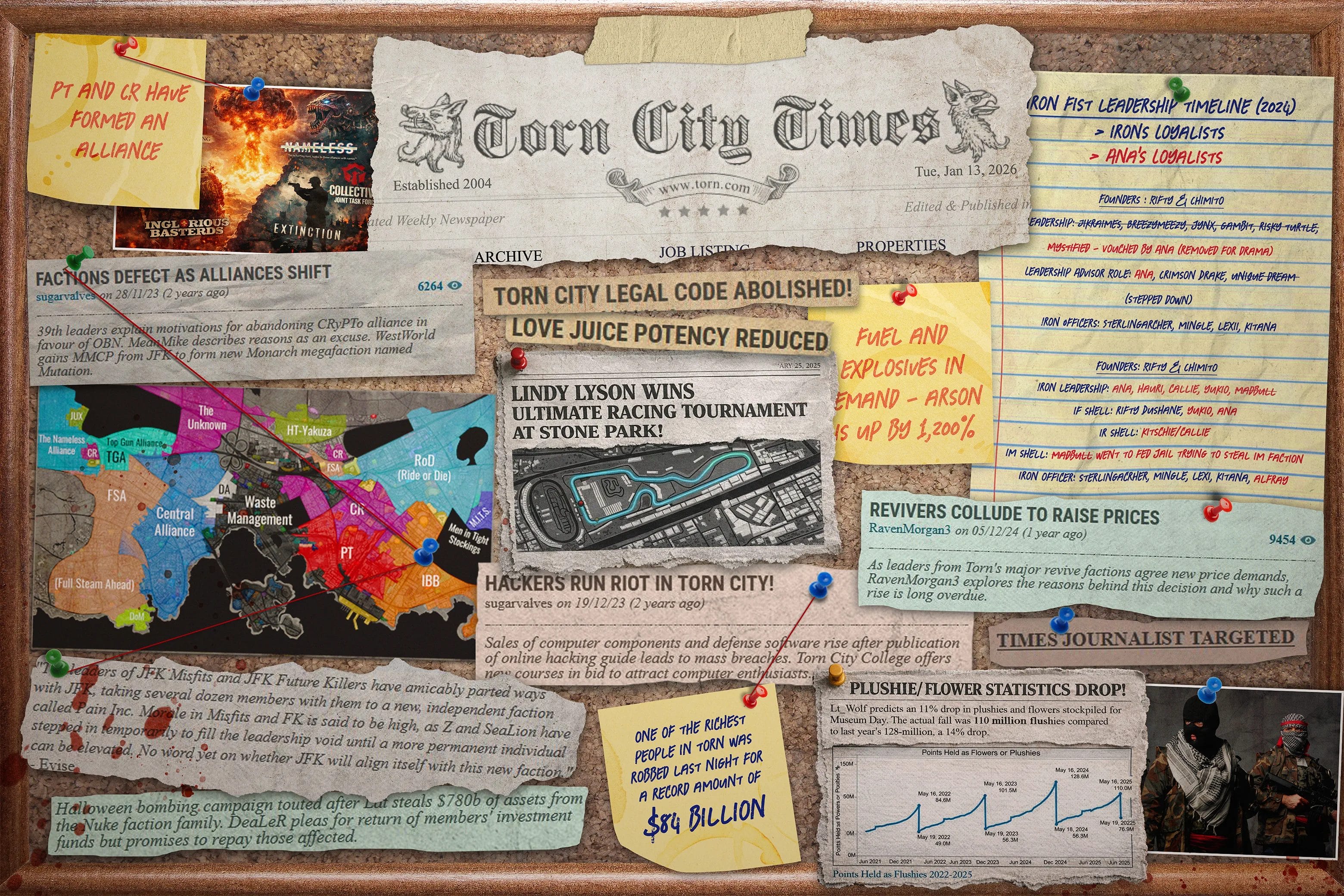
The “watchlist” claim isn’t entirely without merit, given the game’s history of social engineering. One of the most notorious incidents in the archives involved a player known as Lat, who executed a heist worth over 800 billion in-game assets. This wasn’t a technical hack, but a months-long campaign of psychological manipulation.
The fallout of Lat’s heist, which targeted the well-respected “Nuke” family faction, saw the player transition into a villain persona, eventually leading to multiple forum bans for harassment. It serves as a stark reminder that when 100,000 people engage in a crime simulation, the social consequences can bleed out of the browser.
The Evolution of the MUSH
While TORN is technically a Massively Multiplayer Online (MMO) game rather than a Multi-User Shared Hallucination (MUSH), it occupies the same cultural space. It represents the survival of the “pure” roleplaying game – one where the narrative is provided by the players rather than a scripted campaign. As modern gamers tire of scripted open worlds, the total agency offered by a text-based city where you can be a bank tycoon, a contract killer, or a simple flower shop owner is seeing a massive resurgence.
The success of TORN suggests a massive, underserved market for roleplaying games that prioritise agency over aesthetics. By doubling its player base two decades after launch, the game has proven that the “granddaddies” of the internet, systems built on text, community, and consequence, are perhaps the only truly “future-proof” genre in gaming.