Mythmere Games occupies a rare position in the tabletop industry. Founded by Matt Finch, one of the primary architects of the Old School Renaissance, the publisher is responsible for some of the most influential “retro-clone” systems and creative tools in the hobby. From the seminal Swords & Wizardry to the exhaustive Tome of Adventure Design, Mythmere’s output has defined the mechanics and aesthetics of modern old-school play for nearly two decades.

Today, the operation remains a lean, fiercely independent duo. Run by Matt and his fiancée Suzy, the company is currently navigating a significant transition with the development of OSRIC 3. This new iteration of the Old School Reference and Index Compilation arrives at a time when the roleplaying games industry is still recalibrating after the 2023 Open Game Licence controversy, with Mythmere leading a move toward more stable, Creative Commons foundations.
We spoke with Matt and Suzy about the “molecular” nature of creativity, the challenges of running a DIY business in a market obsessed with “gimmicks,” and why the best stories are the ones that go off the rails.
The RPG Publisher Spotlight: Mythmere Games
To start things off, is there a story behind the name ‘Mythmere’? It sounds like a location one might find in a classic hex-crawl – is it a place in your own home campaigns?
Matt: Unfortunately, there’s no cool story behind the name “Mythmere Games.” I used “Mythmere” as my name on gaming forums in the early 2000s, and when I started publishing on a small scale, I just kept using the name.
Matt, many know you as a titan of OSR design, but Mythmere is a team effort. How do you and Suzy divide the labour? Who is the one making sure the dragons are fed and the books actually ship on time?
Matt: I think a lot of people assume we’re a much larger operation than we really are, but for the most part it’s just me and Suzy, with help from a few really amazing freelance artists and the occasional freelance writer. In general, I do most of our writing, and Suzy does all the visual design: layout, cover design, graphics for the crowdfunding, website, and marketing, overseeing the warehousing operations, website maintenance, printer relations, convention coordination, and so on. We collaborate on product planning: if we’re going to run a crowdfunding campaign, we both throw ideas into the mix and the final result is something we both agree on. We split up lots of the background work of running a company.
Suzy: We are somewhat interchangeable when it comes to customer relations, although we often divert questions to each other depending on the particular question.
You’ve become a cornerstone of the Old School movement. For someone who has only ever played modern editions of the world’s most popular roleplaying games, how would you describe the ‘Mythmere’ approach to adventure?
Matt: That might be a different answer depending on whether we’re talking about the sourcebooks (Tome of Adventure Design, Tome of Worldbuilding, and the Nomicon), the rulebooks (Swords & Wizardry and OSRIC), or the adventure modules such as Tomb of the Iron God. In general, I think all our material is designed with the assumption that the Gamemaster is focused on seeing an exciting, unpredictable story develop out of player decisions, not focused on following instructions that lead the players through a predictable set-piece. What I enjoy about GMing is being surprised by player ingenuity (or terrible ideas), and watching an adventure go totally off the rails into the undiscovered country. We try to write adventures that give the GM tools for handling unpredictability, not tools for restraining it.
Put slightly differently, since I’m a GM, my objective is that the GM should be having just as much fun as the players, if not more. Gamemastering is FUN when you stop worrying about it as a performance and start viewing it as an administering a role in the production of the rolling, cascading disaster of mistakes and mayhem that’s the average gaming session.
The Tome of Adventure Design is legendary – it’s often cited as the one book a GM needs if they’re stranded on a desert island. What is the secret to creating tables and prompts that stay fresh even after a decade of use?
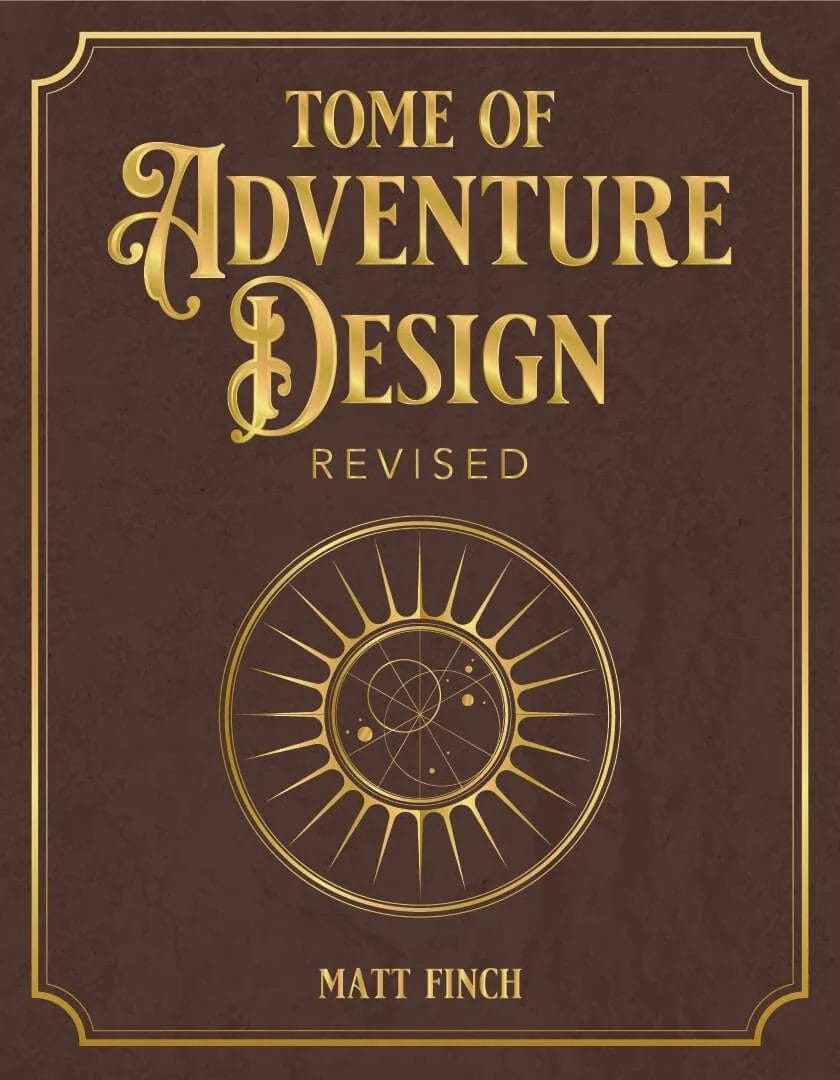
Matt: The secret is that Tome of Adventure Design doesn’t provide completed ideas; it provides bits and pieces of ideas that build and combine to spark the GM’s creativity. Most resource books do more of the creative work for the reader. It’s a lot faster to roll the result “Adventure Location #1: The Fortified Island of the Leopard-Mage: the characters are tasked with finding and rescuing a now-senile enchanter from the castle of a shapeshifting wizard” than it is to assemble those elements one by one.
On the other hand, using the Tome of Adventure Design, you would see that “Fortified” might actually be “Airborne, Toxic, Crimson, or Glittering (along with many others) for an Airborne Island, Toxic Island, Crimson Island, or Glittering Island. Those are all quite different paths for the writer to follow. Then you can vary the “Island” into Crypt, Garden, Haven, and many other possibilities. So the “Fortified Crypt of the Leopard Mage” is also quite different from the Fortified Island, especially since now you’ve got what might be an undead Leopard Mage. Or perhaps the villain is a Leopard-Society, a Leopard-Statue, or the Leopard-Weaver. All of these terms come from just a couple of “Location” tables, and you can see why it’s creativity at a more molecular level than a resource that just outlines a whole, pre-created adventure idea all at once. The mission (rescue) varies on another one of the tables in the book, and the rescue-objective (in this case, a now-senile enchanter) is also just one result from a d1000 table (d1000, not d100).
The Big Reveal: OSRIC 3
We’ve seen the buzz about OSRIC 3 on BackerKit. Since the original OSRIC was such a pivotal spark for the entire OSR movement, what felt like the ‘right’ reason to bring it back for a third iteration now? What’s changing in the shadows of those rules?
Matt: There are a couple of different things that led us to do a third iteration of OSRIC. When I first wrote OSRIC with Stuart Marshall, it was the first retro-clone, and as a result we didn’t get as close to the original AD&D rules (meaning the game mechanics) as – in retrospect – we could have. So part of the objective was simply to bring the rules closer to the AD&D game mechanics.
A second objective, coming from general feedback, was that the rules could benefit from a more modern rules-presentation. This mainly meant breaking the paragraph-style style presentation of several rules into bullet points or sub-headers for clarity. By producing OSRIC under the Creative Commons Licence instead of the OGL, we also circumvented various problems that could arise under the OGL (although this licence is still active, there are concerns that it could be cancelled in the future).
Beyond OSRIC and the Tome of Worldbuilding, what’s brewing in the Mythmere cauldron? Are there any new genres or completely different systems you’ve been itching to experiment with?
Matt: Our next projects are geared toward supporting the systems we already have available, so probably a crowdfunding for a set of adventure modules, and a world setting.
Suzy: I would like to write fiction, but I am still thinking about what I want to write, exactly.
Matt: That’s a good point, because I’d also like to see Mythmere Games get into the business of publishing fiction, whether we write it or not. But it’s not the same business as publishing game products, and we barely have the free time to manage what we’re already doing.
The Business of DIY
You’ve had incredible success on Kickstarter and BackerKit lately. What’s the most surprising thing you’ve learned about the tabletop community through these crowdfunding campaigns?
Matt: As a company, we’re not very focused on social media. We don’t contact our mailing list more than once or twice in an entire YEAR, compared to some companies that make contact on a weekly basis. We operate a lot more like a regular gamer writing DIY (do it yourself), trying to get it exactly right, widely usable, with high value for the money – not so much focusing on recent trends or flashy Kickstarter “extras.”
So, it’s a bit of a surprise to us that we’re doing as well as we are, when all the conventional wisdom says to remain in constant contact, and to design Kickstarters that contain lots of gimmicks and flash. On the other hand, I’m not sure that it would be good advice for a NEW publisher to follow that lead, because it’s definitely true that adding “gimmicks” to a Kickstarter boosts its total size, and it’s a lot harder to build a fan base for a new company than it is for people who already have some name recognition in the general gaming community. We consider ourselves just regular DIY publishers who happen to have gotten enough critical mass to spend more money on art, cartography, and other production values.
Suzy: I do think that people seem to really like our responsiveness to requests for additional material (although it does create more work for us in the end), and have been more accepting than I initially thought to any delays in fulfilment, which we always do our best to avoid.
If a new designer came to you today wanting to start their own small press, what’s the one piece of ‘Old School’ wisdom you’d give them to survive the modern market?
Matt: I’m a huge fan of gamers publishing DIY materials. We’re a hobby that’s all about creativity, and most of us have great ideas that can flourish if they are released into the wild. But the first piece of advice would probably be, “don’t expect to make any measurable profits until you’ve been working at it for at least 5 years.” Beer money? Absolutely. In fact, it’s probably a bit more profitable than you’d expect, as long as it’s being measured in terms of beers.
If the goal is to start a serious company, though, scaling up from the “one adventure module every six months, if I have the time” to “enough output to pay my rent” is a long process of reputation-building (you should launch and fulfil Kickstarters with great communication, and always deliver on time), building a customer list, growing the word-of-mouth “conventional wisdom” that your material is worth reading, and also just building a catalogue. A corollary to this is that it’s all about reputation building, so never, ever take a shortcut in terms of product quality. Always build the best product you can manage with your budget, because over time, it’s your reputation that builds a company.
Discover Mythmere Games
You can find the full range of Mythmere Games products, including the OSRIC 3 Player’s Guide and the Tome of Adventure Design, at the links below:
- Official Webstore: mythmeregames.com
- DriveThruRPG: Mythmere Games Catalogue
- Featured: OSRIC 3.0 Player Guide
- Community: Join the Mythmere Discord
- Socials: Facebook | Instagram | YouTube