The tabletop landscape is currently undergoing a visual and mechanical metamorphosis, driven by a new generation of designers looking to bridge the gap between kinetic anime action and tactical roleplaying games. These are gamers who care less about Tolkien. At the forefront of this movement is Gates of Krystalia, a project that made headlines by hitting its latest campaign funding goal in a staggering thirty seconds.
However, the journey hasn’t been without friction. From ditching the iconic D20 in favour of a standard deck of playing cards to navigating the stormy waters of the generative AI debate and the inclusion of explicit “Hero’s Harem” content, creator Alberto Dianin has remained steadfast in his vision. Following the recent discussions surrounding the UK Games Expo, a steadfast ally of the hobby, and reviews from major outlets like Polygon, we sat down with Alberto to dig deeper into the mechanics, the controversies, and the “second chance” philosophy that defines the Isekai genre.
You’ve famously ditched the D20 for what some call a ‘D52’ – a standard deck of playing cards. Beyond just being a different way to generate numbers, how does the physical act of holding a hand of cards change the ‘vibe’ at the table compared to rolling dice?
Cards provide a strategic layer both in combat and in narrative actions because you have a hand of cards available. You are not at the mercy of rolling a natural 1 during an important or epic moment. Since the deck has a finite number of cards, you also gain awareness of how probabilities are evolving during play. If many low cards have already been played, you can reasonably expect that statistically a higher card may come soon. This changes the emotional pacing at the table. It creates tension, anticipation, and planning instead of randomness alone.
One of the most praised parts of the demo is the simultaneous combat where no one is just sitting around waiting for their turn. Was this born out of a specific frustration with traditional initiative systems, or was it purely to mimic the high-speed ‘Sakuga’ moments of anime?
The decision was purely driven by the desire to bring anime to the gaming table, not just visually but mechanically. The fact that the system feels cinematic and dynamic was something we realized afterward. Everything started from watching anime and imagining how those fast, overlapping action scenes could be recreated at the table. The goal was not to fix initiative systems, but to translate anime rhythm into gameplay.
There has been some spirited debate online regarding the use of AI tools in Gates of Krystalia. You’ve mentioned that it’s used for ‘lighting studies’ and ‘concept exploration’ before manual refinement. For the skeptics who worry about the soul of the art, where does the AI end and the human artist begin in a typical piece of your world-building?
We intentionally waited before responding in detail to criticism because we believe concerns deserve thoughtful and transparent answers, not rushed reactions during the intense first week of a campaign. First, the use of AI has always been openly declared in all our Kickstarter campaigns, fully in line with Kickstarter’s disclosure policies. Whether someone agrees with this approach is a personal opinion, but transparency and platform compliance have always been a priority for us.
Gates of Krystalia is a deeply human project created by a multidisciplinary team of professionals: game designers, illustrators, 3D artists, translators, a singer, makers, and marketing and crowdfunding specialists. There is also a massive amount of human work in layout, typography, and page composition. Every page is manually designed in InDesign for readability, pacing, and print-ready formatting. These books are not automated outputs. All game systems, rules, lore, worldbuilding, and mechanics are entirely human-made. AI is never used to generate rules, narrative content, or game design. It never acts as an autonomous creative source.
Regarding illustrations, the only artist who partially uses AI tools is Andrea Ruggeri, the project’s creative director. AI is used exclusively during early exploration stages, starting from original hand-drawn sketches, within a controlled human-led workflow. Every final illustration is manually refined and completed until it is fully print-ready. For full transparency, the process is publicly documented:
- Process:Video walkthrough of the artistic workflow
- Pipeline:Visual infographic explaining the workflow
- Project:Kickstarter campaign page
- Social:Instagram with illustration process videos
Our team also includes multiple fully human illustrators, including one who has worked on One Piece related projects and contributed specifically to the new expansion. Our creative vision is to produce books that are visually dynamic, avoiding the classic academic TTRPG layout of two text columns and one illustration every ten pages. Some pages contain up to eight illustrations, and each book includes over 500 illustrations. Producing that volume exclusively through traditional pipelines would be unsustainable in terms of cost and production time. When funding allows, we involve more fully human artists. In our current Kickstarter, we were able to bring in several additional illustrators. We respect that not everyone will agree with our approach. What matters to us is transparency and honesty about how the project is made.
Some critics have used the term ‘AI Slop’ to describe the project, which is a harsh phrase for any creator to hear. Do you think the TTRPG community is sometimes too quick to judge tools over results, or do you feel there’s a legitimate responsibility for creators to be more ‘hand-crafted’ in this hobby?
I do not pay much attention to insults. We live in a free world where everyone can express their opinion, and I am actually the first person to seek negative feedback to improve. However, comments like that do not create constructive debate or improvements, so I do not consider them meaningful criticism. We have a community of around 1500 people who have been playing the game for two years and understand the work behind every phase of development. I believe we are one of the few companies that openly admit the use of innovative tools instead of hiding them. That transparency is important to us.
The decision to offer explicit/NSFW versions of the game is quite rare in the mainstream Kickstarter TTRPG space. What led you to decide that ‘Hero’s Harems’ and adult themes belonged as a formal part of the product rather than just something players ‘homebrew’ behind closed doors?
When creating Gates of Krystalia, I decided to base it purely on themes commonly found in Japanese anime, without forcing the product to be politically correct just to align with mainstream trends. This is not provocation. It is simply a faithful representation of anime culture themes.
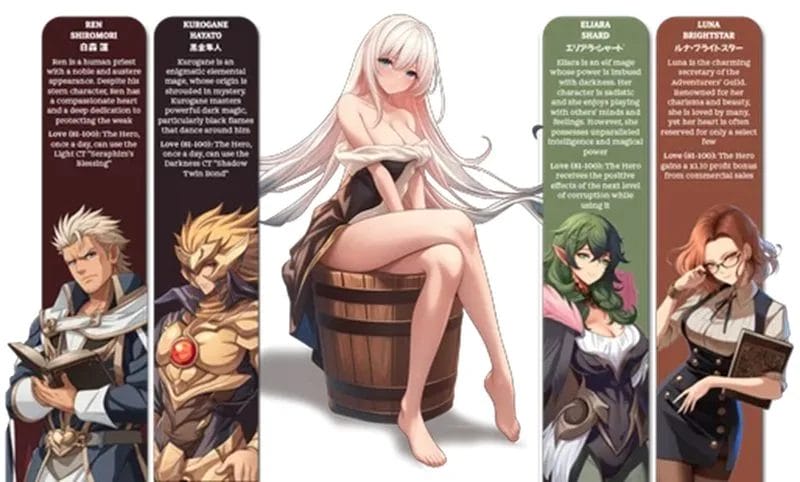
In the Lumina expansion, you mention that romantic relationships aren’t just narrative flavour but offer mechanical bonuses. How do you balance those ‘waifu/husbando’ mechanics so they feel like a meaningful part of the RPG experience rather than just a side-game?
These mechanics are already present in the core rulebook. The term Harem was chosen to align with Japanese terminology, but in practice we are talking about a Relationship Level system. This includes strong friendships and is not necessarily adult-only content. During the Lumina Kickstarter campaign, for Valentine’s Day, we added a digital add-on designed for Solo Play, but usable in group adventures as well. It includes additional mechanics to explore different romantic styles, including hentai and similar genres. We will not promote the product with explicit imagery, but we aim to remain faithful to various anime genres to offer an immersive experience for fans of all styles.
Building a custom VTT is a massive undertaking when giants like Roll20 and Foundry already dominate the space. What does the Gates of Krystalia VTT do that those platforms can’t, and why was it important for you to own that digital experience?
Our VTT is designed specifically for Gates of Krystalia and does not aim to compete in that broader market. Because our system is unconventional, we needed a dedicated platform that we could update and expand quickly. Most importantly, it allows us to provide timely support to our players.
The Isekai genre (being transported to another world) is exploding in popularity. Why do you think modern gamers are so hungry for that specific ‘starting over’ fantasy right now?
Isekai is fascinating because it represents a second life and a second chance. The theme of personal redemption resonates deeply. When I moved abroad, my first thought was that I could be anyone and change my life. That is the emotional core of isekai. There is also the acceptance of losing everything you built and starting from zero, including dealing with trauma in a world governed by different rules. It is two sides of the same coin.
Funding in 30 seconds is a dream for most designers. What’s the one thing you think Gates of Krystalia offers that resonated so instantly with your community?
Our first Kickstarter was not perfect. We lacked experience. So we studied, invested in consultants, and improved. This Kickstarter is built on two years of consistent support and service to our backers. They know we are present, that we answer questions, and that we solve problems. We are not just selling books. We live alongside our community. That trust was fundamental to our growth.
If you could see one specific anime-inspired world added to the multiverse in the future that you haven’t touched yet, what would it look like?
We already have ten additional worlds beyond Lumina, several briefly introduced in the core rulebook. Now we simply need to choose which one comes next. Perhaps we will let the community decide.
Whether through the strategic deployment of a card hand or the exploration of complex relationship mechanics, Gates of Krystalia is clearly a project that refuses to play by the established rules of the Western TTRPG market. By leaning into the specific tropes of anime, both the celebrated and the controversial, Alberto Dianin has cultivated a community that values transparency and high-octane gameplay above all else. As the Lumina campaign continues, the question remains: where will the gates lead next? For those looking to trade their dice for a deck and start their own second life, the multiverse is currently wide open.