The gold standard for heavy trebuchets is the Warwolf, believed to be the largest trebuchet ever built. It was constructed by Edward I during the siege of Stirling Castle in 1304.
How far could the Warwolf throw D&D monsters?
The Monster Hurler
Calculating the ballistics of iconic roleplaying game monsters
The Science of Squish
In the rigorous world of high-velocity monster ballistics, we must acknowledge the "Squish Penalty" - the disappointing difference between throwing a dense, cooperative limestone block and a flailing resident of your favourite roleplaying games. While a stone maintains its structural dignity from sling to impact, a living creature is prone to "aerodynamic non-compliance." This results in a flight path that is significantly shorter, more wobbly, and substantially more chaotic than the theoretical maximum suggested by simple physics.
This penalty accounts for the momentum lost to flailing limbs, panic-induced drag, and the unfortunate tendency of certain specimens to suffer "premature structural redistribution" mid-air. Essentially, if a subject has fur to catch the wind, appendages to create turbulence, or a body composition that is more "wobbly jelly" than "solid granite," the laws of nature will shave yards off the final distance. It is a necessary calculation for any siege engineer who prefers their projectiles to arrive at their destination in one piece - or at least, with a somewhat predictable trajectory.
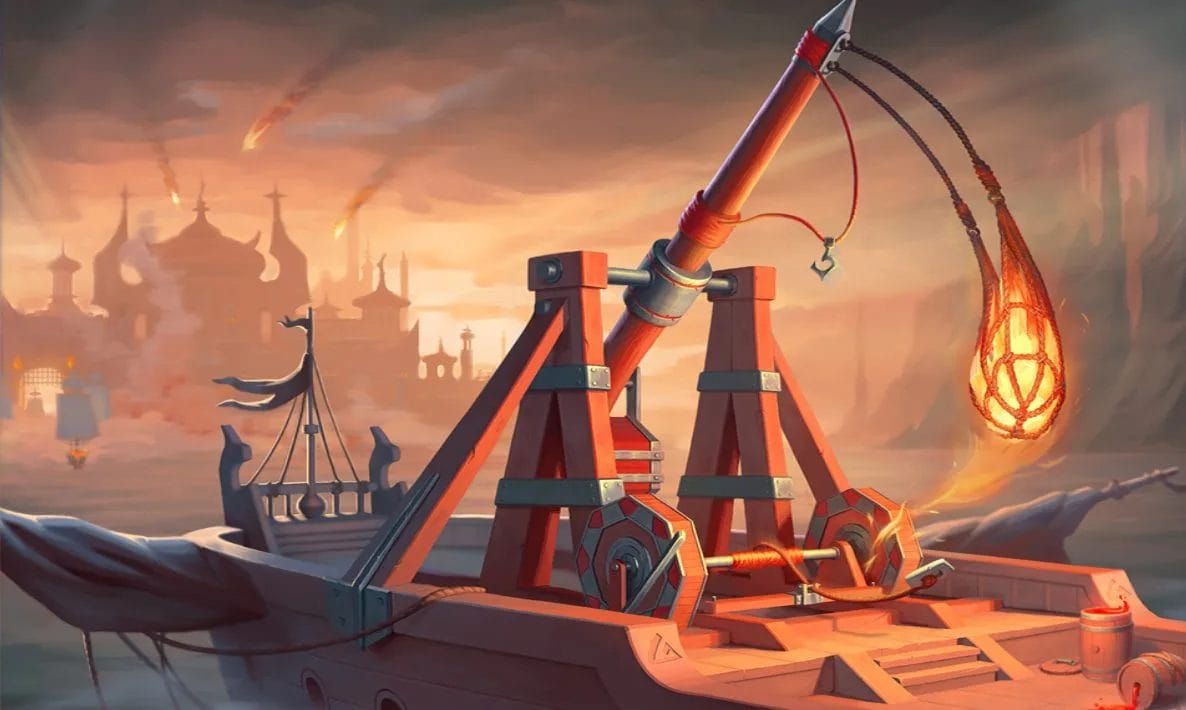
(Not the Warwolf but a Creative Commons licensed trebuchet image)
If you want to read more about the actual Warwolf, then the Scottish Tales Substack has a good write-up. Stirling Castle is in Scotland.
The real Warwolf was such a colossal engine was so imposing that it reportedly took thirty carpenters three months to build, and its reputation was so fearsome that the Scottish garrison attempted to surrender before it had even been fired. Edward, however, famously refused their surrender, forcing the defenders back into the castle so he could finally "test" his new weapon, which was capable of hurling three-hundred-pound stones with enough force to dismantle the fortress's curtain walls.