When Oddvoid Productions launched Heretic Hunt, they dragged audiences into the gritty, industrial depths of the 41st Millennium with a production quality that set a new standard for actual plays. Featuring beloved Warhammer personalities Louise Sugden and Chris ‘Peachy’ Peach, the series was a masterclass in atmospheric grimdark storytelling. Now, the team has executed a complete 180-degree turn, trading bolters for beam sabres in a neon-soaked love letter to Saturday morning cartoons.
Mecha Force Tango keeps the stellar cast but throws them into a world of hyper-saturated colour and high-octane absurdism. Instead of seasoned inquisitors, the players control support staff – from HR to the cafeteria – forced to pilot giant war machines. We caught up with Producer Jamila Hall and Game Master Dan Saye to discuss this massive vibe shift, their custom-built game system, and the sheer joy of looting robot parts in a synthwave city.
Your previous hit, Heretic Hunt, was steeped in the gritty, gothic lore of Warhammer 40,000. Mecha Force Tango feels like a massive, neon-soaked pivot into joy and colour. What was the catalyst for shifting gears from “in the grim darkness of the far future” to “Saturday morning cartoon chaos,” and was it a relief to trade in the skulls for sparkles?
(Jamila & Dan) Mecha Force Tango was created in a synthwave powered, caffeine fueled 15-minute creative session. A month out from shooting the 2nd Season of Heretic Hunt we were discussing also shooting a series of holiday themed one-shots: Holidays in the Hive, Spring Break, Halloween. Then Dan had the idea of a “Gundam” or “Power Rangers” themed episode and very quickly the overall style, genre and “vibe” fell into place. So it wasn’t so much a “gear shift” as it was an “excited tumble down the rabbit hole.” But damn it was rad. It was such an awesome shock going from a grubby, abysmal-future setting to a mecha anime city. The genre change was an absolute blast: us all being fans of different shows meant that we each brought tropes and elements from our favorites to the world. We genuinely had to cut the cameras and step away to compose ourselves several times across the season because we were completely broken.
The “Unqualified Heroes” Hook. One of the most delightful twists in the show is that the characters aren’t elite soldiers – they’re the support staff! You have a janitor, a secretary, HR, and cafeteria staff piloting these war machines. How does playing a character who is woefully unqualified for the cockpit change the typical “power fantasy” of a mech RPG?
(Jamila) It changes the typical mech power fantasy by being “un-sexy.” The game is influenced by the mundane parts of being an average human in an extraordinary situation, I think that’s the biggest difference. There is tremendous joy in desperately grasping for anything you’ve got in your limited cafeteria lady wheelhouse to save all of humanity from the menace of Uranus.
You’re releasing the custom RPG rules used in the show, which is a huge undertaking. For the mechanics-lovers in our audience: what is the design philosophy behind the system? Does it prioritise crunchy tactical combat for the mechs, or is it more narrative-driven to capture that fast-paced anime flair?
(Dan) SPEED! I didn’t set out to make a system, but it kind of happened along the way. The aim initially was to strip down D&D to something swift and approachable for the show, so that gameplay and combat would have that punchy anime pace. Then the system grew around that: combining the original Pokemon game’s combat with a simplified D20 system. The genre that inspired it is full of off-the-wall heroics and shocking moments, so a system that was flexible enough for madness and creativity was the perfect fit. Plus it made combat so punchy. Pun intended.
With legends like Louise Sugden and Peachy (Chris Peach) at the table, we know the miniature painting game is going to be strong. How central was the physical “hobby” aspect – building, bashing, and painting these custom mechs – to the show’s identity? Do the physical models influence the story, or vice versa?
(Dan) It was rad building a system and story around the mechs. Peachy created his character and mech in tandem, giving it a weathered paintjob. Louise “upgraded” hers with all kinds of absurdly unnecessary accessories to fit her Magical Girl genre. Jamila chose a mech that contrasted her character, though she was also the most excited to loot parts torn from their enemies. And Greg lent into his mech being completely out of his character’s wheelhouse, making it a huge issue for him to pilot. We mostly used the 30 Minute Missions models for the series, with a handful of Gundam kits as well. They brought so much character to the game, were a lot of fun to add animations to and meant that “customizing” ended up being part of the game system and the story.
You’ve cited Pokémon, Sailor Moon, and Transformers as key influences. Were there specific tropes from those 90s/00s cartoons that you knew you had to include in the show? (e.g., Is there a mandatory 2-minute transformation sequence every time someone powers up?)
(Dan) You have no idea the volume of genre specifics rattling around in my head for this game. But if I had to pick one it would be the Obvious Traitor, it’s absurd but takes itself so seriously. I asked the players for a couple of theirs: * The power of friendship. No matter what is happening, use the power of friendship. • Impractically long and ridiculous names for attacks / abilities. • “Teleports behind you: nothing personal kid.”
The synopsis mentions protecting “Sayonara City” from the “forces of Uranus.” It sounds like you’re walking a fine line between high-stakes action and tongue-in-cheek humour. As a producer and player, how hard is it to keep a straight face at the table when the threat is… well, Uranus?
(Jamila) Keeping a straight face is impossible. Completely gorram impossible. The only way to get through was for us all to commit to the genre, to the style of taking everything so seriously. It’s incredible fun because unlike scripted work I get to play a part in a grander narrative while making split-second choices about my character’s story. At the same time, series production relies on your audience being excited to see the next episode. It’s not enough to crack up with your friends and put it on camera – everything is about using the gameplay to tell the story. So having a background in TV and film production definitely helps manage the double duty of playing and producing.
“Mecha Force Tango” is such a catchy title. Is there a story behind the name? Does “Tango” refer to the military alphabet, the dramatic dance, or is it just because it sounds cool when you shout it?
(Jamila & Dan) The name comes from the NATO military alphabet, without giving much away all I’ll say is that things don’t go smoothly for Mecha Force Alpha through Sierra…
You’re not just the producer; you’re in the pilot’s seat as ‘Cathy from the Cafeteria.’ How has the dynamic at the table evolved between you, Greg, Louise, and Peachy now that you’re a few episodes in? Who has become the unexpected “wild card” of the group?
(Jamila) The five of us actually only met the day before filming our first show, Heretic Hunt. I literally went over, filmed that show in 6 days and then flew back to Canada. This time around the schedule was much the same and the truth is, somehow, this group just magically clicks the second we’re all in the same room. It’s a cliché but the old “the sum of all our individual parts is greater than anything we could have come up with alone” is actually what it’s like working with Louise, Peachy, Greg and Dan. The best vibes, it’s infectiously fun. And HA. We’re all equally likely to cause unexpected chaos! Props to Dan’s patience, big time.
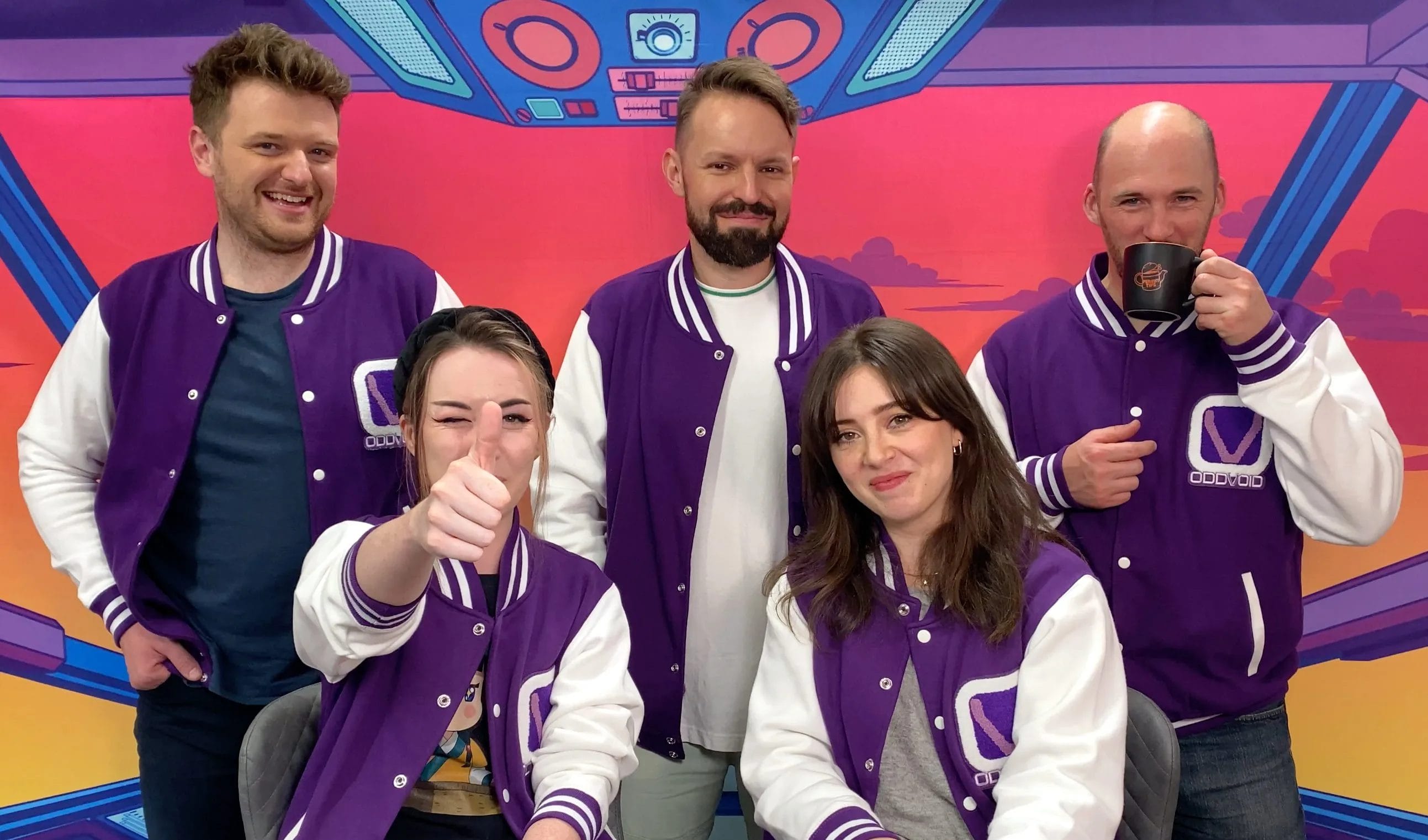
Oddvoid Productions seems to be carving out a niche for high-production, visually stunning actual plays. What is the long-term vision for the studio? Do you see yourself exploring other genres after mechs, or maybe even publishing this new system physically?
(Jamila & Dan) Thank you so much for this compliment! Oddvoid started out with the aim of taking the skills built from working in the film industry and using them to tell stories through the brilliant chaos of roleplaying games. A long-term dream is to become a production house known for shorter episode-length, well edited shows. As far as the game system goes: having refined down a ruleset that plays well into the style we like to play and create, it’s definitely on the to-do list to release it for others to play if they’d like. We can’t wait to produce a new season of Mecha Force Tango, but we absolutely see ourselves exploring other genres. In fact there’s one story we desperately want to tell in a world that we’re really, really excited about bringing to life. Stay tuned!
If your character could install one non-combat upgrade to their mech – something purely for comfort or style – what would it be? (e.g., A cup holder, a heated seat, or a sound system that only plays Eurobeat?)
Cathy – A co-pilot chair for MonMon.
Spencer – A playmat and auto-shuffler.
Max – A Yorkshire Teasmade.
Sally – The full box set collection of Pretty Pretty Heart Catch Mecha Mecha Smash Smash, Seasons 1-4.
The cast’s enthusiasm for this genre shift is palpable in every frame of the show. Whether you are there for the tactical mech combat, the nostalgia of 90s anime tropes, or just to see if a janitor can actually pilot a war machine, Mecha Force Tango offers a fresh, high-energy take on the actual play format.
You can watch the 60-second trailer below to get a sense of the vibe, or head directly to the Oddvoid YouTube channel to catch up on the first few episodes. For a deeper dive into the lore and custom rules, see the full synopsis on their website.