It is a familiar dream: one rulebook to rule them all. Ghost Ape Games has thrown its hat into the universal system ring with GAS: Ghost Ape System, a title that promises to strip back the walls between genres and let you run anything from dungeon crawls to neon-soaked heists.
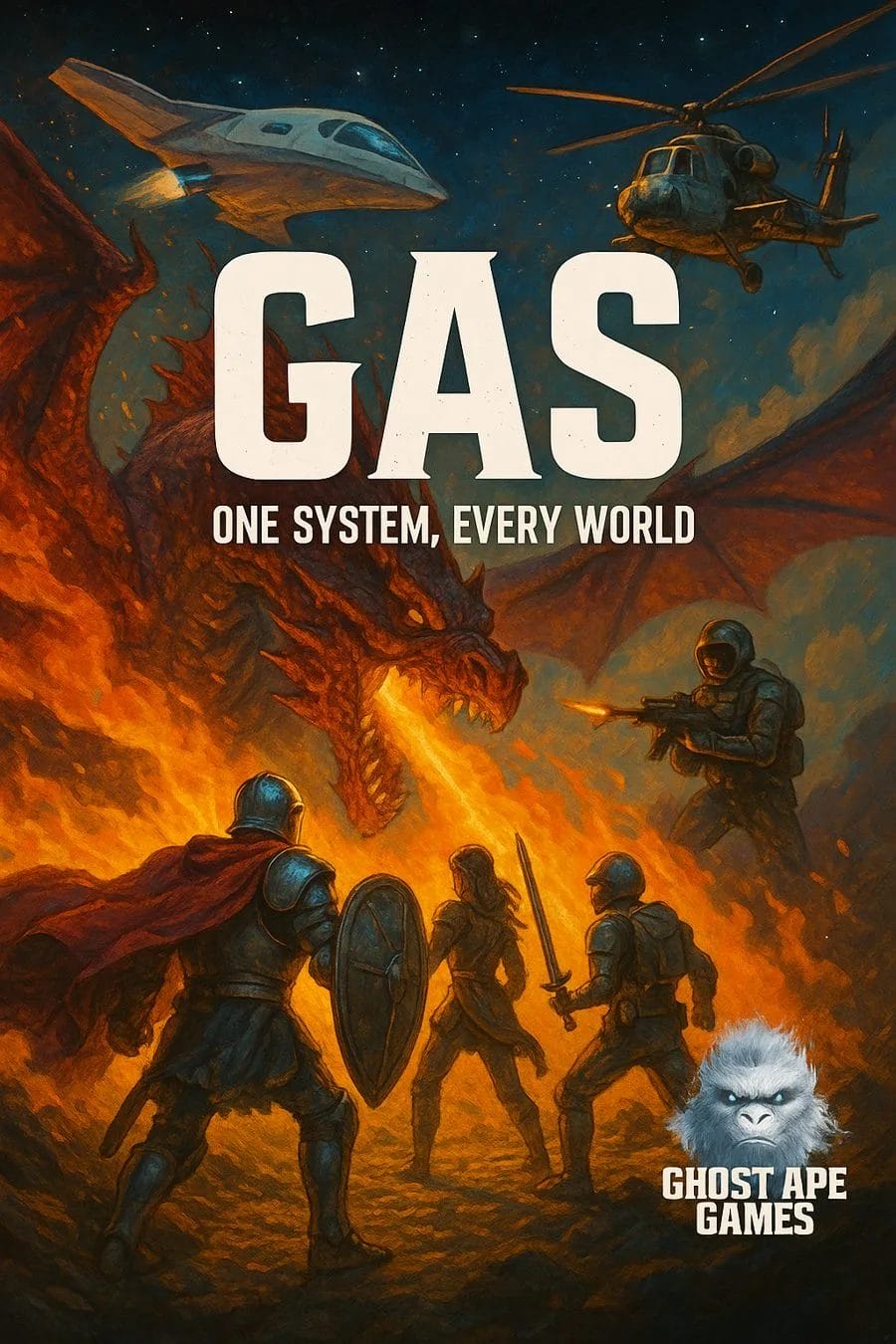
While the ambition is admirable, the execution lands somewhere in the middle of the pack, offering a functional chassis that struggles to distinguish itself from the giants it seeks to emulate.
The premise is straightforward. GAS wants to be the last game you buy, offering a free PDF. It positions itself against “edition creep” and the need for multiple sourcebooks. However, in trying to be everything, it often feels like a stripped-down version of the very systems it critiques, lacking the specific flavour that makes a focused RPG sing.
The System
If you have played a d20-based game in the last twenty years, you already know how to play GAS. The core mechanic is a d20 roll, adding a Stat Modifier and any relevant Tags, attempting to beat a Target Number (TN). It is a roll-over system, which the text notes is a departure for veterans of older roll-under systems, aiming to keep attacks and saves under the same mathematical roof.
The primary twist here is the exploding damage dice. When a damage die rolls its maximum value, you roll again and add the result. This applies to everything, from a humble dagger to a fireball, meaning danger is always present, and combat can spike unexpectedly. While this adds a layer of excitement, the core resolution mechanic of d20 plus modifiers is so ubiquitous that GAS feels less like a new system and more like a house-ruled simplification of the world’s most popular RPG.
Character Generation
Character creation is quick, intended to get you from a blank sheet to play in six steps. It adheres to “old school” sensibilities by defaulting to rolling 3d6 for the seven stats: Strength, Dexterity, Constitution, Intelligence, Wisdom, Charisma, and Perception. The modifiers are standard fare, ranging from -3 to +3.
There are seven broad classes designed to fit any setting: Fighter, Rogue, Magic User, Psionist, Bard, Tech, and Specialist. The game argues that these archetypes are “genre-proof”; a Fighter is a knight in fantasy or a marine in sci-fi. While functional, this approach can feel a bit reductive. A Barbarian is just a Fighter with specific Tags, and the nuances between a cyberpunk hacker and a fantasy wizard are largely handwaved as “flavour” on top of the same mechanical skeleton.
Magic and Patrons
The magic system is perhaps where GAS tries hardest to innovate within its d20 framework. It rejects Vancian “fire and forget” casting in favour of a slots-as-fuel system. You know your spells and spend a daily allotment of slots to cast them.
The most interesting wrinkle is the emphasis on Patrons. The game explicitly states that magic is a relationship, not just a resource. Whether it is a deity, a demon, or a corporate AI, the source of your power dictates your Tags and potential consequences. This adds a welcome narrative layer to the spellcasting, forcing players to consider who they are dialling up when they cast a fireball. However, the mechanics themselves remain standard; a Magic Missile is still just a damage spell, regardless of whether it comes from a god or a microchip.
Look and Feel
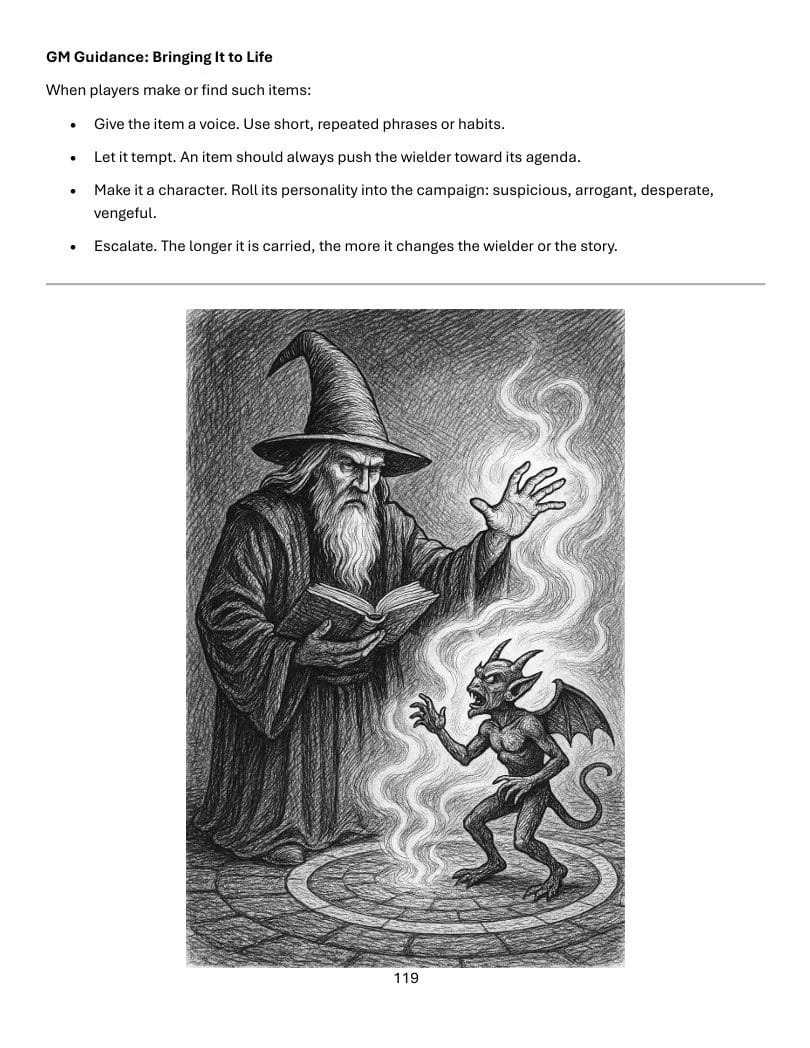
GAS is presented in a very basic format. The text is legible, but the layout lacks the polish one might expect from a modern RPG, even a free one. The presentation is utilitarian, with lists and tables that get the job done but do little to evoke the “pulp-born” excitement the introduction claims.
Ultimately, GAS succeeds as a functional, universal d20 system, but only by staying very close to its inspiration. It does not stray far enough from the d20 standard to offer a truly unique experience. It is a toolbox for GMs who want a lighter version of 5e or OSR gaming across different genres, but it may leave players craving the depth and specific flavour of more specialised systems.
Quick Links
- Pay What You Want: GAS – Ghost Ape System.