Geek Native was lucky enough to catch up with some of the creative team behind the Welcome to Hole audio drama, including Kate O (Writer, Editor, Game Master), Natalie Haven (Writer, Performer), Duncan Thompson (Writer, Performer), and Brendan Way (Writer, Performer). The full team also includes Sean Toole (Writer, Editor, Performer).
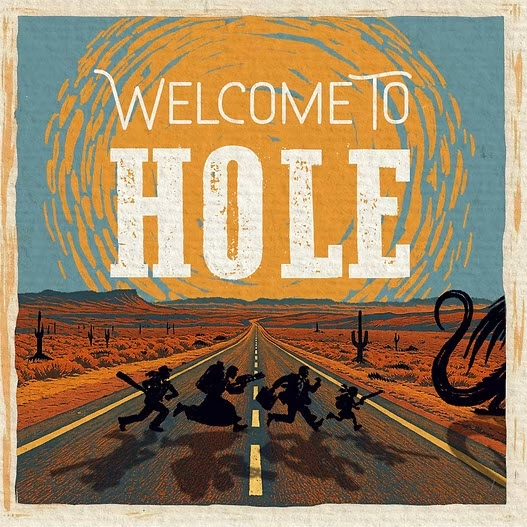
‘Welcome to Hole’ started life as a Monster of the Week campaign. What was the moment during your game when you realised, “Hey, this is more than just our TTRPG; this could be a show”?
Brendan Way: After one game late in our run, I did specifically call out that it reminded me of an episode of Buffy (season four, episode twenty). Our campaign also ran for twenty-one games – the length of a proper American TV show. So it already felt like a series!
Natalie Haven: I can’t remember exactly when, but there was a moment when it dawned on me that I had been so consistently and utterly delighted by what the others were putting out, and Ada felt so effortless, that I wanted to play these dynamics forever. So, selfishly, part of me wanted to make a show in order to carry on with the fun. I also thought that three middle aged dudes watching over / wrangling a magical child was a unique dynamic and a pretty solid hook. Finally, and perhaps most importantly, I find that joy is contagious, and there is a special type of spark to art made by people who are just having a really great time.
Kate O: I wish I could pinpoint a single moment, but for me it all kind of snowballed organically from the same impulse that Nat talks about. We were coming to the end of what felt like the arc of a season in our game, i.e. it was time for them to face the Big Bad, and I was starting to think about what would come next. I didn’t want to let go of those characters, I really felt the dynamic that the players had developed was just so consistently fun and funny, it deserved more. So I started to scheme about how we could create something new, and shareable. But this all happened right at the end or even after the playthrough ended. We didn’t know as we were playing what we would go on to do with it.
Monster of the Week is known for its narrative focus and playbooks. How did using a Powered by the Apocalypse system, specifically, shape the original story and its eventual transition into a scripted format?
Natalie Haven: I enjoy the flexibility of magic in PbtA systems. I’ve always been drawn to playing casters, but sometimes I find the spells, in, for example D&D 5e, to be so specific that I feel paralyzed by choice. It was so joyful to have a relatively broad guideline for magic, and be able to essentially negotiate with the GM from there (sorry Kate for everything I put you through), especially as Ada is prone to testing boundaries and breaking rules. I think overall this flexibility resulted in more unexpected, non-linear, character and story development in the original campaign, and this translated to the scripts we have now.
Duncan Thompson: I wasn’t very familiar with this format, and how much of the focus was on the narrative and role-play. I’ve played D&D quite a bit, both as a player and a DM, and that has so much focus on the mechanics around what your characters can do, in fact the role-playing can be very secondary. In this format we needed to focus so much more on the characters we were building and their choices, so it made it a natural fit to create a script out of. It was almost an extended devising session for a season-long narrative in the hands of a very skilled game master.
Kate O: Oh man, I could talk all day about this system as a storytelling device. It’s fantastic. It took some getting used to for me as a GM being used to more rules heavy systems, but I think that’s exactly what ended up making it so rich for collaborative storytelling. When I would have to make decisions on the fly, and create consequences for the players’ actions, that was where some of the most exciting ideas came from. This system gives the players equal creative input into the story and I think that translates into the script. Every plot point is inherently driven by the players’ desires and wants, and every outcome is a direct result of their actions. That makes for a naturally very driven story.
Adapting an improvised TTRPG campaign into a tight, 12-episode scripted series must have been a challenge. Can you talk about what you had to leave on the cutting room floor and how you decided which story beats were essential to keep?
Brendan Way: Aptly for a horror comedy, you have to kill your darlings. RIP Jenny the waitress and rookie cop Shep Cornington – we just couldn’t fit you into the plot.
Kate O: I completely forgot about Jenny the waitress!! Which means it was the right choice to let her go. Yes, this was a pretty time-consuming part of the scripting process. Again, the MotW format really helped, because in general, a new monster would mean a new episode. But our game did have lots of ancillary characters and in-between monster plots that we needed to tidy up. We started by going back through our notes of the game and then wrote a synopsis for each of the twelve episodes. Some were very clear cut because the monster plot would wrap up nicely, so we started with them. Then we looked at all the in-between stuff or plots that carried through multiple episodes and we worked out if it was crucial to the wider story. That would then get peppered into the twelve where needed. It helped having group consensus as well, we could bounce off each other about what needed to go and what needed to stay.
Brendan Way: Another reason for cuts was that some lines and shenanigans were just too goofy to keep. For example, at one point the gang put on vaguely Christmassy costumes and spraypainted their vehicle to resemble the Coca-Cola truck.
Duncan Thompson: Brendan is right, I will forever miss the “Coke-Pope”, but yes, tightening things up for this kind of format led to some streamlining. In TTRPG play you are free to explore things and they don’t need to be “entertaining”, they’re about your freedom as a player and improviser to explore. As directors always say in theatre, it’s much better for you as an actor to go too far, so the director can pull you back, rather than the other way round. This was like that, we ended up with piles of material that we could use and it was about culling down to what made a clear concise narrative that would be compelling and interesting.
Your creative team met through London’s improv comedy scene. How has that shared background influenced your writing process, your performance, and your ability to voice a reported sixty different characters for the show?
Natalie Haven: Wow, sixty? Didn’t fully compute that until now. Silly voices are improv 101 in my opinion. Some voices come easier than others, or are more fun, and you definitely fall into patterns. Hopefully we’ve done a solid job of mixing it up – I hope there are a few cases where the audience can’t tell who is voiced by who.
Brendan Way: We already bring an improv energy to our tabletop roleplaying, instinctively Yes And-ing ridiculous in-game plans and dumb comedy bits. That was therefore built into our performances once we stepped behind the mic.
Natalie Haven: In improv, you want to get messy. It’s about finding the balance between knowing, as a performer, that getting into trouble makes for an interesting story, and playing a character who wants to achieve their goals as easily as possible. The characters in Welcome to Hole have always been excellent at getting into trouble, and okay at getting themselves out.
Kate O: I think our improv experience together gave us a great foundation of trust. And a hive mind ten years in the making. Priceless.
Natalie Haven: When we started playing TTRPGs, we often commented how it felt just like improv, but without the stress of trying to impress an audience (unpack that how you will, fellow improvisers). We’ve now taken that experience and, through significantly more time and effort than it took to play the original campaign, translated it into a series that we are exposing to audience scrutiny. LOL.

You’ve described the monster hunters as a “ragtag group” consisting of a Vatican-trained vampire hunter, a man in black, a conspiracy-loving trucker, and a super-powered eight-year-old. What makes this particular dynamic so fun to write for, and what can you tell us about the team without giving too much away?
Brendan Way: I mean, immediately we have to highlight that it’s three middle aged men and a child. So you have ostensibly who you THINK would be in charge – the authority figures representing church and state – but guess who actually ends up calling the shots? I’ll give you a hint: it’s not the trucker.
Natalie Haven: Following on from what Brendan said, everyone in the group thinks that they are the most capable (except perhaps Corbin), and somehow they are all wrong.
Duncan Thompson: Don’t worry, Corbin absolutely thinks he’s the most capable vampire hunter.
Natalie Haven: I think there’s something of an unexpected lack of ego to this group of characters, which translates into quite a sweet undertone. Don’t get me wrong, they spend ninety-nine percent of the time grating on each others’ nerves, and they want to be the best at what they do (and each have very different opinions and approaches to that), but on the deepest level, there’s no sense of ego for its own sake, so you’re really rooting for them.
Kate O: I have nothing to add here, the gang has spoken for themselves, and quite rightly.
Launching on October 29th is perfect timing for Halloween! What are some of your favourite monsters, horror tropes, or spooky stories that you were most excited to bring into the world of Hole?
Natalie Haven: I’m fascinated by biblical and demonic lore.
Duncan Thompson: I have to agree with Natalie, I loved exploring the biblical “horror” elements especially while playing a role that was supposed to be so closely related to that Christian mythology.
Kate O: I’m a sucker for a classic haunting and we do get to see that in Hole.
Brendan Way: I adore the many rules and lore surrounding vampires!
You cite classics like Buffy the Vampire Slayer and The X-Files as key inspirations. Beyond the “monster-of-the-week” format, what specific elements from those shows—be it the humour, the heart, or the horror—did you strive to capture in your series?
Brendan Way: I like the hangout vibe of those shows. Yes, there’s thrills and spills, but it’s also really fun to spend time with your friends, Mulder and Scully!
Natalie Haven: I love the tonal flexibility of this genre. It’s freeing. You can pick and choose what topics you treat as tragic or comic, real or fantastical, and switch up those choices at the drop of a hat. When this flexibility is leveraged well, there’s nothing like it (eg. Buffy’s “The Body”).
Duncan Thompson: Yes, I love leaning into the heart and levity of it. By not shying away from the comedy and levity it really gives you a proper gut-punch when things get serious.
Kate O: There is so much about the writing on Buffy in particular that is so ingrained in my psyche I wouldn’t even know if I was actively trying to capture it. I do think it’s probably a part of my writing style naturally because I love it so much, particularly how it floats between comedy and tragedy as others have said, but I also think the tone and texture of this show is uniquely our own.
This is your debut scripted series as a team. What has been the biggest learning curve in moving from playing a game together to becoming the writers, producers, and performers of a fully-realised audio drama?
Brendan Way: While the five of us have dabbled in writing, editing, and acting before, none of us have ever done something of this scale. So getting grips to that (in addition to remembering to treat each other as friends, not colleagues) was a challenge.
Natalie Haven: At the beginning of the project, we all waxed lyrical about how we’d ALWAYS remember it’s about fun first and foremost, and we would NEVER let this project cause friction between us. You can probably guess how that went. Not to say it wasn’t a massive amount of fun – it absolutely was, but I’ve learned that tough moments will happen, and I don’t think it serves anyone to pretend that they won’t. Rather than try to completely avoid them, I’d say if you’re going to dive into something like this, do so with a mature and compassionate group, who are willing to do the hard work of talking out and working through the rough patches. It has turned out that this is that group, and my gratitude for that cannot be put into words.
Duncan Thompson: I second what Natalie said, even though we warned each other that this would be a massive commitment, it was still more than that. A fully produced, professionally recorded audio-drama, with twelve episodes forty-five minutes each? It was a monumental amount of work. I am very grateful to have done it with this group, I think that if we weren’t able to discuss the problems that came up the way we did, this wouldn’t have seen the finish line. I feel very blessed to know all of these people and call them friends.
Kate O: Yeah this was a huge undertaking and a big shift for us as a group. I thought it was super fun and would continue to be super fun the whole time non-stop. It was, but it was also very hard. And so I think it became about how we survived when the scales tipped from fun to hard. I’m so proud that we found a way to both hold on to our friendship and complete what we set out to do. It’s really very special. I think that the care that we have for each other comes across in what we created.
The first season is a 12-part series. Are there more stories from the town of Hole that you’re hoping to tell? Have you already started rolling the dice on a “Season 2” campaign?
Brendan Way: At time of writing, we haven’t released any of season one but are already dreaming of what happens next. I can neither confirm nor deny the existence of a mega-doc with stray ideas.
Natalie Haven: I can confirm the existence of a mega-doc of stray ideas. But it’s such a massive undertaking between the five of us, if it does happen, it won’t be straight away.
Brendan Way: Fortunately, even if we do have a long production gap a la Stranger Things, our young character won’t visibly age. Nat can play Ada forever.
Duncan Thompson: Yes, a ‘Lisa Simpson’ situation. I think we can tease that there’s a reason why Hole is an epicentre of paranormal activity, maybe you’ll find out why in a later season? Who knows?
Kate O: I can only coyly smile, rub my hands together and say mwuahahhahaah.
For the Geek Native TTRPG community, who love discovering new worlds and compelling stories, what is the one thing you hope they take away from their first visit to Hole?
Kate O: Hunting monsters is hard and thankless but we do it anyway.
Brendan Way: You may not be able to save the world, but maybe you can save your neighbourhood.
Duncan Thompson: Spend time playing games with the people you love. One day you won’t be able to, so do it as much as you can whenever you can, regardless of your age, gender, or what other people think of it. Be proud you have people who you can share that with, a lot of people don’t.
Natalie Haven: The sixth love language is annoying your friends.
Thanks, Welcome to Hole team!



