The year is 1821, and Greece is a powder keg. While the human world burns with the fires of revolution against Ottoman oppression, a second, “silent” war rages in the shadows. Edge of Mythos, an indie studio based in Athens, is preparing to launch Mythomachus on Kickstarter this Tuesday. Billed as “The Witcher meets Highlander” during the Greek War of Independence, this dark fantasy roleplaying game offers a grim reclamation of Hellenic folklore, stripping away the “Disney-fied” veneer of Mount Olympus to reveal the blood-soaked superstitions of the 19th century.
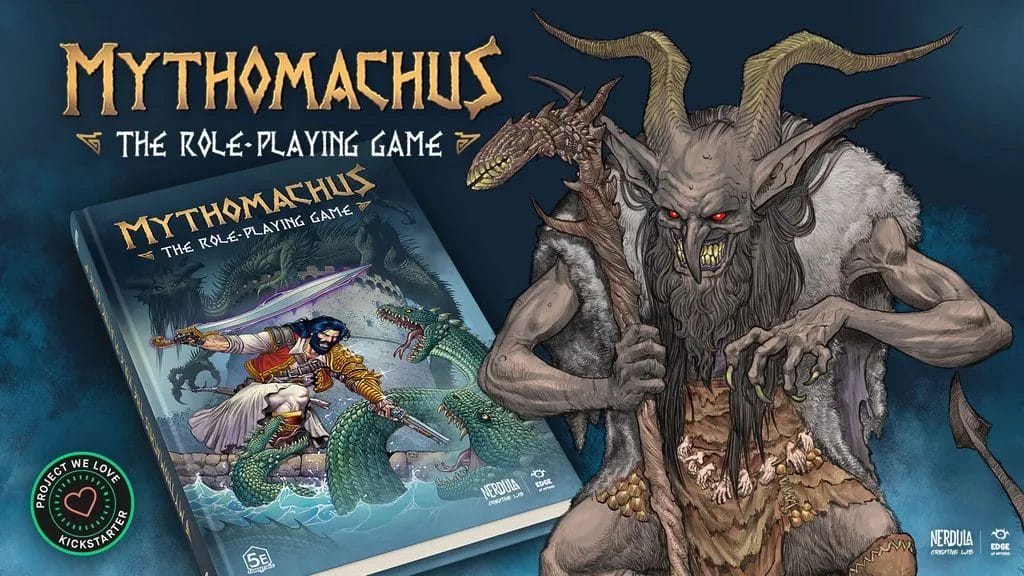
At its core, Mythomachus is a philosophical character study built on a 5e chassis. Players do not just slay monsters; they are forced to confront the “Central Dilemma” of their own existence. After their first kill, a hero must choose between absorbing the Essence of the fallen, becoming an immortal monster-slayer who risks addiction and madness, or remaining mortal to build a Legacy through fabled deeds that survive the centuries. To understand how these disparate historical and mythical threads weave together, we spoke with Alex Papadakis, Lead Designer at Edge of Mythos.
The pitch for Mythomachus is ‘The Witcher meets Highlander’ during the 1821 Greek Revolution. For the folks who might have slept through history class, or those who only know Greek myths from Disney’s Hercules, how do these three very different ingredients actually taste when they’re mixed together at the table?
In short, the game focuses on these three pillars: being either an immortal or a human hunter of monsters, a defender battling the mythical creatures that our world has mostly “forgotten” till the 19th century. Entities that everyone believes might exist but no one is brave enough to admit they do. Meanwhile it is a world where heroes become immortal, either through the Essence, a force that can transform them into living legends, or through Legacy, the fabled stories of their deeds that survive through the centuries. Finally, the 1821 Greek Revolution is an ideal historical setting for our heroes to test their limits as a world is filled with turmoil and political imbalance. A very real and familiar world, burning by human hands while also being plagued by supernatural forces. The characters will be called to face two battlefields simultaneously. The most interesting aspect of the 19th century as a historical setting is that we rarely see it being used in any medium. It is the perfect “bridge” between the Old and Modern World, just before the Industrial Revolution and the dominance of rationalism and science over prejudice and myth.”
One of your most striking mechanics is the choice players face after slaying their first monster: absorb its Essence to become an immortal Mythomachus, or remain mortal to build a Legacy. From a game design standpoint, how do you ensure that ‘staying human’ feels just as powerful and rewarding as becoming an immortal monster-slayer?
A lot of people ask this question. Why would I stay mortal and not just become an immortal Mythomachus? The answer is simple, while being a Mythomachus, your sole purpose becomes to hunt supernatural beasts in order to drain Essence and maintain their power to survive. While a Mythomachus enjoys improved vigour, they have to keep a delicate balance so they do not get addicted to Essence. On the other hand, a mortal follows a specific Legacy Path, which includes 3 distinct tiers, each with their own perks, creating their own legend that will stay “immortal” through history. Design wise, we give the player an opportunity, to either stay fixed on a difficult path with set perks and weaknesses or to be more versatile, following one of many legacy paths available to them, with unique benefits. It would also be interesting for long lasting campaigns taking place in different eras. Imagine the immortal heroes joining forces with their long lost comrades’ descendants to continue their Legacy in honour of their memory. The game offers lots of opportunities to grow your character based on the deeds of your previous characters and family name thus making a Legacy of your own that affects your current gameplay.”
We see creatures like the Kalikanjari and the Vourkolakes mentioned in the Quickstart. These aren’t your standard D&D Goblins or Zombies; they carry centuries of local Greek superstition. How did you go about adapting these ‘real-world’ legends into 5e stat blocks without losing their unique, eerie flavour?
The monsters of the game were the main pillar in which we built everything. We put great amounts of time and effort in research of folk tales from all around Greece, in order to make sure we respect and accurately portray every supernatural creature. Additionally, design wise, Vaesen by Free League Publishing was a big source of inspiration in how it treats fey creatures. We did not want creatures to feel common, to be just another monster you can simply slay. We kept almost every encounter a puzzling mystery that our players needed to solve in order to triumph. That’s where “Folklore Traits” come into the game; since there are many, often contradicting, stories for every folklore being, a list of special abilities is provided for the GM to choose which of these traits will be relevant when encountering a creature. Only through research will the players be ready to truly face a creature. Also, many creatures are difficult to be dealt with, unless a specific ritual or weakness is discovered. For example, Kalikanjari might be constantly raiding a village unless a specific ritual is performed in order to banish them for good.”
In Mythomachus, magic (or ‘Magick’) feels genuinely dangerous. With the Magickal Calamity system, there’s a 10% chance per rank that reality just… snaps. What is the most disastrously memorable ‘mishap’ you’ve seen happen during a playtest?
Well, during one of the playtests I ran myself, the Magus of the party tried to perform one of the 2nd rank Magicks “Heartburn”. The roll of the dice was a very unfortunate “1”, resulting in Ayleen, the Magus, to start literally coughing flames that consumed her from the inside. This kind of moment is the exact feeling we wanted to give to the magick of Mythomachus; the magus can weave magicks all they want but it will always be dangerous and sometimes deadly.”
The backdrop of the game is a land under Ottoman oppression. How do you balance the ‘Secret History’ of monster hunting with the very real, grounded drama of the Greek War of Independence? Can a player be a hero of the Revolution and a Mythomachus at the same time, or do those duties eventually clash?
Every character, no matter if they are an immortal or a mere human, will eventually be dragged into the events of war as they are inescapable. Even at small remote villages, while hunting creatures hidden in forests, reality is always there, at the face of every villager, everyone fighting in the war. Sometimes, hard choices need to be made, as the creatures of Greek folklore rarely stay away from human affairs. Many of them, as they have their own agendas, will make offers or seal deals with mortals to their benefit. And such deals might tip the battle in the War of Greek Independence towards one side or the other. The characters will be called to decide what they value most or what their greater purpose truly is.”
This RPG is based on the graphic novel by Yannis “RUBUS” Rubulias. How much of the visual ‘DNA’ of the comic was carried over into the game mechanics? Did Rubus’s art style influence the way you designed specific classes, like the Crypthound or the Archon?
Yannis is one of the most crucial members of the team, and the graphic novels clearly shaped the feeling of the game. He helped form and outline all the unique class ideas, especially the Archon who is pretty much the class of the main protagonist of the graphic novels. Sometimes a specific class feature would be the inspiration for an art piece, and vice-versa, a clear art scene or action sequence from the comic pages would shape how a class works and feels.”
The Quickstart adventure, The Doom That Came to Fira, takes place on the iconic island of Santorini. Most people think of blue domes and sunsets, but your version is a plague-ridden quarantine zone. Why was this the perfect ‘first step’ for players entering the world of Mythomachus?
I will try to answer this question, without spoiling too much about the story of the adventure. Historically, Santorini was one of the more infamous places for horrors such as the one in the story to exist. Horrors that brought plague and sickness to cattle and humans, spreading discord inside a community. Now the kind of threat we used for our story is very well known among other folk tales in other parts of the world, in various shapes and forms, but we depicted it as accurately as possible based upon Greek folklore and legends. So, we wanted something that’s mainly familiar and terrifying, but adhering to its Greek roots too. This is the way to say to the players “This is not your typical “doom” that you know from elsewhere”.”
The Divine Gaze mechanic suggests that the gods aren’t distant – they’re watching. But they aren’t necessarily ‘helping.’ How does drawing the attention of a god change the game for a party that’s just trying to survive the night?
The more “important” the characters become within the cosmic balance, the more the deities keep an eye on them. Sometimes they will be rewarded with omens or prophecies that will show them the proper way to deal with things. However, being closely observed by deities means that one small misstep might anger divine beings, making a character’s journey harder.”
Thanks, Alex!
Seeking the Secret History
The reliance on visual “DNA” from Yannis Rubulias, the creator of The Dragonphoenix Chronicles, is evident in every spread of the 45-page Quickstart. By moving the focus from the Bronze Age to the 19th century, Mythomachus carves out a unique niche in the crowded 5e market. It isn’t just a monster manual; it is a “National Gothic” toolkit that leverages the tension of the 1821 Revolution to heighten the supernatural stakes.
For those curious about how 5e handles a 10% chance of spontaneous internal combustion, the 45-page Mythomachus Quickstart, featuring the Santorini-set adventure The Doom That Came to Fira, is currently free to download at DriveThruRPG.


