The tabletop roleplaying community is bracing for a wave of expansive new sourcebooks and campaign settings, headlined by the upcoming crowdfunding campaign for Well of the Worlds. Michael Surbrook, the veteran writer and driving force behind Surbrook Press, confirmed the portal fantasy setting is slated for a release later this year through Mobius Worlds Publishing.

Designed primarily for the Prowlers & Paragons system, Well of the Worlds leans heavily into the isekai genre. The premise strips player characters of their familiar surroundings, dropping them into a hostile universe where they spontaneously manifest superhuman abilities. This announcement is a significant draw for fans of portal fantasy who are looking for a robust mechanical framework to support zero-to-hero character arcs.
Beyond his own crowdfunding efforts, Surbrook remains deeply entrenched in several monumental adaptation projects. Most notably, he is serving as the lead researcher and writer for PaksWorld, an ambitious endeavour to translate Elizabeth Moon’s beloved Deed of Paksenarrion literary universe into the Chivalry & Sorcery roleplaying game. Condensing over 7,000 pages of established fantasy lore into a functional, engaging tabletop supplement highlights a design philosophy that prioritises exhaustive world-building over mere statistical blocks.
This encyclopaedic approach is a hallmark of the Surbrook Press catalogue, much of which is available on DriveThruRPG. Whether revisiting the legendary superhero campaigns of the late Aaron Allston in Strike Force Organizations or dissecting military science fiction tropes for the upcoming Beam Spam sourcebook, the focus remains on delivering thoroughly researched content that game masters can mine for inspiration, regardless of their preferred ruleset.
To dig deeper into this extensive slate of upcoming releases, Geek Native Patreons voted to put their questions directly to the source. Michael Surbrook spoke to Geek Native about his current projects and design philosophy.
Well of the Worlds is heading to crowdfunding later this year. For readers who love Prowlers & Paragons but haven’t heard of this setting yet, what is the “elevator pitch” that makes this world a must-visit?
The elevator pitch is one of “PCs are sent to a strange world and must adapt and survive as they explore the world and gain superhuman powers.”
A deeper explanation is: an isekai/portal fantasy setting for fans of such series as El Hazard, John Carter of Mars, and Castle Perilous. As with many isekai series, the PCs are plunged into a strange new world, where they come to the attention of powerful enemies. However, due to the nature of this new world, they discover they are developing superhuman powers and abilities, which allow them to opposed these same enemies.
I have run a number of campaigns using the Well of the Worlds setting and most people have greatly enjoyed the setting, the concept, and game itself. I hope the crowdfunding campaign is successful and we can introduce this setting to a wider audience. I’ve found that Philip Jose Farmer’s The World of Tiers is a handy resource.

You’ve mentioned that much of your new work, like Beam Spam and Fearsome Critters, starts with HERO System but might migrate to 5e, BRP, or even Shadowdark. How do you approach designing a supplement so it remains “soulful” across such different mechanical engines?
For products such as Beam Spam and Fearsome Critters, the idea is to present information first and game stats second. So, the primary idea is the presentation of the subject and getting that information across to the reader, then we worry about the game stats. So, when moving from HERO to P&PUE, the bulk of the work remains the same, I just need to concentrate on how each game system presents characters and the like. This usually means reordering the descriptions and the like for creatures and characters.
I will note that since HERO lets you build everything, things that get stats in HERO doesn’t always translate over to (say) P&PUE. So, I need to judge what gets stats and what doesn’t. As I haven’t fully explored BRP and Shadowdark, I am not sure if/how that will work.
You’re the lead researcher and writer for PaksWorld, bringing Elizabeth Moon’s Deed of Paksenarrion to Chivalry & Sorcery. That’s a beloved literary universe – what has been the most challenging (or rewarding) part of translating Moon’s specific vision of paladins and warfare into a tabletop format?
The challenge is reading 13 novels and story collections. That’s… 7,000 pages of material? It’s a lot! So, on one hand I get to reread one of my favourite series, but on the other, as I am working on the A-Z, there’s a lot of copying content into various files so I can eventually assemble this content into a coherent whole. The 1st A-Z was over 50,000 words (I think it is around 55,000 words). The second one will be much larger — I am at 15,000 words, but I still need to tackle the huge list of people mentioned as well as all of the general notes I have taken. And, I still need to read the three short story collections.
Aside from trying to collect, collate, and then write-out each entry, there is the issue of presenting things in a complete and coherent manner. Fortunately, I don’t have to worry about game mechanics — my job is to present the setting itself.
Strike Force Organizations is the companion to the late Aaron Allston’s legendary work. What does it feel like to step back into that world, and what do you think defines the “Strike Force” style of play for a modern audience?
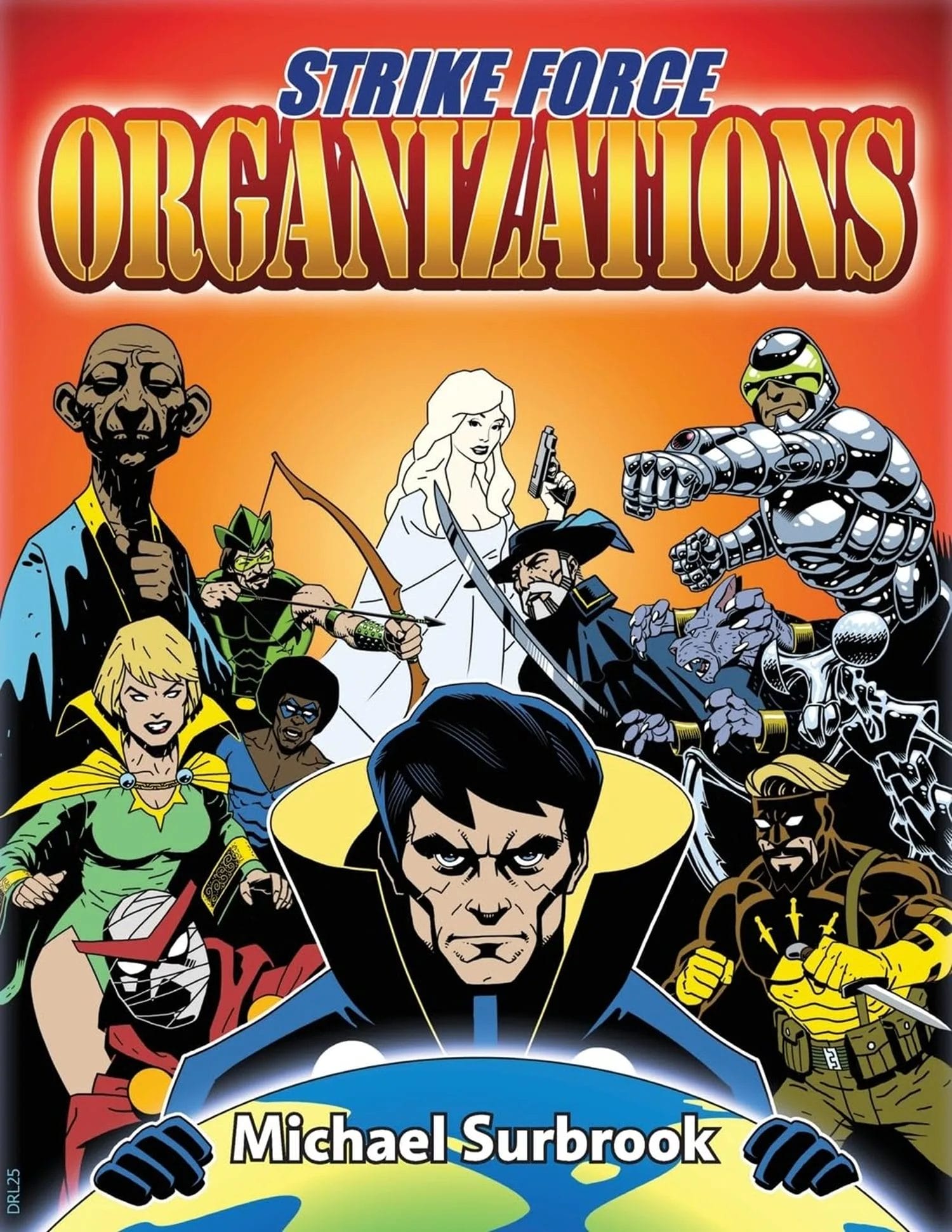
I wanted to do SFO as part of the first Strike Force book – in fact, it was a stretch goal and several of hoped we could make it work, but the funding wasn’t there. Diving back in was amazing. Basically, each time I tackled a new section, I learned new things about the setting, the campaign, how campaign elements progressed, and the like. I was also gobsmacked at the sheer scale of the game. Granted, I think of lot of it has to do with the fact Aaron often presented his material for the old Rogues Gallery APA, so he fleshed things out that might have remained more sketchy otherwise.
Of course, he did run like 10-15 (or more) campaigns set in his universe, so he tended to flesh out everything and apparently plotted things behind the scenes, so he knew what everyone was up to at all times. Interestingly, this happens to me in my Well universe. NPCs created off the cuff for one game will get expanded on later, so I have a more detailed character if I use that NPC again or if I run the campaign again.
Now, as for the “Strike Force” style of play, I feel it is marked with a level of scope and scale most modern game don’t have. Consider this — SF ran for 230+ sessions over 20+ years. The typical D&D 5e campaign book runs from 30-50 sessions and comes to an end once the PCs accomplish certain plot points. Granted there is nothing stopping you have running a perpetual D&D campaign (I note that Critical Role’s campaigns run for 150 sessions or so).
I also note that Strike Force very much dives into what the PCs are doing at all times. Aaron handed out worksheets asking what the PCs would be doing each “season” (or story arc), so there is a desire for players to really think about their PCs and their PC actions and goals when not at the game table. This leads to a very soap operatic style of play (which Aaron ramped up to 11 with his soap opera specific superhero campaign).
Looking at your catalogue, from the Shape of Things to Come to Larger Than Life, you seem to have a knack for “encyclopedic” gaming content. What defines a “good” sourcebook for you? Is it the crunch of the stats or the flavour of the world-building?
In my mind, stats are not as important as content. I own a lot of GURPS book simply because they are wonderfully detailed examinations of the subject matter. For example, I recently found (and bought) a copy of the old GURPS sourcebook for Callahan’s Crosstime Saloon. I am never going to run GURPS or a Callahan’s campaign, but as a resource for the setting, it’s excellent. I have the GURPS New Sun for the same reason (said book also made me wonder if I really wanted to read the Book of the New Sun.)
I note that many people have mentioned Larger Than Life is a great resource for information on historical and fictional figures and the game stats can be ignored. I recall someone telling me it was “teacher approved” due to the scope of the content.
You’ve worked with HERO Games, Mobius Worlds, and your own Surbrook Press. What would you like to be known for in the TTRPG community, and what do you think you are currently best known for?
I think… right now, most people (especially those in the HERO community), know me for Kazei 5. Personally, I would like to be known for writing well-researched products that are informative and useful. I also note that if we can get Well of the Worlds out, I would really like to be known for that setting.
Fearsome Critters and Old School Enemies both suggest a love for the “bestiary” style of book. What is it about creating antagonists and monsters that keeps you coming back to the drawing board?
For many of these products, the fun is in the research. The Asian Bestiaries allowed me to take a deep dive into the folklore and mythology of numerous Asian cultures. It also let me discover some of the strangest creatures from mythology and present in game stats for others to use.
The same for Fearsome Critters. I also note that Beam Spam will involve me re-reading a lot of military SF, such as Hammer’s Slammers, Old Man’s War, The Forever War, and so on.
Aside from the projects we’ve discussed, is there a “dream project” or a specific creator in the tabletop community you’re dying to collaborate with?
My dream project would be the develop The Venture Brothers for P&PUE. I think it would be an amazing product and would let me take a deep dive into the series. In addition, while it starts as a farce, it develops into a complex and deep superhero setting with a little something for everyone.
Lastly, for the military SF fans waiting for Beam Spam, can we expect a “hard sci-fi” approach, or is this more about the cinematic “pew-pew” of giant robots and space cruisers?
Oh, hard SF. As I noted before, things like Hammer’s Slammers, Old Man’s War, The Forever War, Starship Troopers, and other books.
You can find Michael Surbrook‘s extensive library of supplements and bestiaries over at DriveThruRPG. With Well of the Worlds preparing for its crowdfunding debut via Mobius Worlds Publishing later this year, the “isekai” era of tabletop gaming looks set to gain a significant new entry.
Independently covering Prowlers & Paragons since 2013. Our archive includes 7 entries connected to this topic.
Latest entry: February 2026
Creative Commons credit: South American jungle by Sascha Grabow.