From One Dwarf Army Games, The Frontier 2nd Edition is a tabletop RPG designed by Georgios Chatzipetros that brings the frantic energy of “looter shooter” video games like Borderlands to the tabletop.
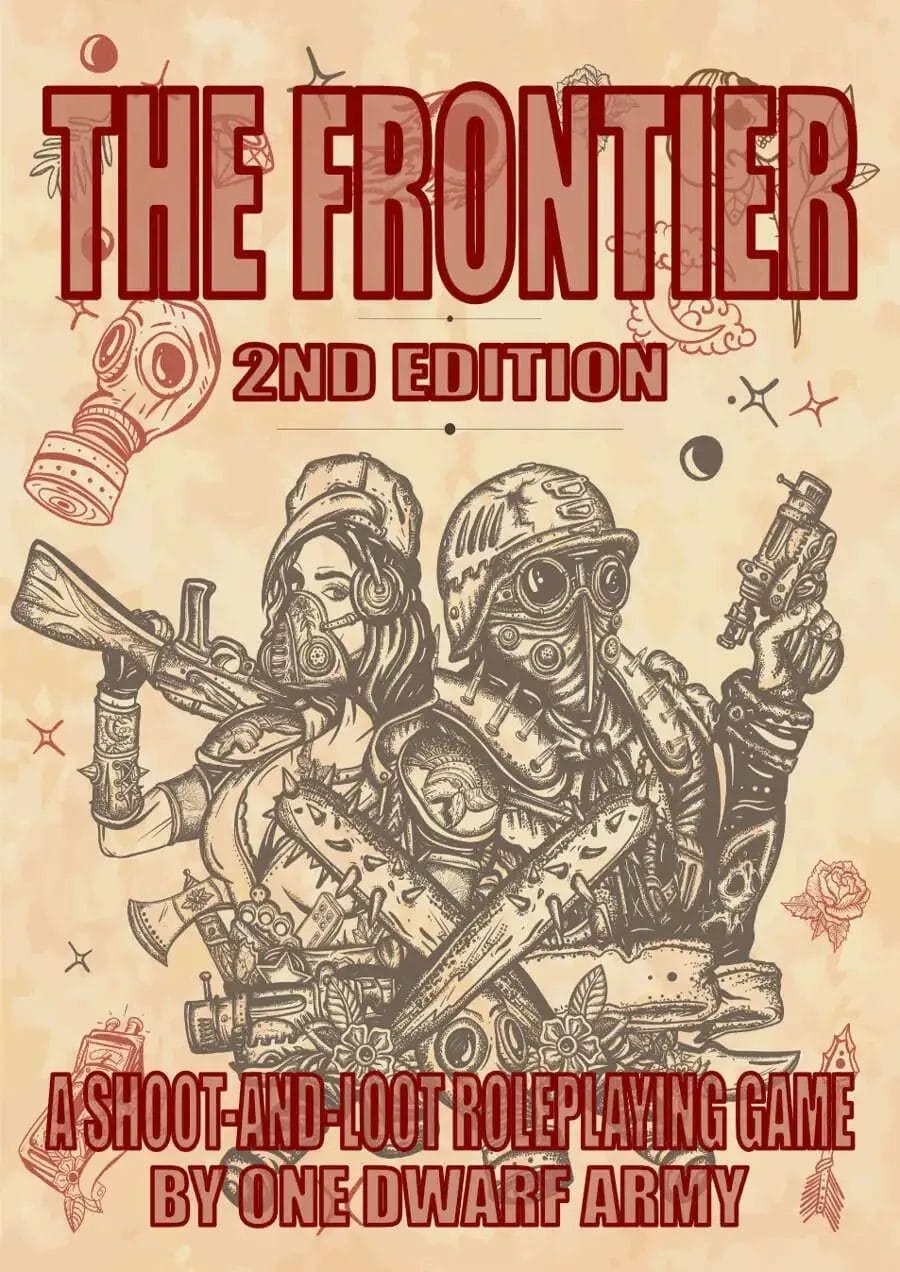
The game promises high-octane action, hordes of enemies to defeat, and a wealth of loot to discover, all wrapped up in a compelling post-apocalyptic sci-fi package. This review will explore the core rulebook, its dedicated equipment supplement Gear of War, and the bestiary Threats of the Frontier, highlighting how these three components work together to create a cohesive and engaging experience.
System
The Frontier uses a custom d20-based system that will feel comfortably familiar to anyone who has played similar games before. Actions are resolved by rolling a d20 and adding one of the four core attributes – Muscles, Reflexes, Brains, or Guts – to beat a target Difficulty score.
The system has some clever twists that help it stand out and support its fast-paced design. A particularly neat mechanic is how it handles multiple dice pools; instead of summing the results of a roll like 3d6, you simply take the highest single die result. Furthermore, certain dice, denoted with a capital ‘D’ (like D8), can ‘explode’ once, allowing you to roll again and add the result when you score the maximum value. The game streamlines character abilities by eschewing a skill list, with every action tied directly to one of the four attributes. Armour is also handled elegantly, providing a static defence value that you use in place of your Evasion if it’s higher, ensuring it remains useful even when a character is caught off-guard. This streamlined approach to combat and character abilities sets the stage for the diverse gear and threats detailed in the companion books.
Setting
The game is set on Prometheus, an earth-like planet in the Andromeda galaxy that humanity reached via an ancient alien jumpgate. The world is a treasure trove of artefacts left behind by a vanished, hyper-advanced race dubbed the Prometheans. Twelve years ago, a catastrophic event known as “The Collapse” destroyed the jumpgate, cutting the colonists off from Earth and plunging their new home into a chaotic, post-apocalyptic state.
This new frontier is a dangerous place, populated by the aggressive, lizard-like S’vra natives and beset by unpredictable, violent storms. Society has fractured into competing factions, most notably the authoritarian remnants of the colonial Government ruling from the city of Bethlehem and the rebellious Blue Coalition seeking to overthrow them. The default campaign area, the Three Lakes region, is richly detailed with numerous settlements, hazardous geographical features, and plenty of Promethean ruins to tempt adventurous loot-seekers. This backdrop provides a fantastic sandbox for adventure, full of conflict and opportunity, and serves as the perfect environment for the varied foes found in Threats of the Frontier.
Character Creation and Advancement
Creating a character in The Frontier is a refreshingly straightforward process that gets you into the action swiftly. You begin by distributing 12 points across the four attributes, allowing for quick customisation without getting bogged down in complexity. An optional rule for random attribute generation is also included for those who prefer it. After assigning attributes, you simply choose one of the four distinct classes, calculate your starting Health, and grab your initial gear.
Characters advance by earning Experience Points (XP) from defeating foes and completing missions, progressing up to a maximum of level 10. Each new level grants an increase to maximum Health, a new class ability, and, at most levels, a permanent point increase to an attribute of your choice. This steady and frequent power progression feels rewarding and effectively captures the rapid growth seen in the game’s video game inspirations, allowing characters to quickly make use of the increasingly powerful gear available in Gear of War.
Character Classes
The rulebook presents four character classes, each fulfilling a classic RPG archetype that feels perfectly suited to a shoot-and-loot adventure.
- The Commando is the quintessential soldier, proficient with all weapons and armour. Their abilities, like the iconic “Time to shine!”, let them take extra actions and dominate the battlefield with sheer firepower.
- The Shadow is a deadly infiltrator and assassin, adept at striking from concealment. They favour light armour and precision weapons, using abilities like “Hit’em where it hurts” to inflict massive damage on unsuspecting targets.
- The Telepath wields powerful psionic abilities, manipulating minds and projecting telekinetic force. Using a pool of Psi points, they can unleash a vast array of powers, from healing allies with “Psychic surgery” to devastating foes with a “Kinetic blast”.
- The Wirehead is a high-tech hacker with cortical implants, allowing them to run powerful programs in the heat of battle. By spending Power charges, they can deploy digital assistants like the “Healbot,” disrupt enemy mechs with “Logic bomb,” or boost their squad’s combat effectiveness.
Art Style
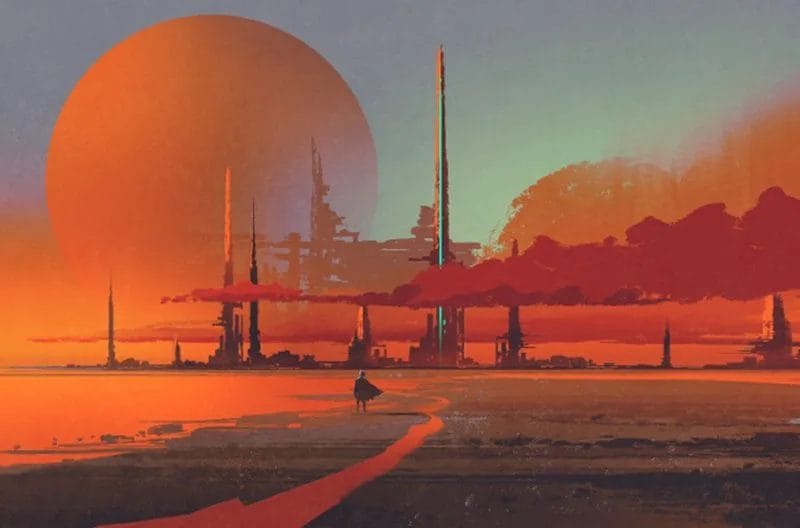
The book is filled with impressive, full-colour artwork from a team including Intueri, Tithi Luadthong, and Liu Zishan. The style is evocative of high-quality sci-fi concept art, depicting sprawling alien vistas, grim futuristic firefights, and character pieces that perfectly capture the game’s gritty, adventurous tone. The visuals do an excellent job of bringing the world of Prometheus to life and setting the stage for epic shoot-and-loot action.
Equipment / Gear of War
Following the core rules, Gear of War is the dedicated equipment supplement for The Frontier 2nd Edition, providing the “loot” for the “shoot-and-loot” experience. The book presents a vast catalogue of armour, weapons, alien artefacts, and other useful items for characters exploring the dangerous world of Prometheus.
Inventory System
The book begins by outlining the game’s inventory system, which uses an abstract, slot-based approach. Each item, regardless of its actual size, occupies a single inventory slot, from a clip of ammunition to a hefty assault cannon. A character’s carrying capacity is determined by their Muscles attribute, with penalties to Speed and Reflexes for those who try to haul too much. This method streamlines gameplay by avoiding detailed weight tracking, though some may find the equivalence of a small ammo clip and a large weapon occupying the same “space” to be a significant abstraction. Rules are also provided for managing held items, requiring a move to swap weapons during a combat round.
Armour
Gear of War categorises armour into three basic types: light, medium, and heavy. While functional, these common armours serve primarily as the foundation for the book’s main offering: Advanced Armour. These items, rated from uncommon to legendary, each come with special abilities derived from a long list of “Models”. A suit of armour might be Agile, increasing the wearer’s speed, or Hardened, providing a direct bonus to its armour rating.
The book contains a large catalogue of named armour sets, such as the military-style Aegis series or the aggressive Berserker suit. When players find one of these, they roll on a table specific to that item to determine which Model it features, creating a wide variety of potential loot drops. This system of named items paired with randomised properties certainly delivers on the “looter” promise, though many of the unique armours in the catalogue are distinguished primarily by which Models are available on their random tables.
Weapons
The weapons section makes up the bulk of the book and follows the same design philosophy as the armour. A table of common weapons provides the baseline statistics for everything from a simple dagger to a rocket launcher. These are followed by an extensive catalogue of Advanced Weapons, each a unique item of uncommon or higher rarity.
Like the advanced armours, these named weapons often come with a special rule and a table of randomised “Models” that grant further abilities. For example, the Avenger autoloader gains combat bonuses against enemies who have recently hit the wielder, and can also roll for a Model like Bloody or Electrified (X) to gain even more power. With hundreds of named weapons, from the Alcatraz combat shotgun to the Zeus bolt-action rifle, the book provides a truly staggering amount of firearms and melee options. This volume is the book’s main feature, but it may also be a challenge for some groups to manage the subtle differences between the many options available.
Promethean Artefacts
Shifting focus from conventional gear, the book offers a selection of Promethean Artefacts. These are pieces of alien technology that must first be understood before they can be used, a process that takes time and a successful Brains roll. Many of these artefacts have a finite number of charges that cannot be replenished by human technology, making their use a significant decision. The items in this section offer more narrative and utility-focused effects, such as the Energy Bridge, which creates a traversable plane of energy that ignores gravity, or the Sanctuary Gate, which transports the party to a pocket dimension where they can rest and heal.
Other Gear
The final section of Gear of War covers other essential items. This includes consumables like medkits and combat stimulants, alongside adventuring equipment such as jetpacks and night vision goggles. The book concludes with a series of random tables designed to help the Gamemaster quickly generate item drops of any rarity, reinforcing the game’s focus on acquiring a constant stream of new and varied loot. The sheer volume of gear presented here directly supports the “looter shooter” ethos established in the core rulebook.
Threats of the Frontier

Threats of the Frontier is the bestiary and antagonist book for The Frontier 2nd Edition, dedicated to populating the world of Prometheus with a wide range of hostile creatures and characters for players to encounter. This book provides the “shoot” aspect of the “shoot-and-loot” experience, offering a diverse array of challenges for players to overcome with their hard-won gear.
Stat Blocks and Encounter Building
The book opens with a clear explanation of how its enemy stat blocks are structured and how a Gamemaster can use them to build encounters. It introduces concepts like “Instinct,” an attribute that replaces Brains for creatures of animal intelligence, and provides rules for creature size and the space they occupy. A helpful clarification is made that any bonus damage an enemy has with a weapon is due to their personal skill, and a weapon looted from them will only have its base statistics.
For building encounters, the book provides a straightforward, level-based system. The Gamemaster is advised to sum the levels of all enemies in an encounter and compare this to the total level of all player characters. An encounter where the enemy level total is equal to the party’s is considered an easy challenge, while a total that is triple the party’s level is a tough challenge. This provides a simple mathematical baseline for balancing combat. To further assist, nearly every creature entry is presented with a standard version and a higher-level “Badass,” “Hardened,” or “Evolved” variant, allowing threats to scale alongside the players and ensuring a consistent challenge regardless of character progression.
Foe Categories
The majority of the book is dedicated to an extensive catalogue of threats, which are organised into several distinct families. This structure provides a solid toolkit for building encounters themed around different factions or environments, tying directly into the world-building established in the core rulebook.
- Humans: The book presents three categories of human opponents. Bandits are the common lawless rabble, with archetypes ranging from the hulking Bully to the quickdrawing Gunslinger and the psionically-gifted Rogue Psion. Mercs, a step up in terms of discipline and gear, represent professional soldiers with specialised roles like the Heavy Gunner and Battle Engineer. This group also includes several elemental specialists, such as the Frost Commando and Hell Trooper.
- Promethean Natives: The fauna of Prometheus is represented by several families. The Draks are vicious, pack-hunting predators akin to wolves, with numerous subspecies including the heavily armoured Armadrak and the colossal, element-breathing Drakons. The S’vra are the planet’s primitive, lizard-like sentient species, featuring warriors like the Skirmisher, and powerful psionic Mystics and Elders.
- Insects and Worms: Two families of monstrous invertebrates are detailed. The Skalix are a species of giant, burrowing worms that hunt by sensing vibrations. This group includes acid-spitting Larva, constricting, heat-generating Flamba, and the enormous, earthquake-causing Volca. The Xorak are a hive-minded species of giant six-legged insects, with a caste system including expendable Drones, warrior Soldiers, and psionic Overlords, all led by a Queen.
- Robots and Constructs: Finally, the book provides two categories of non-living threats. Mechs are the leftover security and military robots from before the Collapse, ranging from simple Security Bots to the walking tank known as the Dreadnought. Guardians are the enigmatic biomechanical constructs the Prometheans left behind, blending organic and machine traits. These alien protectors, such as the tentacled Clawshade and the artillery-platform Dragonshade, share unique abilities like phasing through walls and psionic resistance.
Overall
The Frontier 2nd Edition succeeds admirably in its mission to translate the frenetic energy of a “looter shooter” video game into a compelling tabletop roleplaying game. The three-book combination provides a remarkably cohesive and complete experience, where each volume directly supports the others. The core rulebook lays a fantastic foundation with a fast-paced, intuitive d20 system and swift character progression that keeps the action moving, while Gear of War delivers the all-important “loot” in staggering quantities, with randomised properties that make every drop exciting. This is all brought to life on the dangerous world of Prometheus, a well-realised sci-fi sandbox perfect for adventure.
By providing a vast and varied bestiary in Threats of the Frontier, the game gives players a constant stream of challenging foes to test their hard-won equipment against. From the straightforward encounter-building rules to the scaling enemy variants, the Gamemaster is given all the tools needed to run an extended campaign of high-octane combat. Bolstered by an impressive art style that perfectly captures its gritty tone, The Frontier 2nd Edition delivers a complete and exciting toolkit for groups eager to dive into a campaign of frantic combat, character advancement, and the thrilling pursuit of the next legendary drop.
Quick Links
- Download: The Frontier 2nd Edition
Disclaimer: My copy of Frontier 2e was provided free to review.



