There are three different tabletop RPGs on offer in Tyler Crumrine and Possible Worlds Games’ latest Kickstarter. James D’Amato and Andrew Mierzejewski from One Shot Podcast Networks and Meghan Cross from Siren Song Games are collaborating.
We have an interview with Tyler Crumrine, but first, let’s take a quick look at the pitch, which promises “one hundred swords, five missing matriarchs, and a very little lover” in one crowdfunding campaign.
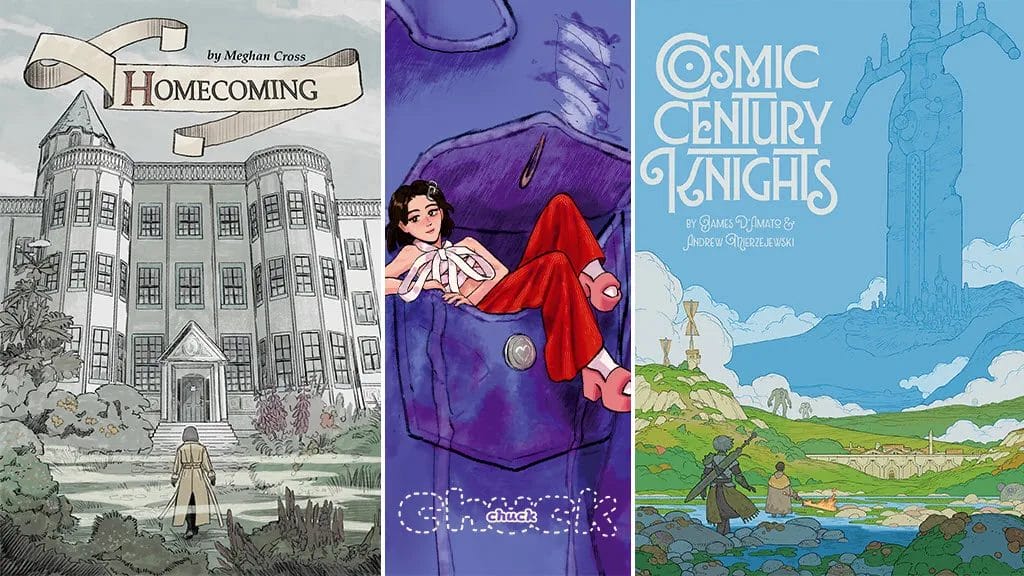
Become a legendary hero in Cosmic Century Knights, a tabletop roleplaying game of high-fantasy adventure. Inspired by classic JRPGs and shonen anime, you will battle terrifying foes, build your world collaboratively, and forge powerful bonds in serialised campaigns. The game prioritises creative solutions and thrilling action. Created by James D’Amato and Andrew Mierzejewski, with art from Baptiste Pagani and Ben McEntee.
300 years ago, a gigantic sword descended from the heavens and plunged into a fantasy world. It carried 100 legendary blades, which spread across the land. These Century Blades have played an important role in history and myth, empowering noble warriors and enabling terrible tyrants in equal measure. However, now new and terrible threats from the Star Conquerors, the Fell Knights, and the Blight Labyrinth test the mettle of every knight. Draw your blade and steel your heart!
Return home to unravel a family mystery in Homecoming, a collaborative storytelling game by Meghan Cross. As the eldest daughter of a troubled family, you must search the labyrinthine Braddock House for your missing mother. Every room unlocks a memory; every choice shapes your story.
The game features card art by Ash Lane and box illustrations by Theo Stultz.
The eldest daughter of the Braddock family has finally returned home after walking out the door for what she thought would be the last time. News of her mother’s disappearance—the latest victim of a mysterious family curse—has led her back to her ancestral home. Will you strive to find all the answers—even to the most difficult of questions—or will you leave Braddock House once again and never look back?
Your partner just shrank! In Chuck, a solo romantic comedy roleplaying game by Tyler Crumrine, you must navigate the massive challenges of a now-tiny relationship. Test your connection and adapt to your new life together in a story inspired by Shungiku Uchida’s manga Minami’s Lover, with art by Brianna Lei.
What if your lover shrunk down to a few inches tall? This won’t put a stop to your relationship, though—you’re both just going to deal with this new reality. Or are you? Over time, even little problems can add up. Which one of you is big enough to make the hard choices?
Backers can pick up Chuck in both physical and digital formats with a pledge of $10.
Alternatively, at $25 backers get PDF copies of Homecoming, Cosmic Century Knights and Chuck.
There’s a print copy of Cosmic Century Knights or Homecoming for backers at the $30.
However, the top and popular tier is $60, which gets all three RPGs in both digital and physical formats.

An interview with Tyler Crumrine
Tyler kindly agreed to answer some questions. I regret now not asking two questions, then a tiny question, then two questions and then a tiny question. Oh well! Here goes!
This Kickstarter is incredibly ambitious, launching a shonen fantasy epic, a gothic horror mystery, and a solo romantic comedy all at once. What’s the story behind bringing these three very different titles together, and what do you hope backers take away from this eclectic collection?
Before I worked in games I worked in theatre, and a big part of the yearly theatre cycle is season planning. You’re not just selecting a single play to perform all year, you’re producing multiple, and a well-planned season needs variety. The backbone of a theatre is its subscribers—existing fans or people intrigued enough to purchase an entire season—but you need to care about single ticket sales too. You have to tap into new audiences with new ideas while staying true to what makes your theatre special. If you do your job right, you exceed your core audience expectations while expanding your audience at the same time. A bigger audience means more and bigger plays, and more and bigger plays means more work for collaborators and more room to take risks.
These are very different games thematically, but are all still distinctly Possible Worlds Games titles: they’re affordable, have original rulesets with unique, engaging mechanics, and lean heavily into collaborative worldbuilding—whether in collaboration with the text or with your fellow players. They’re also all doing something new and different compared to the rest of our catalog, focusing on longer-form play, a more authored story, and a strictly solo experience. I want to give backers more of what they love, but new and different experiences too.
Possible Worlds Games has built a reputation as a “proud creative collaborator.” Can you walk us through how you connect with designers like Meghan Cross, James D’Amato, and Andrew Mierzejewski, and what your process is like for bringing their distinct visions into the Possible Worlds library?
Meghan, James, & Drew are all creators who’ve been on my radar for some time now, and I’m grateful that when I made the decision to expand Possible Worlds Games to publish more designers, they already had works-in-progress that were a good fit. I take community very seriously, and part that is commiserating with people—listening when they have a project they’re excited about but don’t know if they can finish it on their own. I had the opposite problem—a catalogue that couldn’t keep up with demand and pressure to design more games than I had in the tank. The decision to collaborate was an easy one, and while it’s still labor, I’m able to utilize the skills I’ve developed running Possible Worlds—art direction, product design, developmental editing, etc.—to collaborate in bringing their ideas to life in a way that meets both our goals and priorities instead of coming up with an increasing number of ideas and projects all on my own.
You designed Chuck yourself, and its premise is fascinating—a relationship that’s not about if it will end, but how. What drew you to explore a romantic comedy through the lens of an inevitable breakup, culminating in the very physical act of literally chucking the game piece?
Chuck is a game I’ve had in the back of my head since reading Shungiku Uchida’s manga Minami’s Lover, so about two years now. In the book, the titular Minami’s girlfriend Chiyomi mysteriously shrinks to a few inches tall and moves in with him. The initial chapters are your typical rom-com fare, but the manga takes the situation increasingly seriously the deeper you get. Chiyomi is lonely and depressed, her life functionally uprooted, and Minami feels less like a romantic partner and more like a caretaker. The change is never explained or solved, with the story focusing instead on how they react or adapt to it. It really blew me away.
This theme paired nicely with another idea I’d been toying with—a game that’s explicitly limited in a gaming culture that’s obsessed with the “forever game.” It’s unrealistic to expect a game or campaign to last forever, the same way it’s unrealistic to expect the same from every relationship. You can obviously part with something other than the game piece to signify your story’s end, but playing rules-as-written, I wanted to ask players to sit with that discomfort. To focus on enjoying an experience for however long it lasts, knowing that once it’s over, that’s it. It doesn’t cheapen the experience, it just is what it is.
It’s a unique game—so unique that’d be a tough sell on its own—but collaborating with Meghan, James, and Drew to include it in a larger slate of releases lets me take more risks too. Rather than feel pressure to make a big game that speaks to everyone, I can make a small game that speaks to me. And if someone is curious enough to pick it up—whether based its pitch or the strength of our other titles—who knows, it might speak to them too.
The inspirations for Homecoming, like Gone Home and House of Leaves, are masters of atmosphere and environmental storytelling. How did you and designer Meghan Cross work to capture that specific feeling of exploring a single, deeply personal, and unsettling space within a card-based tabletop game?
To quote Art Webb on visual design, “if everything is bold, nothing is bold.” The same is true in storytelling—you need dynamism for moments or details to feel impactful. You’ll draw a new room each turn in Homecoming, but what you discover or experience there is drawn from a separate deck. You always learn or determine something new, but whether a supernatural event is drawn from the third deck depends on how those first two cards interact. It makes for a story—and house—that’s never reveals itself the same way twice, and never all in one playthrough. And because players are given plenty of opportunity to shape their own protagonist’s thoughts, opinions, and priorities, the story always feels personal despite having a highly-authored overarching plot.
From collaborative mapping in Beak, Feather, & Bone to the grand adventure of Cosmic Century Knights, your catalogue is wonderfully diverse. Is there a core design principle or a feeling you look for that makes a game, regardless of its genre, feel like a “Possible Worlds” game?
I think a diversity of genres is part of what makes the Possible Worlds Games catalog distinct! We’re always going to focus on original rulesets and mechanics you won’t find in other TTRPGs, but telling new kinds of stories in new and different ways is also a priority. If anything, working with other designers allows me to expand that a Possible Worlds title can be. I design a lot of short games personally—they’re a better fit for my skills, interests, and schedule—but I like playing all kinds of games. Publishing others means publishing games I couldn’t make myself, and puts me in a position where I can figure out what’s a Tyler design preference and what’s part of Possible Worlds’ design identity. To return to theatre comparisons, you can’t have build a collective vision until you start sharing the stage.
After this huge three-game project is successfully launched into the world, what’s next on the horizon for you and Possible Worlds Games? Are there any other unique collaborations or solo projects you can give our readers a hint about?
Austin Walker’s Realis is our next big release and our most ambitious project to date. Text is nearly done, as is a treasure trove of original art from the game’s almost 20 illustrators. Editing and layout are next, with our eyes on a 2026 release. Once this campaign is done we’ll be entering the next phase of development for CANON/EYES by Jeff Stormer, Space Between Stars by Viditya Voleti, and Hearts like Comets by Adam Bell and locking in early playtest mechanics for Apocalypse Canaries by Charu Chandni Patel and Overcure by D.G. Chapman. Even with all that, though, we still have a few unannounced projects you’ll be hearing more about soon. Follow us on socials or sign up for our newsletter to stay in the know!
Thanks, Tyler.
We have until September 26th to back the Kickstarter and only until January 2026 before the team hopes to start shipping copies of all these games.



