The tagline for RPG publisher Montford Tales is “More than fluff”, and Rori Montford‘s bio says she “spent a great deal of time studying and manipulating the laws of physics”. So when Montford’s latest crowdfunding effort promised no GM, Scrabble tiles and cards, I knew I had questions. I got answers and even clues on what Rori is working on next.
Hundreds of backers, however, knew straightaway that they were in, and Asher’s Ridge smashed the £1,000 funding goal. It’s a short Kickstarter, though, which concludes on Tuesday, September 16.
The pitch for the game promises “Lights, camera, action”.
Direct – and star in – your own paranormal drama television show set in the remote fictional town of Asher’s Ridge. Experience the unexplainable in the breathtaking heart of the Lake District. Gather your cast of characters, scout your filming locations, and make a show that will keep them guessing for years to come.
As we’ll see in the interview with Rori below, the game visits the style of Twin Peaks, Stranger Things and the X-Files. The backer rewards, though, are no mystery.
Fans who pledge £12 or more get a copy of Asher’s Ridge as a reward and a digital copy of the play aid map.
Then, the next tier up is £30, which gets backers the physical copy of Asher’s Ridge. The expected delivery for both editions is May 2026.
Higher up the reward ladder is the Collector’s Edition, which unlocks at £60, and the Collector’s Edition “All-In” at £135. The latter is very limited in number and adds the A2 double-sided map poster of the town, the Marquetry Letter Tile Set (50/50 mix), and Location and Risk Tiles.
Unclaimed, for now, at the very top is a £500 special which adds the original and hand-painted Location and Risk cards.
An interview with Rori Montford

Rori was kind enough to find time between toddler herding and Kickstarter running to answer some questions from me.
Congratulations on another successful Kickstarter! For our readers who are just hearing about Asher’s Ridge, what makes it the perfect game for fans of shows like Twin Peaks and The X-Files?
Several things make it great for fans of these shows. The setting is a large part of it; the drama takes place in a small, remote town (albeit in the UK, rather than the US’s Washington State) surrounded by dense woods, high hills, and a deep glacial lake. The pace of life is slower, tourists come and go, and there’s a sense of surface-normalcy with something else lying underneath.
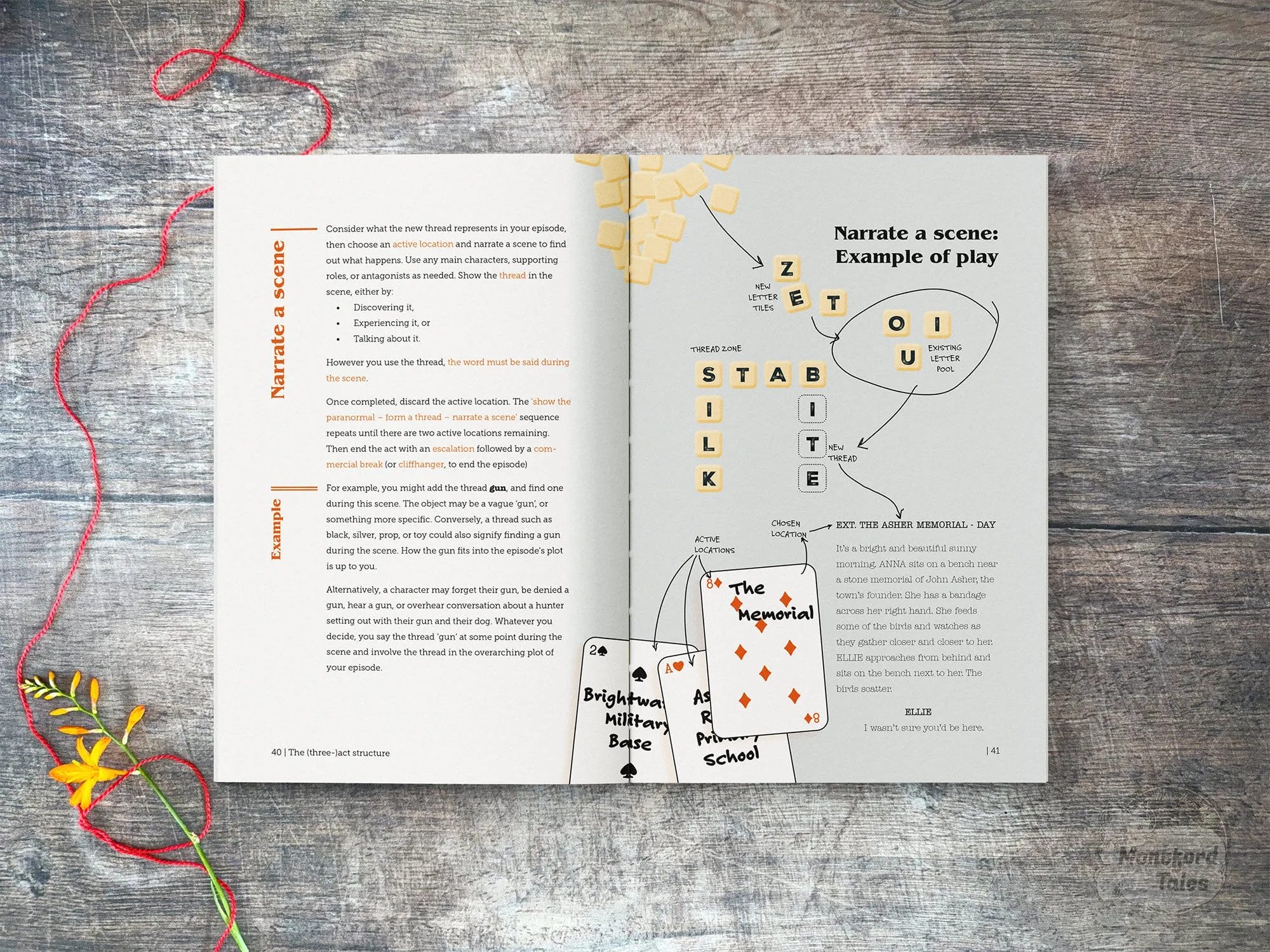
Secondly there’s the way the letter tiles prompt the plot threads you use during play. In shows like Twin Peaks and The X-Files, as a viewer you go through a continuous development of theories over what is actually going on and see the plot develop in surprising ways. Similarly with the plot threads in Asher’s Ridge, you’ll hypothesise theories for how they tie together, but it can all be turned on its head later in the game when another — ever so perfect — word gets added to the table and brings it all into focus.
Finally there’s the framing of the game’s narrative as a TV show. Asher’s Ridge borrows heavily from the format used in mystery drama’s. For instance, you begin with the “cold open” – showing the consequences of the episode’s problem without sharing what the problem actually is (e.g. flashlights searching in woods, bodies being discovered, mystery radio static while driving through a location), and then proceed through a series of three acts with regular brief flashes of scenes showing how the (usually paranormal) problems facing the town have developed and gotten worse.
The structure of the game, the nature of the plot threads, and the setting all combine to reinforce the feeling of those shows.
Instead of dice, Asher’s Ridge uses an innovative system of letter tiles and a ‘Risk Deck’ of playing cards. What inspired this unique approach, and what kind of atmosphere does it help create during play?
As I suspect is common, the mechanics came from the remnants of multiple project ideas that didn’t pan out. What was left evolved, after many iterations, into Asher’s Ridge. The playing cards came from working with tarot-driven writing prompts for my previous games (Dead Letter Society and The Almanac of Sanguine Paths) and exploring what other roles they could fill. In this case they became the locations for scenes to play out in, as well as representing the danger characters face. The addition of letter tiles from an abandoned game idea gave a pleasing amount of constraint and problem-solving.
It feels tense during play. Your available letter tiles dwindle across the game, but you still have to make words from them, and the ever-escalating situation means you must make difficult choices about what locations to use and how.
The game is GM-less and requires no prep, which is a huge draw for many groups. What’s the secret to designing a compelling paranormal mystery game that can be picked up and played by anyone, without a dedicated storyteller?
I believe it’s important that there’s a touchstone to refer back to (in Asher’s Ridge it’s the “loglines”, or the ‘blurb’ of an episode that you either choose or create as a group) so if ever people feel stuck for ideas they can recall it and get back on track. The fact that no-one is GMing means that there is no right or wrong answer as you play – it should make sense with everything that’s gone before, but it’s freeing to know that your theory doesn’t have to be correct in the moment.
Personally, the joy of a GMless mystery game is in figuring out what the mystery is together.
Your bio describes Montford Tales as a “Writer and illustrator.” How does wearing both of those hats influence your creative process? Does the visual style of a game like Asher’s Ridge come first, or do the story and mechanics lead the way?
The story and mechanics have always come first (so far!) Wearing both hats is hard but does have benefits. When writers block looms, art helps, and vice versa.

First, The Almanac of Sanguine Paths funded in just six minutes, and now Asher’s Ridge has smashed its goal. Why do you think these narrative-rich, mechanically unique games are connecting so strongly with the tabletop community right now?
I can only speak for myself, and for me narrative-rich games designed with solo play in mind give me a creative outlet that fits into my time-poor life. Having a game that can picked up, put down, and sometimes lingered over is very, very satisfying.
With Asher’s Ridge on track for a 2026 release, our readers are always eager for a scoop! Can you give us any clues about what other strange phenomena or intriguing worlds Montford Tales might be exploring next?
There’s a whole long list of ideas to explore in more depth after Asher’s Ridge, but it’s hard to say what will- or won’t work out! However, there are two that have made it far enough to get working titles: In Thunder, Lightning, or in Rain is a 1-3 player tarot-driven epistolary game about witches and their covens, and Oxford Comma is a solo-game about editing the Necronomicon (or other strange texts).
Thanks, Rori!
The Kickstarter, at the time of writing, has just over a week to go and is still attracting attention.
Quick Links
- Kickstarter: Asher’s Ridge.