The year was 1993. The internet was a nascent, arcane realm for most, and PC gaming was rapidly evolving. We’d navigated the blocky corridors of Wolfenstein 3D, but nothing quite prepared us for the cultural detonation that was Doom. Passed around on clandestine (i.e. pirated) floppy disks, its shareware first episode, “Knee-Deep in the Dead,” wasn’t just a game; it was a revolution. It was a visceral, terrifying, and exhilarating descent into a pixelated Hell that would consume countless hours of my youth, fuel a worldwide phenomenon, and lay the groundwork for decades of first-person shooters. Now, in May 2025, with id Software’s latest infernal chapter, Doom: The Dark Ages, freshly clawing its way into the hands of slayers worldwide, it’s time to look back at the franchise’s blood-soaked legacy and dissect how this new, medieval-themed prequel measures up.
Part 1: Knee-Deep in the Shareware – A 90s Descent into Hell
My first encounter with Doom is seared into my memory. A friend handed me a stack of 3.5-inch floppies, a digital smorgasbord carrying id Software’s forbidden fruit. The installation was a ritual, freeing up precious conventional memory, configuring Sound Blaster (Sound Blaster!) settings. Then, E1M1: Hangar. The moment the game loaded, the gritty, pseudo-3D (2.5D, as we’d later learn to call it) visuals were a monumental leap. The oppressive atmosphere, the flickering lights, the distant guttural growls of Imps , the revolutionary graphics… – it was immediately arresting.
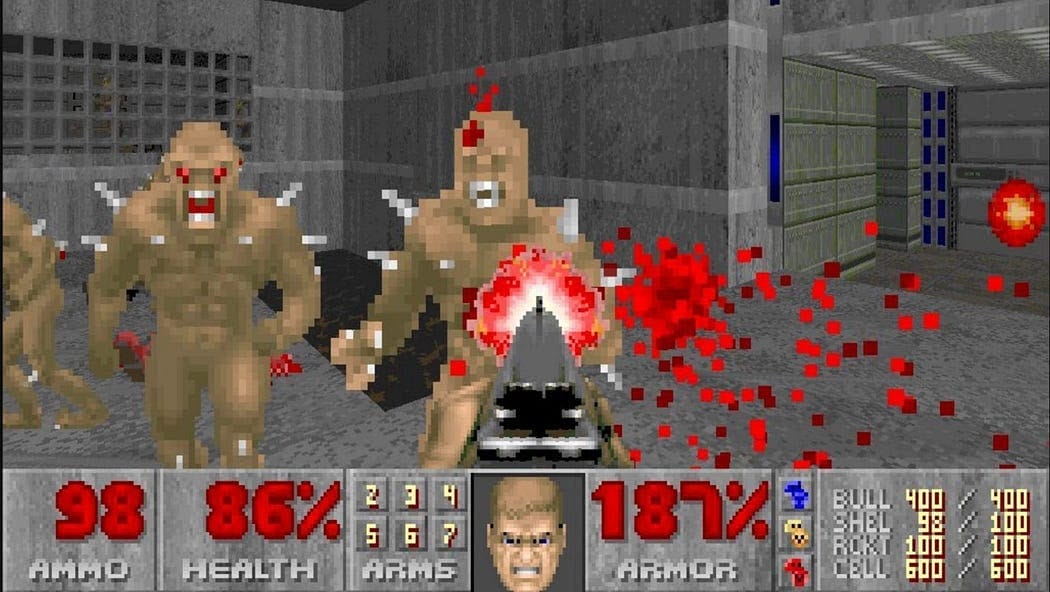
This wasn’t the heroic, somewhat cartoonish Nazi-blasting of Wolfenstein. This was darker, faster, and infinitely more brutal. The feedback from the shotgun (and the sound effect!), the desperate search for health packs and armor shards, the sheer panic when a Pinky demon charged — it was an adrenaline rush unlike anything before. The guttural roars, the explosive sound effects, and Bobby Prince’s iconic MIDI metal soundtrack, which somehow sounded both menacing and empowering blaring from a Gravis Ultrasound or Sound Blaster 16, were integral to the immersion.
Discovering the BFG (for those new-ish to the franchise, that means Big F****g Gun) 9000 was a moment of religious awe, a weapon that didn’t just kill enemies but erased them from the screen in a glorious green flash. Finding secret rooms by humping suspicious-looking walls became a secondary obsession, rewarded with precious ammo or game-changing power-ups like the Invulnerability sphere. We learned the demonic bestiary by heart: the fireball-flinging Imps, the charging Spectres, the formidable Barons of Hell, and the terrifying, screen-filling Cyberdemon.
Then came multiplayer. Local Area Network (LAN) parties transformed basements and study rooms into cacophonous arenas of deathmatch. Four players connected via IPX, the air thick with trash talk and the click-clack of keyboards (mouse-look wasn’t standard then for many, with arrow keys and strafe modifiers being the norm for movement and aiming). Cooperative play was a blast too, tackling the campaign with a mate. For those lucky ones venturing online, some services offered a glimpse into the future of connected gaming, albeit with the characteristic screech of modems and often laggy connections. It was primitive by today’s standards, but the thrill of playing Doom against someone miles away was revolutionary.
And then there were the WADs. The realization that Doom was moddable — that players could create and share their own levels, monsters, and even total conversions — was a game-changer. The community (such as it was then) exploded with creativity, from simple map packs to ambitious projects that extended Doom’s lifespan indefinitely. Downloading a new WAD from a Bulletin Board System (BBS) felt like unearthing a hidden treasure. Doom wasn’t just a game you played; it was a game you lived in, a platform for endless demonic slaughter and boundless creativity.
Part 2: From Phobos to Earth and Back – The Ever-Evolving Hellscape
Doom’s initial success was just the beginning of a franchise that would see numerous iterations, reinventions, and spin-offs, each leaving its mark.
- Doom II: Hell on Earth (1994): Arriving quickly on the heels of the original, Doom II didn’t reinvent the wheel but gave players more of what they loved: larger levels, more complex encounters, and iconic new demons like the Mancubus, Revenant, and the dreaded Arch-Vile. The introduction of the Super Shotgun, a double-barreled beast with a satisfying punch, became an instant fan favorite. It was less about exploring Martian bases and more about fighting the demonic hordes across a devastated Earth.
- Final Doom (1996) & Doom 64 (1997): Final Doom packaged two challenging 32-level megawads, TNT: Evilution and The Plutonia Experiment, largely created by the community, cementing their talent within the official canon. Doom 64, developed by Midway Games for the Nintendo 64, offered a significantly different experience. It featured a darker, more atmospheric art style, redesigned monsters and weapons, and a more ambient, eerie soundtrack. It was a unique and often underrated entry that has since gained a cult following, especially after its 2020 re-released
- Doom 3 (2004): After a long hiatus, Doom 3 arrived as a full-fledged reboot, built on id Software’s groundbreaking id Tech 4 engine. It was a technological marvel, with per-pixel lighting and bump mapping creating incredibly detailed and terrifying environments. However, it controversially shifted the series towards a slower, more survival-horror-oriented pace. The infamous “duct tape mod” (allowing players to have their flashlight and weapon out simultaneously, which wasn’t possible in the base game) became a symbol of the community’s division over this new direction. While critically acclaimed for its graphics and atmosphere, some long-time fans missed the relentless action of the originals.
- The Wilderness Years & Mobile Excursions: The period after Doom 3 saw various mobile spin-offs like Doom RPG and its sequel, which were surprisingly well-received for their turn-based take on the universe. However, a true successor to the mainline FPS series remained elusive for many years, with a troubled development cycle for what would eventually become Doom (2016).
- Doom (2016): When Doom was rebooted in 2016, expectations were mixed after its long and reportedly difficult development. It blew all doubts away. id Software had masterfully recaptured the spirit of the original while modernizing it for a new generation. The “push-forward” combat philosophy, encouraging aggressive engagement to regain health (via Glory Kills) and ammo (via chainsaw kills), was a revelation. Mick Gordon’s thunderous industrial metal soundtrack became instantly iconic, perfectly syncing with the on-screen carnage. It was a triumphant return to form, critically lauded and commercially successful.
- Doom Eternal (2020): Building on the foundations of the 2016 reboot, Doom Eternal cranked everything up to eleven. The Doom Slayer became even more agile, with new traversal mechanics like a dash and monkey bars. The combat loop was refined further, demanding players to strategically use their full arsenal — including the new Flame Belch for armor and an expanded Glory Kill system — to manage resources and overcome increasingly complex demonic encounters. The lore was significantly expanded, delving deeper into the origins of the Slayer and the celestial war. While some found the increased platforming and more overt storytelling a bit much, Eternal was widely praised for its incredible depth, relentless pace, and sheer audacity.
Part 3: The Slayer’s Reign – Doom’s Modern Resurgence
By early 2025, prior to the launch of The Dark Ages, the Doom franchise was arguably at its zenith since the 90s. Doom (2016) and Doom Eternal had not only revitalised the series but had also set a new standard for single-player FPS campaigns. The Doom Slayer had transcended his early, vaguely defined “Doomguy” persona to become a true pop culture icon, a symbol of righteous, unyielding fury against the forces of Hell.

The classic games continued to thrive, thanks to excellent ports on modern consoles and PCs, and an incredibly dedicated modding community that, armed with powerful source ports like GZDoom and Zandronum, continued to produce breathtakingly ambitious WADs, from faithful recreations of classic levels to entirely new games built within the Doom engine. The “Can it run Doom?” meme was a testament to its enduring legacy and technical adaptability. Doom wasn’t just a game; it was a benchmark, a cultural touchstone, an undying testament to pure, unadulterated fun.
Part 4: A Medieval Heresy – Introducing Doom: The Dark Ages
And so, the stage was set for Doom: The Dark Ages. Announced as a prequel to the 2016 reboot, the game immediately caught attention with its dramatic shift in setting: a brutal, medieval, dark fantasy world. This wasn’t the sci-fi corridors of Phobos or the ravaged cityscapes of Earth; this was a realm of castles, demonic knights, and, as trailers revealed, rideable dragons and colossal mechs. Released in early access for premium edition owners around May 12th, 2025, with the full launch following closely after, The Dark Ages promised to show us the Slayer in an even earlier, perhaps rawer, incarnation, battling Hell’s legions with a decidedly more archaic, yet no less brutal, arsenal. The question on everyone’s lips: could id Software once again successfully reinvent their flagship franchise while staying true to its core? (Hint: yes, they could. But keep on reading.)
Part 5: Rip and Tear, With a Shield and Mace – Doom: The Dark Ages Under Review
Initial impressions and reviews for Doom: The Dark Ages, emerging in mid-May 2025, paint a picture of a game that is both familiar in its ferocity and daringly different in its execution. id Software has clearly not shied away from shaking up the formula established by its recent predecessors.
A central innovation is the Shield Saw. As Game Rant’s review (May 9, 2025) puts it, “The Shield Saw is the star of the show in Doom: The Dark Ages,” usable for offense, defense (parrying), and even traversal, making players feel like “an ultraviolent version of Captain America.” This parry mechanic is a significant addition. PlayUA (May 13, 2025) notes, “The attempt to turn Doom Slayer into more of a tank has resulted in action that’s more focused on the main character. Successfully deflecting attacks gives an incredible feeling of inner satisfaction and balance.” This suggests a shift from Eternal’s hyper-mobile dance to a more grounded, yet still aggressive, combat style. Rock Paper Shotgun (May 9, 2025) describes this as the Slayer being “less grounded than landlocked, less weighty than weighed down,” and notes the game “wants you to dance to its tune” with its “call-and-response enemy design and Simon Says traffic light parries.”
The medieval setting and arsenal are also key. Alongside traditional shotguns, new weapons like the Skullcrusher (which, as detailed by Slayersclub.bethesda.net, can “saturate the battlefield with superheated bone shards”) and melee options like a flail and spiked mace offer fresh ways to dismember demons. The game also introduces larger-scale combat scenarios, including piloting a “30-story Atlan mech” and riding a “cybernetic, fire-breathing dragon,” according to Bethesda’s own gameplay reveals. NME (May 14, 2025) praises the “impressive visuals, an appropriately metal soundtrack, and some really wild set-pieces,” though they, along with PC Games (May 12, 2025), found some “cookie cutter dragon and mech levels” or “lame story and vehicle sections” to be less engaging.
The pacing and overall feel have drawn comparisons. Game Rant acknowledges that while “Doom: The Dark Ages slows things down when compared to Doom Eternal… it’s still plenty fast-paced.” However, Rock Paper Shotgun felt it was “the slightest, least essential, and least creatively vibrant of the modern trilogy,” despite still being an “intoxicating beast of an FPS.” This hints at a game that, while mechanically sound and visually stunning, might not hit the same frenetic highs or revolutionary notes for everyone as Eternal did.
The narrative and presentation seem to be more cinematic. Bethesda highlighted that “DOOM: The Dark Ages’ lore ventures out from the Codex and into the cutscenes,” aiming for “top-notch presentation.” Some early player discussions on Reddit, like those reacting to SkillUp’s review (May 12, 2025), suggest mixed feelings about the story’s execution and the new soundtrack by Finishing Move, especially when inevitably compared to Mick Gordon’s iconic scores for the previous two entries. However, Gaming Age (May 14, 2025) found it “an absolute blast to play through,” and Toisto (May 9, 2025) called it “an epic heavy metal odyssey that proves the iconic franchise is still king of the genre.”
Overall, the Metacritic score, sitting around a “Generally Favorable” 85 based on initial critic reviews, indicates a strong, if perhaps slightly more divisive, entry. IGN (May 9, 2025) summarised it as “a pure-blooded Doom game, although not perfect, with its melee combat dynamics, new and strengthenable weapon options, a brand new upgrade system and perhaps most importantly, its magnificent atmosphere.”

Conclusion: Hell Hath No Fury Like a Franchise Reborn (Again)
From its humble shareware beginnings to a multi-decade, multi-billion-dollar cultural phenomenon, Doom has consistently defied expectations, reinvented itself, and, most importantly, remained ludicrously fun. It dragged PC gaming into a new era of 3D action, birthed competitive multiplayer as we know it, and fostered one of the most passionate and enduring modding communities in history.
The journey from the pixelated demons of 1993 to the grim, medieval battlegrounds of Doom: The Dark Ages in 2025 is a testament to id Software’s willingness to take risks while honoring the brutal heart of their creation. The Dark Ages, with its new shield-and-parry mechanics and fantastical setting, is another bold evolution. While early reactions suggest it may not universally supplant Eternal in every fan’s estimation, it undeniably carves out its own savage niche, proving that the core concept of one heavily armed warrior against the legions of Hell is a timeless wellspring of visceral entertainment.
Whether you’re a grizzled veteran who remembers typing IDDQD (look it up) or a newcomer drawn in by the Slayer’s modern legend, Doom‘s legacy is undeniable. It’s a franchise that has not only survived for over thirty years but has repeatedly clawed its way back to the forefront of the genre it helped define. Doom: The Dark Ages is the latest chapter in this infernal saga, and one thing is certain: Hell will always find new ways to challenge us, and the Slayer, in one form or another, will always be there to rip and tear until it is done.