The Middle Ages started entering Western art from the 18th and 19th centuries. It was at this time that the period started shedding the ‘Dark Ages’ image attached onto it during the Renaissance and reappeared in Romantic art and architecture as an antidote to the stiffness and rigidity of Neo-Classicism and Academic art.

These Medieval revivalists were drawn to the same elements of the Middle Ages that still undoubtedly attract video game designers in our times: in a word, fantasy.
From the Gothic Revival buildings of Pugin (including Westminster Parliament), the dragons and maidens of Pre-Raphaelite painting, to William Blake’s illustrations of Dante’s poetry, fantasy has played a key role in the dialogue with the Middle Ages.
And this is precisely what makes them such fertile hunting grounds for video game settings. Especially RPGs. A quick glance at some of the most iconic RPGs of the last decades reveal a common thread: The Witcher 3, Dragon’s Dogma, Kingdom Come Deliverance, Final Fantasy 16, Baldur’s Gate 3 and so many others are, to varying extents, rooted in the Romantic vision of the Middle Ages.
Even the very term high fantasy, so often used to describe these video games, is inextricably bound to the Middle Ages. According to some literary historians, William Blake’s romances, based on a quasi-medieval world, are to be considered the first works of high fantasy.
A cursory look at the art and literature of the Middle Ages reveal that all this bridging between fantasy and the period isn’t unmerited. Medieval romances (epics/novels) are full of tales of chivalrous crusaders and epic battles. Medieval art, even church art, is filled with demons, mythical animals and chimeric beasts. This almost casual intermingling of the fantastical with the rational can be seen in a 9th century letter relating to the question of whether dog-heads (cynocephali) are creatures of God or aberrations:
I would not believe that these cynocephali, whom we are studying, consistently possess rational minds, even if they have their beginnings from humans, were I not persuaded by what you wrote and by those things which we read or which are reported concerning them. Now, however, there seem to be such strong and so many things [said about them], as reported above, that it would seem to be stubbornness rather than prudence to deny them or to disbelieve. (Ratramnus, Epistola de cynocephalis)
Certain medieval scholars argued that there is no such thing as ‘ugly’ or ‘deformed’ because everything in the universe, from dog-heads, to dragons and demons, were created as part of God’s universe. This kind of thinking is tailor-made for video game world building.
Of course fantasy does not have a monopoly on medieval-set games. Earlier I mentioned Kingdom Come Deliverance (1 and 2). In this ultra-realistic game, in contrast, fantasy takes on a different form: the fantasy of living in the Middle Ages, as a peasant working his way up through society’s ranks. Even in this gritty game, the romance of the Middle Ages is strong: the values of knights and honour, a world dominated by faith and divided by incessant wars, these are all elements that have – like dragons and dames – fascinated modern minds since the 19th century.
On a personal level I must confess a bias: I was first drawn into my life-long love of the Middle Ages through a video game, Age of Empires 2. I played it back when it first came out, in the 90s, on PC. I must have been around 11. The strategy game, like Kingdom Come Deliverance, takes a realistic approach to the Middle Ages. But I was hooked.
Its gameplay, its world, its campaigns, so obsessed me that before I knew it I was going on monthly visits to the public library to take home a haul of books on medieval history. I needed to know who Genghis Khan was, what trebuchets were, who the Byzantines were, the Crusades, the battle of the Horns of Hattin, etc.
The game sparked my love of reading and my love of learning in a way books never did at that age (they have since) – something odd for an eventual writer to admit. But I was hooked on the period through the medium of video games. So the relationship between video games and the Middle Ages is a two-way street.
The Middle Ages are not just perfect for video games; but video games are perfect for the Middle Ages. Video games are a medium that encourages world-building, fantasy, the imagination. And arguably, no other time in human history so perfectly locks into those traits.
Postscript I: My Top 10 Video Games Inspired by the Middle Ages
- Dragon’s Dogma 2
- The Witcher 3: The Wild Hunt
- Kingdom Come Deliverance
- Assassin’s Creed Valhalla
- Ghost of Tsushima
- Final Fantasy 16
- Dragon Age: Inquisition
- Baldur’s Gate 3
- Kingdom Come Deliverance 2
- Age of Empires 2
Postscript II: My Top 10 Medieval Artworks

#10 Statue reliquaire de Sainte Foy de Conques [Creative Commons license via WIkimedia Commons] 
#9 Morgan Beatus [By Maius – Public Domain(Creative Commons license via WIkimedia Commons)] 
#8 Eva by Gislebertus [By Cancre – Own work, CC BY-SA 4.0)] 
#7 Vézelay Basilique Ste. Marie Madeleine Tympanon [By Zairon – Own work, CC BY-SA 4.0] 
#6 Meister aus Tahull [Public Domain via The Yorck Project.] 
#5 The Bayeux Tapestry [ F Delventhal CC By 4.0] 
#4 The Ashmole Bestiary [Public Domain] 
#3 Panteón San Isidoro León [CC 1.0 Universal Public Domain] 
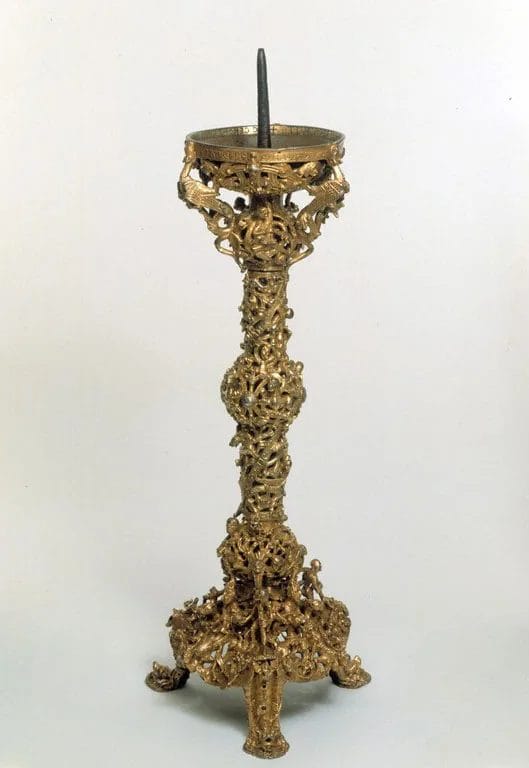
#2 Gloucester candlestick [GNU license] 
#1 Très Riches Heures du Duc de Berry [Public domain]