A Máquina do RPG has a warm-up campaign page on BackerKit for Silent Læke, a card-based roleplaying game that explores the intersection of Beautiful Darkness and Melancholic Horror. The project channels the eerie, dreamlike atmosphere of small-town mysteries where the truth is often less comfortable than the secrets themselves.
The game utilises unique narrative trackers to monitor character corrosion and tension, moving away from traditional investigative tropes to focus on the psychological weight of a town “wrapped in plastic.” We spoke with the creator to discuss how she approaches player agency, the physicality of the game as a found artefact, and why solving a mystery does not always mean finding closure.
The Vibe and Origins
When players leave the table after a session of Silent Læke, are you aiming for the satisfaction of solving a mystery, or something more lingering and uncomfortable?
Ideally, players leave the table with answers—but not with closure. Solving the mystery is important, but it is not the emotional endpoint. What I am more interested in is the quiet weight that remains afterwards: the feeling that something was uncovered, but not healed; understood, but not resolved. Silent Læke isn’t about restoring order. It’s about learning to sit with what was broken long before the murder happened and realising that truth doesn’t always bring comfort. In that sense, plot is irrelevant. Moments are everything.
The game leans heavily into emotional surrealism. How do you help players shift gears from standard investigative realism into that dreamlike, symbolic mindset?
I don’t ask players to abandon logic; I ask them to change what logic is for. Instead of asking “what happened?”, the game constantly asks “what does this mean to you?”. Scenes are framed emotionally first, causally second. The mechanics help with that shift: clues are not puzzle pieces to assemble, but emotional anchors. They don’t say “this proves X,” they say “this hurts,” “this comforts,” or “this refuses to stay buried.” Once players realise that the game rewards emotional honesty rather than procedural optimisation, the transition tends to happen naturally.
The Mechanics of Melancholy
Your list of triggers and items includes things like donuts, cherry pie, and even heroin. How might a simple donut help a character face grief within the game?
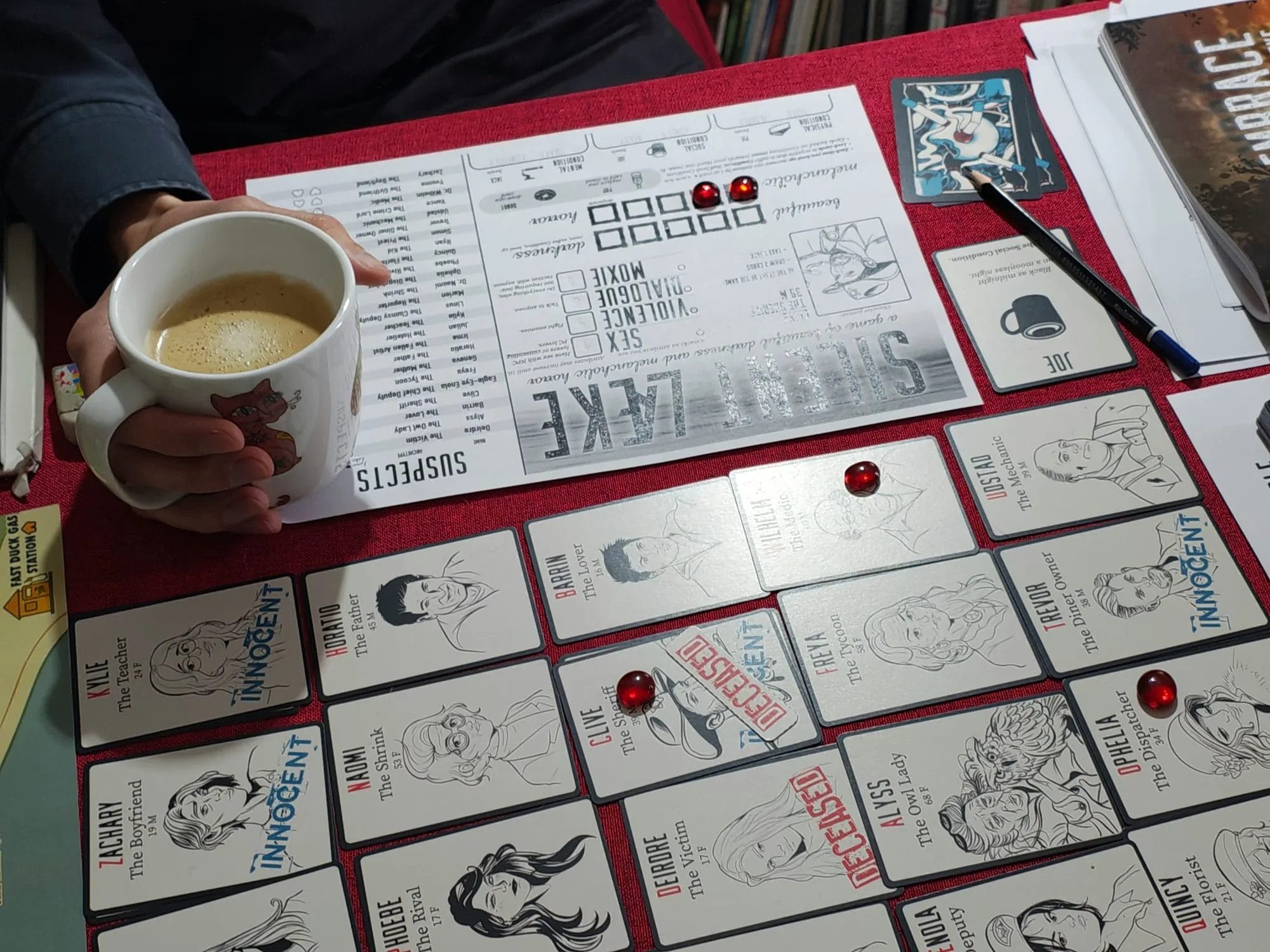
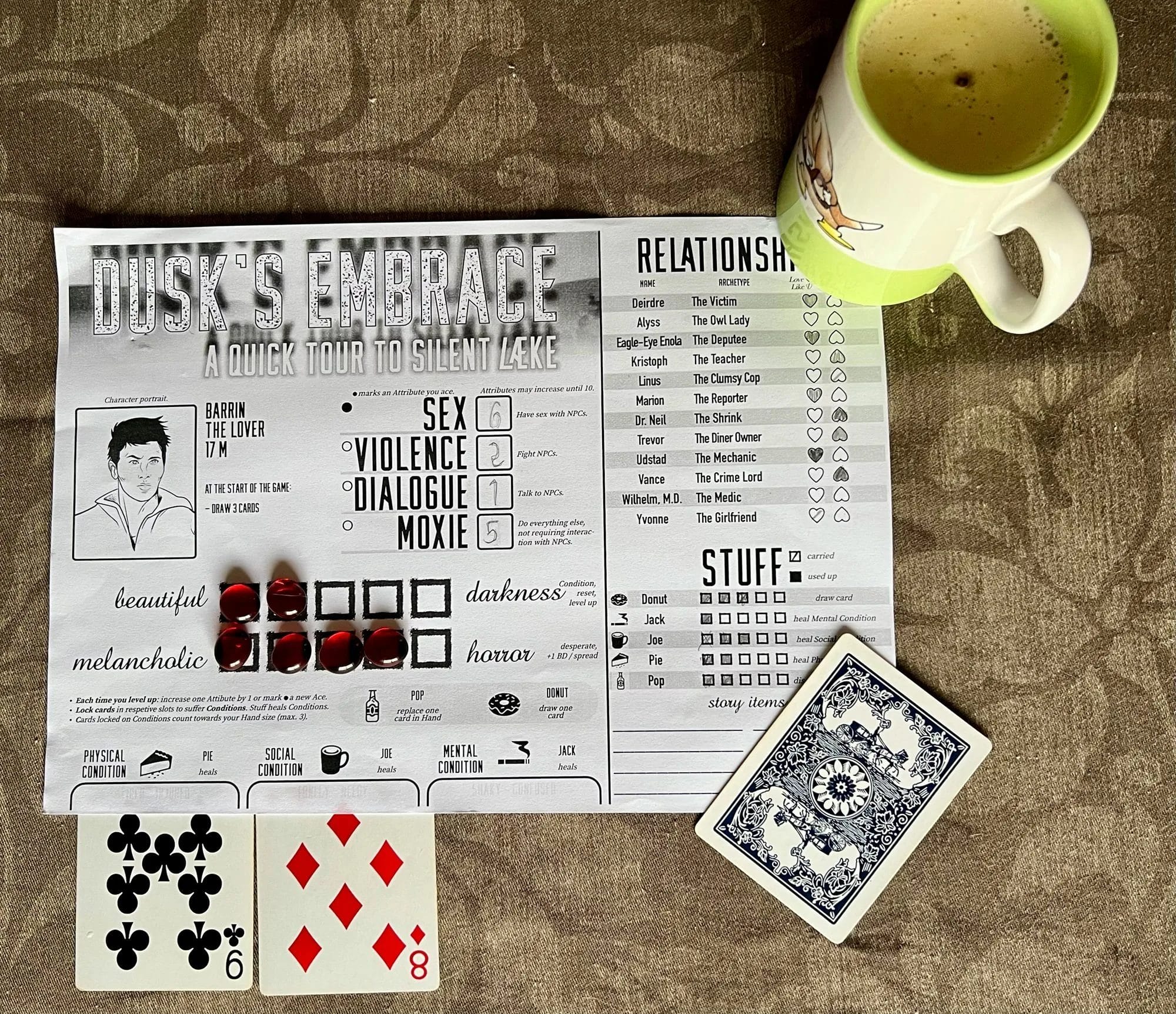
These items exist at the intersection of comfort and decay, which is where Silent Læke lives. A donut is not sustenance; it is a ritual. Mechanically, using a donut allows a player to draw a card from the Oracle, increasing the number of cards in her hand. That matters because cards in hand directly translate into narrative capability: more options, more leverage, more ways to act meaningfully within a scene, both fictionally and mechanically. Narratively, that extra card reframes the moment. It might introduce tenderness, denial, nostalgia, or quiet resistance—not as an answer, but as an opening. The donut doesn’t remove grief or tension; it gives the character more room to face it, shape it, or momentarily hold it at bay. The design philosophy is simple: objects don’t matter because they’re useful—they matter because of what we project onto them. In moments of grief or exhaustion, small comforts can feel disproportionately powerful, and the game treats them with that same emotional weight.
The Story Structure
The game spans different eras, specifically 1975 and 1992. Can players carry the ghosts of 1975 into 1992, or are they separate experiences?
They can, but not in the way prequels usually work. Although Miss Eagle Herself is set earlier, Silent Læke isn’t designed around chronological discovery. What matters is not when something happened, but when it is felt. You can play Miss Eagle Herself before the events of Silent Læke, but it’s often more surprising—and more painful—to experience it afterwards. That scenario is filled with echoes, references, and emotional callbacks to what players may already know from Silent Læke and Dusk’s Embrace. Played in that order, 1975 doesn’t explain 1992; it reopens it. Players who return to the material may enjoy replaying the scenarios in chronological order, precisely because they have strong replay value. But for a first encounter, discovering the past after the present tends to make its revelations sharper, heavier, and more tragically intimate.
With a random killer involved, how do you ensure the story remains a coherent tragedy rather than a “clue problem” where the pieces don’t fit?
Silent Læke is very open about what it is doing: it borrows the structure of games like Cluedo, Guess Who?, and even Blackjack, and then uses that structure as a pretext rather than a promise. The objective is clear—discover the killer within three days—but the game is not trying to simulate a rational investigation. In that sense, it is a false murder mystery. It asks for a degree of suspension of disbelief, and it’s comfortable doing so. The randomisation of the killer removes the burden of “making it all add up” from the Director. Instead of one person being responsible for coherence, the table is invited to do what humans naturally do: find patterns in chaos, build meaning retroactively, and create their own justifications. When it works—and it often does—the solution doesn’t feel mathematically correct, but emotionally inevitable. The truth emerges not because every clue points cleanly in one direction, but because the players collectively decide that this version of events is the one they can live with.
Production and Audience
Given the partnership with Games Omnivorous, was it important that the physical book felt like a found artefact?
Absolutely. The physicality of Silent Læke matters. I want the book to feel like something you found, not something you bought—an object that carries weight, texture, and restraint. Games Omnivorous understand that language perfectly. Their work treats roleplaying games as cultural artefacts, not commodities, and that alignment is crucial.
You’ve mentioned the game is “safe but not sanitised.” How do you balance the need for safety with the refusal to look away from dark themes?
Silent Læke deliberately avoids the term “safety tools,” because I don’t believe roleplaying games are inherently unsafe. If someone at the table feels genuinely at risk, that’s not something a game can or should resolve; that belongs outside the table. The Director is not a psychotherapist, and the table is not a healing circle. What the game does explicitly support is a respectful, supportive environment grounded in agency and mutual trust. This philosophy is built directly into the mechanics. Every possible scene in the game falls into one of four types: Sex, Violence, Dialogue, or Moxie. Crucially, it is the player—not the Director—who chooses which type of scene her character will have on her turn. That means a player can decide to engage only in dialogue scenes to avoid certain kinds of discomfort entirely, or to explore different forms of tension at her own pace. The game assumes that uncomfortable material exists, but it never forces players into it. Instead, it gives them control over which discomfort they are willing to approach. It does so by trusting them with clear choices and the freedom to step closer—or step back—whenever they need. Players always choose how close they want to stand to the fire.
The Solo Experience
How does the shift to solo play change the experience? Does it move from a mystery toward a confession?
The mystery doesn’t become secondary in solo play, but everything around it becomes more intimate. The crime remains the engine of the experience, but it functions more clearly as a MacGuffin: an invitation rather than a puzzle to be optimised. Without other players at the table, the descent into melancholy, obsession, and Beautiful Darkness becomes quieter, slower, and more personal. In solo play, Silent Læke leans even harder into mood and interiority. The investigation still matters, but it primarily exists to draw the player deeper into the town’s emotional gravity—into its silences, its repetitions, and its quiet, unsettling beauty. It’s also worth noting that solo play is currently envisioned as a stretch goal, not part of the core book. It’s something I would genuinely love to see unlocked by the backers—a way for the community to signal how much they want that solitary descent to become an official part of the project.
Starting the Descent
For those new to your work or this specific world, what is the best entry point?
Dusk’s Embrace takes place immediately before the events of Silent Læke, but it’s designed very deliberately not to spoil anything. Its role is not narrative revelation, but preparation. In Dusk’s Embrace, the game is structured in a more traditional way. The Director leads more actively, scenes are framed more clearly, and the experience is paced to introduce the unique mechanics gradually. Silent Læke itself is very different. Once players step into it, they are given full agency over their scenes: choosing where to go, what kind of scene to have, and how to engage with the town. The Director’s role shifts accordingly—less about driving the story, and more about managing spotlight and clarifying rules. There are also a handful of quiet easter eggs woven into Dusk’s Embrace—subtle references to Miss Eagle Herself that only reveal their full meaning once players have experienced both. My hope is that it attracts those willing to take that first step and then dare to descend into a game that is stranger, freer, and far more demanding, but also far more rewarding. If the water feels right there, then Silent Læke is waiting underneath.
Quick Links
- Find out more on BackerKit.
Independently covering horror since 2009. Our archive includes 412 entries connected to this topic.
Latest entry: March 2026


