Dark Wizard Games is the honouree of the October 2025 RPG Publisher Spotlight, and that feels appropriate for the month of Halloween.
I’ve an interview with Mark Taormino, who, despite being incredibly busy adding to Dark Wizard’s electronic bookshelf, made time for us.
We’ll find out about Dark Wizard Games’ clear, unapologetic mission: to bring back the “old-school brutality and funhouse chaos” of classic fantasy. Its “Maximum Mayhem Dungeons” line is a deliberate throwback to the golden age of gaming, promising challenge, irreverence, and a distinct lack of modern hand-holding.
Mark’s raised over $250,000 on Kickstarter for projects, but, as we’ll read, he struggles to reach 5e players, and Dark Wizard Games might focus on 1e.
An interview with Mark Taormino
To start, Dark Wizard Games has such a cool, evocative name that perfectly captures the classic fantasy vibe of your adventures. Is there a story behind how you chose it?
Yes, actually — Dark Wizard Games was the third and final official name for the business. When I first started making my first book, I only planned to do one, so I didn’t really have a solid grasp on whether it would be successful enough to justify forming a company. Those first Kickstarter copies went out under my original label, Freakshow Games.
After that first book did well and people started asking for more, I made a second and then a third book, Villains of the Undercity. By that point, I realized I didn’t want to keep using the Freakshow Games name. For a short time, I switched to Maximum Mayhem Dungeons, but that quickly became confusing since it was more of a product line than a company name.
So I decided to come up with a final name — Dark Wizard Games. I liked the sound and feel of it; it captured that classic old-school fantasy vibe I was going for, like something you might’ve seen on an old TSR logo. I told my friend Alan, who was doing my graphic design work at the time, to create a logo with a rustic wizard looking sideways and to maybe use something similar to the Dark Horse Comics font. The result looked fantastic — it had that perfect nostalgic, old-school feel. That’s when Dark Wizard Games was officially born.
Your adventures proudly fly the “Maximum Mayhem Dungeons” banner. What, to you, defines a “Maximum Mayhem” adventure? What can a gaming group expect when they sit down to play one of your modules?
The brand name Maximum Mayhem Dungeons™ was meant to capture the old-school brutality and funhouse chaos of classic first-edition D&D modules — the kind you used to see with the yellow stripes back in the day. My Maximum Mayhem Dungeons™ are designed to be fun, challenging, and full of that nostalgic feel: detailed blue maps, removable covers, and incredible fantasy art from some of the best artists in the business.
They’re packed with diabolical villains, irreverent characters, over-the-top monster encounters, outrageous magic, mischievous NPCs, traps, puzzles, and plenty of surprises — everything that made those classic adventures so memorable. When I chose such a bold name, I knew the modules had to live up to it. Around the early 2000s, I’d seen a few mainstream companies using similar phrases for their adventures, but I felt the content didn’t really deliver that promise. So I made sure mine did — and based on player feedback, they absolutely do.
I also wanted to bring back that raw, unapologetic energy of old-school Hackmaster-style modules — adventures that weren’t afraid to show intense, gritty, or even over-the-top violent moments in both story and artwork. Back in 2013, when I first started publishing, the industry was beginning to lean more toward a “safe” or politically correct tone. Maximum Mayhem Dungeons™ was my answer to that — a celebration of classic fantasy mayhem in all its wild, bloody, and entertaining glory.
We’ve heard you have an absolutely incredible 22 books planned for release this year by the end of 2025. That’s a Herculean effort for any publisher! Could you give us a little insight into your creative process and how you manage such a prolific output?
When I first started back in 2013, I could only work on my books part-time. I was a full-time computer programmer then, and Maximum Mayhem Dungeons™ was just a passion project on the side. Around 2015, I had to step away from that career to take care of an elderly parent full-time. During those years, I could only manage about one book per year—maybe two if I was lucky. That pace just wasn’t enough to make it a full-time income, but it kept the dream alive.
Things really started to shift around 2020, when I was able to release two or three books a year even while care giving. Then, after my mom passed in 2023, I decided to devote myself completely to Dark Wizard Games™ and go all in. That’s when I hit full throttle—producing four or five books a year at first, and then really ramping up production.
The big turning point was Village on the Borderlands, a massive 64-page adventure that did incredibly well about $33,000 raised from the KS. From there, I realized that to make this a sustainable, full-time business, I had to increase both my output and my visibility. It’s a niche market, and every Kickstarter has to hit hard, so building momentum through multiple releases became essential.
So yes—it’s wild, but I’m releasing 22 books by the end of 2025! When I first counted them all, I thought, “Wait… no way!” But sure enough, here they are:
Goblin Raid on the Winter Stockade (1E/5E) – One Book
Phantom of the Scarlet Heart (1E/5E) – Two Separate Book Editions
Sword of the Wyrm’s Bane (1E/5E) – Two Separate Book Editions
Vigilantes of Subway 9 (1E/5E) – One Book
Sinestra and Her Machina Spidera (1E/5E) – One Book
Minos and the Garden of the Forever Sun (1E/5E) – One Book
Osmo and His Orb of Wondrous Power (1E/5E) – One Book
Archedon the Warlord of Death (1E/5E) – One Book
Pirates of the Serpent’s Den (1E/5E) – Two Separate Book Editions
Temple of the Black Lotus (1E/5E) – Two Separate Book Editions
Forgotten City of the Spider Goddess (1E/5E) – Two Separate Book Editions
Hidden Shrine of the Warlord Chief (1E/5E) – Two Separate Book Editions
Land Beyond the Giants (1E/5E) – Two Separate Book Editions
101 Magical and Mystical Items (1E/5E) – Two Separate Book Editions
That’s twenty-two books—double editions (1E & 5E) for some, no less! Woo-hoo!
As for my creative process, I’m constantly writing down ideas. I keep a massive list of titles and concepts on my computer—right now, there are over 50 planned just for the Maximum Mayhem Dungeons™ line alone. On top of that, I’ve got about 25 more ideas for my post-apocalyptic series, Warriors of the Wastelands, and I’m also developing a new spy-themed series called Mission: Classified™.
Inspiration can come from anywhere—a movie, a piece of art, a line of dialogue, or even a random thought that hits me while I’m working. Sometimes it’s just one cool villain idea that snowballs into a whole adventure. I’ve always got more ideas than time, so I just keep writing, keep creating, and keep that mayhem rolling!
Your most popular title on DriveThruRPG is the fantastic Hidden Shrine of the Warlord Chief. In the author’s note, you touch on the idea of creating a satirical story that explores the tension between the classic, monstrous orc and more modern, peaceful portrayals. What draws you to explore these evolving tropes in fantasy gaming?
Great question! The Hidden Shrine of the Warlord Chief really started as a tongue-in-cheek response to a trend I saw in modern fantasy art and gaming. I remember seeing this picture—maybe a year or so ago—of the new “6th edition” orcs riding horses with falcons on their arms, looking like noble rangers. I just stared at it thinking, “WTF?” and started laughing. That moment instantly sparked the idea for a module that would pit those two visions of orcs against each other—the brutal, old-school, axe-swinging monsters of classic D&D versus the newer, more civilized, peaceful portrayals.
It was the perfect setup for my kind of humor and satire. I love taking modern fantasy tropes and running them through that Maximum Mayhem lens—over-the-top, irreverent, and a little bit self-aware. But beneath all the chaos and comedy, I try to write stories and villains that have real human emotions and motivations behind them. Whether it’s an orc chieftain trying to understand his identity in a changing world or a mad jester with a bruised ego, I want readers and players to feel something—sympathy, recognition, maybe even a bit of reflection. My villains often have relatable goals, fears, or dreams—they’re just twisted in wild fantasy ways. That connection is what makes them memorable.
A great example of that approach is Funhouse Dungeon of the Puppet Jester. On the surface, it’s a zany dungeon romp filled with weird traps, bawdy humor, and puppet antics—but underneath, it’s about a middle-aged wizard having a full-blown midlife crisis. He gives up adventuring to become a jester (his original childhood dream) and creates a puppet show that completely bombs—his humor offends everyone, and he gets run out of every town. One night, he’s performing the puppet show to himself by a campfire, when a bunch of goblins wander out of the woods, sit down, and absolutely love his act. Suddenly, he’s found his audience—and his new “career” as the goblin king of a deadly funhouse dungeon begins.
That story came from my fascination with real-life reinvention—how people sometimes change paths completely in midlife and discover new purpose in unexpected places. It’s also about how sometimes your “audience” isn’t who you thought it would be.
So while my adventures are full of traps, monsters, and mayhem, I always try to weave in those deeper, human themes—dreams, failures, redemption, love, and finding where you truly belong. That emotional undercurrent, mixed with the outrageous old-school fun, is what defines Maximum Mayhem Dungeons™ for me.
Many of your modules are available for both classic systems like 1E and modern ones like 5th Edition. What’s the philosophy behind supporting both of these distinct gaming audiences? Do you find one audience more challenging or rewarding to design for?
I started playing Dungeons & Dragons around 1980 with the Advanced D&D books and those classic yellow-stripe adventure modules, so that old-school style has always been my favorite. The look, the tone, the design—it’s the kind of game I grew up on and the reason I fell in love with tabletop gaming in the first place. So when I began publishing, creating for 1st Edition was a natural choice. It’s where my heart is. My modules have the benefit of hindsight. We know what modules from the old days were done maybe lacking certain things and now I can include those things in modern modules etc along with humor and ferocity.
That said, as a business, I also wanted to reach modern players—so I began producing 5th Edition conversions of my adventures. I wanted both classic fans and new players to be able to experience that Maximum Mayhem style of over-the-top, old-school fun. But honestly, I’ve found it a bit challenging to build a strong 5E audience compared to the die-hard 1E community. The old-school players are incredibly loyal and passionate—they love the nostalgia and the wild creativity of that era—whereas the 5E crowd tends to have a wider range of playstyles and expectations.
At some point, I may retire doing separate 5E versions altogether as I am struggling to reach that audience and just focus on 1E—or at least limit 5E support to special projects. Some of my newer lines, like the Special Edition Modules, Final Encounters™, and Warriors of the Wastelands™, already combine both 1E and 5E stats in a single book. That hybrid format lets me keep things unified and makes it easier for everyone to jump right in, no matter which system they prefer.
In the end, my philosophy is simple: celebrate the roots of classic fantasy gaming while keeping the door open for modern players who want to experience that same sense of danger, imagination, and mayhem that made the old days so great.
The art in your books has a wonderfully nostalgic, old-school feel that really complements the adventure design. How important is that specific aesthetic to the Dark Wizard Games brand, and how do you go about finding artists who can capture that spirit?
Yes, the artwork is extremely important to me. I’m very careful—and honestly, a little picky—about which artists I work with, because I want the art to be top quality and really capture that 1st Edition look and feel. The visuals are a huge part of what makes Dark Wizard Games™ stand out. That classic style—bold lines, expressive characters, and that slightly wild, hand-drawn energy—immediately takes players back to the golden age of fantasy gaming.
I’ve built a small circle of traditional artists I work with whenever possible. Their schedules can vary, so if one isn’t available when I need them, I’ll sometimes supplement with stock, clip, or digitally generated art to keep production moving while maintaining the right tone. The key for me is making sure every image feels like it belongs in that old-school world—nothing too polished or modern-looking.
I’ve also been really fortunate to have some of the original D&D artists contribute to my books—legends like Jeff Dee and Erol Otus. Having their work in my modules is a huge honor and a perfect connection to the roots of the hobby. That blend of classic and contemporary talent has really helped define the Dark Wizard Games™ aesthetic—it’s nostalgic, but still fresh and full of life.
You’ve run successful Kickstarters, like the one for “Double Mayhem Adventures.” How does that direct engagement with your community and backers influence your work and the projects you decide to tackle?
I’ve run about 28 successful Kickstarters so far, with the biggest one being Village on the Borderlands, which brought in around $33,000 on its own. If you add them all up, since 2013 I’ve raised over $250,000 across those campaigns—a number I’m really proud of.
Kickstarter is absolutely fundamental to how Dark Wizard Games™ operates. Without it, producing these books at the scale and quality I aim for would be nearly impossible. The platform doesn’t just fund the projects—it also acts as a huge marketing amplifier. It gets the word out far beyond what I could do on my own. Honestly, a Kickstarter campaign tends to make about double or triple what a direct book launch would bring in through my own store or website, simply because it reaches a wider, more engaged audience.
But the real value is in the community. Each Kickstarter becomes a kind of rallying point—a way for fans, collectors, and players to come together, show support, and get excited about what’s next. That energy absolutely fuels my creativity. Seeing the enthusiasm from backers, reading their comments, and watching the numbers climb—it motivates me to keep pushing forward and keep delivering bigger, wilder, and better adventures every time.
Looking at your extensive catalogue, is there one adventure or project that you’re especially proud of, one that you feel really encapsulates everything Dark Wizard Games is about?
That’s a tough question—because honestly, I’m proud of all of them! Each one has its own personality and story behind it. But there are definitely a few that stand out as milestones for me and really capture what Dark Wizard Games™ is all about.
One great example is Palace of the Dragon’s Princess. On the surface, it’s your classic “dragon kidnaps princess” setup—but with a twist. In this story, the princess develops Stockholm syndrome and doesn’t want to leave the dragon. That kind of unexpected, satirical angle is what I love to do. Another one I’m especially proud of is Legend of the Seven Golden Demons, which is my tongue-in-cheek take on gaming culture and the Satanic Panic of the 1980s. And of course, there’s Funhouse Dungeon of the Puppet Jester, which I mentioned earlier—a bizarre mix of humor, tragedy, and fantasy chaos.
But really, it all started with Hanging Coffins of the Vampire Queen, my very first module. That one set the tone for everything that came after. When I released it, I had no idea if it would be successful. I just wrote the kind of adventure I wanted to play—wild, irreverent, violent, funny, and full of larger-than-life villains. The feedback from players blew me away. People loved the writing, the humor, the grit, the boss villains—all of it. That became the template for what a Maximum Mayhem Dungeons™ adventure should be: a crazy mix of badass villains, funhouse-style encounters, satire, and over-the-top fun.
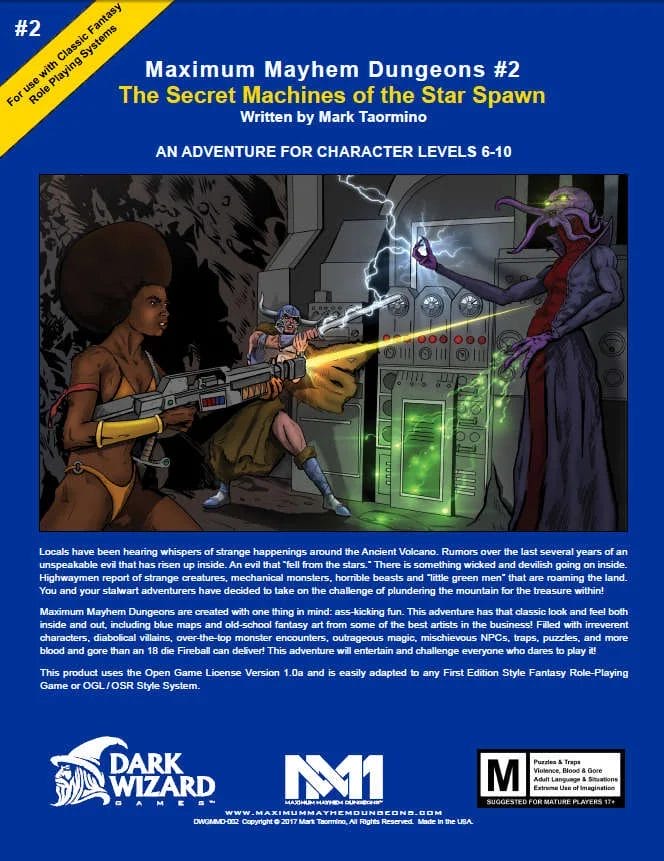
When backers started asking, “Hey, are you going to make another one?” I honestly wasn’t sure I had any ideas left—I thought I’d thrown the kitchen sink into that first book! But then I came up with The Secret Machines of the Star Spawn, an homage to Expedition to the Barrier Peaks. That one did even better. Then came Villains of the Undercity, and after that, the floodgates opened. I realized I’d never run out of ideas again—I just started writing them all down, and the list keeps growing to this day.
Every module has its own story behind the scenes. For example, the Forgotten City of the Spider Goddess was inspired by a real-life moment: I was at a U-Haul pickup and saw a giant green spider painted on one of the trucks. It turned out to be a real species called the “Happy Face Spider.” I thought, “Wow, that would make an incredible cover image—and a perfect boss monster!” From that, the entire adventure was born. I worked with artist Justin Davis, who created the stunning front cover art, and the rest of the story unfolded from there.
Another fun one was working with the legendary Erol Otus. He told me he’d do a cover for me and I told him he could draw whatever he wanted. I told him, “Go for it—I’ll write the story around whatever you come up with.” He painted this wild, green worm-like creature—and that became Fantastic Quest of the Whimsical One. I built the entire adventure from his artwork, exploring themes of two unexpected outcasts Huffenpuff the Wrym as the hero and Discordia as the Rock Elemental villain in a surreal fantasy world of slimes, oozes and deep earth creatures.
So, to answer your question—yeah, it’s hard to pick just one. But Hanging Coffins of the Vampire Queen will always be special because it was the beginning. It set the tone, established the humor and mayhem that define Dark Wizard Games™, and proved that there was an audience for this kind of unapologetically fun, wild, and creative fantasy gaming. And as they used to say—I’ll take the Pepsi Challenge with any big mainstream RPG company’s adventure module for sheer entertainment value and fun!
With so much happening this year, can you give our readers a sneak peek at what’s on the horizon? Are there any upcoming “Maximum Mayhem” adventures or new projects you’re particularly excited to break the news about?
Absolutely! 2026 is already shaping up to be another huge year. I’ve got several new modules in the works, including another collaboration with the legendary Erol Otus—the cover art for that one is already finished, and it looks incredible. That project will be launching as a Kickstarter next year, and I think fans of classic fantasy are really going to love it. It’s another module where I am writing the entire adventure around his awesome artwork that he made for this new book and all of our fans will love it.
Beyond that, I have multiple new Maximum Mayhem Dungeons™ adventures planned, along with a few more entries in my post-apocalyptic Warriors of the Wastelands™ series. Those have built up a strong following, but fantasy remains my biggest seller—and honestly, it’s the one I enjoy writing the most.
I’m also planning to debut the first spy-themed adventure in my Mission: Classified™ line. It’s inspired by vintage espionage and action films—think James Bond meets D&D—with wild missions, cool gadgets, and a touch of cinematic flair. That series will likely see one release per year, since it’s smaller and more story-driven.
And as a fun twist, I’ll also be releasing a brand-new Special Edition module with a science fiction meets Old West theme—featuring my Star Spawn (SEE: Secret Machines of the Star Spawn) character in a wild mash-up that blends cosmic horror, frontier gunslinging, and weird science. It’s like Boot Hill meets Expedition to the Barrier Peaks—a strange and exciting crossover that I think fans will really get a kick out of!
So yeah, 2026 is going to be packed with mayhem—fantasy, sci-fi, spies, and everything in between. The Dark Wizard Games™ train isn’t slowing down anytime soon!
Finally, when gamers see the Dark Wizard Games logo on a book, what’s the one thing you’d like them to know they’re getting? What do you hope Dark Wizard Games will be best known for?
Quality and fun—that’s really what it all comes down to. When you see the Dark Wizard Games™ logo, you know you’re getting something made with care, passion, and a love for the golden age of fantasy gaming. It’s not just about the stories and characters (though those are a huge part of it)—it’s also about the physical quality of the books themselves.
Every module is printed on thick 70lb white paper with rich black inks, gorgeous color covers on 100lb card stock, and a solid, old-school feel that’s built to last. I want these to be books you can use, collect, and treasure for years—just like the classic modules that inspired them.
What I hope is that when people look back, Dark Wizard Games™ will be remembered for delivering high-quality, exciting, and endlessly fun adventures—filled with memorable characters, wild creativity, and that signature Maximum Mayhem energy.
And for anyone new who wants to see what it’s all about, I offer free PDF copies of Hanging Coffins of the Vampire Queen, Palace of the Dragon’s Princess, and Funhouse Dungeon of the Puppet Jester to anyone who joins my email list. Those three will give you a perfect taste of what Dark Wizard Games™ is all about—mayhem, nostalgia, and pure old-school adventure fun.
Advertising Disclaimer: As an Amazon Associate I earn from qualifying purchases. Geek Native also earns money through DriveThruRPG and Skimlinks. Find out how.
Geek Stuff
EA’s $55B Saudi deal faces backlash over hum…
Tabletop & RPGs
Routinely Itemised: RPG #331
Accept cookies?
To provide the best experiences, we and our partners use technologies like cookies to store and/or access device information. Consenting to these technologies will allow us and our partners to process personal data such as browsing behavior or unique IDs on this site and show (non-) personalized ads. Not consenting or withdrawing consent, may adversely affect certain features and functions.
Click below to consent to the above or make granular choices. Your choices will be applied to this site only. You can change your settings at any time, including withdrawing your consent, by using the toggles on the Cookie Policy, or by clicking on the manage consent button at the bottom of the screen.
Functional
Always active
The technical storage or access is strictly necessary for the legitimate purpose of enabling the use of a specific service explicitly requested by the subscriber or user, or for the sole purpose of carrying out the transmission of a communication over an electronic communications network.
Preferences
The technical storage or access is necessary for the legitimate purpose of storing preferences that are not requested by the subscriber or user.
Statistics
The technical storage or access that is used exclusively for statistical purposes.The technical storage or access that is used exclusively for anonymous statistical purposes. Without a subpoena, voluntary compliance on the part of your Internet Service Provider, or additional records from a third party, information stored or retrieved for this purpose alone cannot usually be used to identify you.
Marketing
The technical storage or access is required to create user profiles to send advertising, or to track the user on a website or across several websites for similar marketing purposes.