Josh Fox, known for games like Lovecraftesque, is the designer of Black Armada’s latest game. Ex Tenebris is already through the pledge goal.
We’ve an interview with Josh coming up, but let’s first take a quick look at the Ex Tenebris pitch. We’ve until October 9th to join the campaign.
In Ex Tenebris, players assemble a motley crew of investigators to safeguard the Republic of Stars from the sanity-bending horrors that emerge from the Tenebrium, a nightmarish dimension just beyond the veil of space and dreams. PCs will confront sinister cults, reality-warping sorcerers, and the horrifying remnants of long-lost civilisations.
The setting, the Republic of Stars, is a sprawling gothic sci-fi universe. It’s a tapestry of towering hive cities, tranquil agriworlds, and remote asteroid mining colonies, populated by a myriad of alien species. All of this is ruled by the iron fist of the six noble Houses. Travel between these worlds is only possible via the Tenebrium, a dangerous, monster-infested labyrinth, navigated by colossal cathedral-like ships that fuse science and sorcery.
The game promises an expansive and dangerous galaxy to explore, filled with factions, intriguing characters, and mysterious locations ripe for adventure. Players can expect dozens of replayable, zero-prep mystery scenarios, as well as sprawling, campaign-length conspiracies. With 11 playable archetypes and 9 unique “shadow pathways” to choose from, you can craft your ideal investigator.
The Kickstarter is funding two hardcover books, each between 200 and 250 pages. The core book will provide everything you need to play, while the campaign book delves deeper into the setting, offering additional lore and scenarios to expand your cosmic horror investigations.
Ex Tenebris is a complete TTRPG containing all the rules, setting and scenarios that you need to embark on adventures amongst the stars.

The early birds are still live, but if you miss the chance, then the core rulebook in PDF unlocks at just a £10 tier.
At £20, backers get both books, core and campaign, in PDF.
The core rulebook in hardcover with the campaign book as a digital bonus is the reward at £40, while the £70 tier unlocks both.
For Black Armada fans, of which there are many, as the indie studio has a great record, there’s a slipcase set at £95 and even more impressive “Tomes of bronze slipcase set” at £150. We’re told:
A gorgeous slipcase set containing the collector’s editions of the core rulebook and campaign book – the same incredible Juan Ochoa cover illustrations, but embellished with foiling and spot UV, plus two marker ribbons – and the campaign map by Jog Brogzin. You also get an Ex Tenebris bookmark, an official Moira letter commissioning you as a Guardian, signed by the designer, and your name will be printed in both books. The PDF versions are also included.
An interview with Josh Fox
Josh is one half of Black Armada, and it was quite the treat to be able to run some Ex Tenebris questions by him so early in the crowdfunding campaign. I did miss the start, though!
For our readers who might be new to you, who are Black Armada Games? Is there a story behind the name?
Black Armada Games is Josh Fox and Becky Annison‘s indie design label. We’ve been publishing TTRPGs for about 15 years, and designing and playing a heck of a lot longer. We like to say that we create games that unleash your creativity, bring your favourite genres to life, and give you feelings in your heart. We’ve made a bunch of big-ish games like Lovecraftesque, Bite Marks and Last Fleet, plus dozens of little zine games. One of those zines, Wreck This Deck, a game where you craft and deface playing cards to summon and bind demons, got ideas above its station and is now our most popular game!
As for the name, it’s kind of silly – when we first decided to publish games together we sat down to brainstorm a name, and thought “<colour> <noun>” is a great formula. Plus we really like nautical themes!
Let’s dive right in. The game is described as “Gothic Space Investigation”. What does that blend of genres mean to you, and what sort of experience can players expect?
I love dark epic science fiction like Warhammer 40k, Aliens, Dune, Ninefox Gambit and the Locked Tomb books. And I adore supernatural investigation games where you uncover occult horror and the very ordinary base motives that always sit at the heart of it. Ex Tenebris channels those two passions into a unique setting where your characters walk the stars through an ancient alien labyrinth, uncovering mysteries and fighting indescribable horrors.
Investigation is the heart of the gameplay, with every character archetype having skills and abilities that will help them to gather clues and leads to track down the villains and monsters of the setting. But the game also has a set of narrative forward tactical rules to guide you through those action set pieces: boss fights, chases and the like. Most scenarios will end with a big confrontation and the game makes those really fun to play through. I’ve created a dedicated new system “Spawned from the Tenebrium” that brings those threads together.

The introduction mentions that while this is a dark future, it’s “not hopeless”. How do you balance the grim, gothic horror with that sense of hope for the Republic of Stars?
To me, a dark future is exciting- it’s full of horror and danger, with enemies pressing in from every side. Ex Tenebris has that feeling – you’ve got the supernatural horrors that dwell in the shadowy otherworld of the Tenebrium, ancient alien relics, ravening cults, and venal nobles and politicians who seek to use those dark forces to their advantage.
But I wanted a game where the players’ characters could feel heroic, and where it felt like they were protecting something that matters. That’s why the Republic Of Stars, the setting for the game, is a place where democracy, freedom and tolerance are revered and upheld. There’s plenty of cynical, villainous people who you’re going to bring to justice, but in the end it’s a place of hope, a place worth saving.
The art by Juan Ochoa in the quickstart is incredibly evocative. Could you tell us about the art direction for the game and what you were looking to capture visually?
I’ve worked closely with Juan to build an aesthetic that really works for this game. I have limited art direction skills so it has been a bit of a journey and Juan takes a lot of credit for helping me through it! The key touchstone was to combine occult horror with alien technology: sorcery and science as two sides of the same coin. So on the cover of the book, you see this weird monolith that looks like a Gigeresque (I love HR Giger) combination of biology and technology, with runes on it and a sorcerous portal opening from the tip.
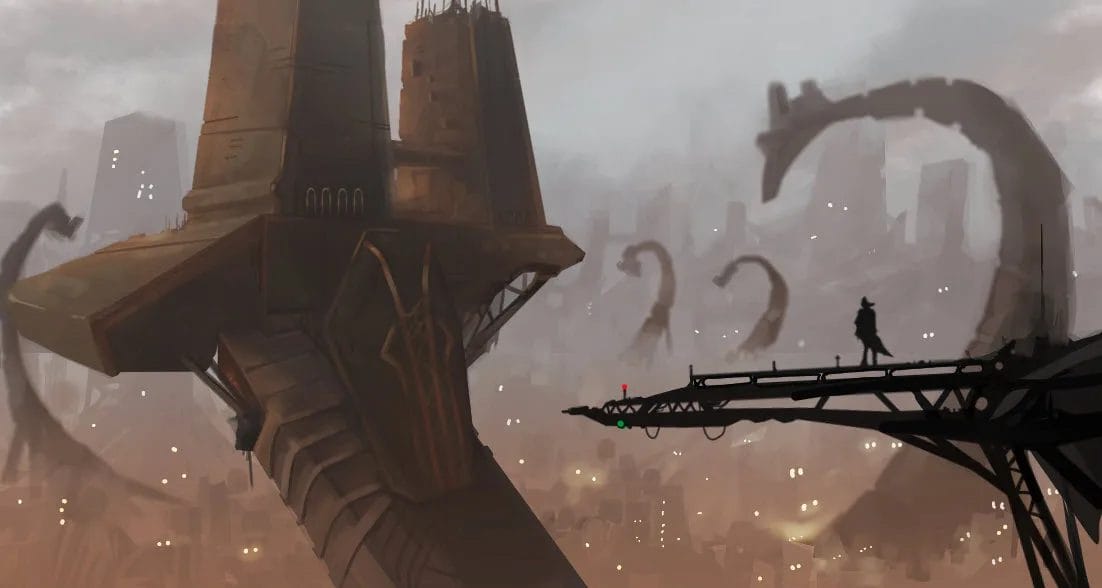
Then there’s the grandeur and vastness of the setting – Juan’s art has really captured that through cyclopean tombs, vast cities built around alien monuments, cathedral-like ships drifting through unnatural storms, and so on. He has also helped to craft a sense of the culture of the setting, blending a modern and archaic palette with little hints of supernatural stuff around the edges.
One of the most interesting parts of the system is how players build a “Theory” and the “Breakthrough Roll” determines if they’re right. Why did you opt for this emergent approach to mystery-solving rather than a pre-defined solution?
Emergent mystery has a bunch of really great benefits. There’s almost no prep required, because so much of what happens is improvised – albeit fuelled by the extensive material provided in the game’s scenarios. The GM gets to discover the mystery at the same time the players do, because the game’s mechanics mean that sometimes the GM’s ideas are king and sometimes they draw on the players’ Theory instead. And, each mystery scenario becomes replayable even when you have the same people at the table, because while the premise, themes and ingredients remain the same, the answers can be different.
Plus, being honest, I find crafting and running a pre-planned mystery quite stressful. As a working parent I don’t have much time in my life for that stuff, and I always worry I’ll forget some important detail and mess up the mystery. But you can’t mess up an emergent mystery. Even your “mistakes” can turn into interesting plot twists.

The “Shadow” track seems like a core part of the character experience, tempting players to push their luck for a greater reward. What kind of tough, dramatic choices have you seen this lead to in playtesting?
It’s a great mechanic, because it gives you the choice whether to be a more heroic character who tries to stay in the light, or charge down the path of darkness – or struggle between the two. When your shadow track fills up you choose a shadow advance and some of them are really juicy. In one scene, two people popped their shadow tracks but made very different choices. We had one who chose “the enemy reveals a new power” and suddenly levelled up the demon they were fighting. The other was playing the Relic, an ancient sentient war machine, who eventually activated one of their cool ancient devices to trap the demon inside their own body – and then took a Shadow advance that gave them a supernatural ability based on the fact they were now a demonic vessel.
Player characters are agents of Moira, an “underfunded and unloved” agency. Why did you decide to cast the players as interstellar rat-catchers rather than a powerful, well-resourced organisation?
It’s partly an aesthetic choice – I just like those underdog stories, and it also has a knock-on implication that the characters are all flawed diamonds, rejected by the mainstream, rather than perfect elite ninjas, which I like. But it has two other important effects. First, it removes the “we should just nuke it from orbit” option that you see, culminating in the idea of the Exterminatus from Warhammer 40k. Incredibly cool, but doesn’t really play well with the hopeful, heroic vision of Moira. Second, it creates a sense of risk and high stakes, because you have few resources and no backup. There’s nobody to turn to for direction or help, so what the players do really matters.
The list of inspirations – Aliens, Event Horizon, Dune, and Warhammer 40,000 – is fantastic. Could you talk a little about what specific elements you’ve drawn from those universes?
There’s so much I could say about this, so I’ll just pick out a few highlights. For Aliens, you’ve got the biological horror, and the way that the true heart of the story is the human evil of the corps, driven by greed. Every Ex Tenebris scenario has some kind of human sin or conflict at its core – it’s never just a gribbly beast (even though there is usually a gribbly beast). Dune gives us the Houses, which feel like a blend of noble lineage, corporate interest and nation – plus the aesthetic of those Houses was an inspiration for thinking about the ones in Ex Ten. Warhammer 40k has the warp, sorcery, and its inherently corrupting influence – ideas which I’ve blended with the river from the Locked Tomb books, and the strange entities of Earthsea, to create the Tenebrium.
Looking at the credits, you’ve assembled an amazing team of writers, including Kieron Gillen. How did that collaboration come about, and what did the different writers bring to the world of Ex Tenebris?
Hiring other writers is one of the great joys of crowdfunding a TTRPG, and it always brings different styles and perspectives to enrich the game. We take the view that if you don’t ask, you don’t get, so we always send cheeky emails to some of our heroes in the hopes that we get to work with them. They usually say yes!
We’ve got too many great writers to name them all but you mention Kieron – obviously a fantastic author and game designer, and he’s really grasped the political dimension of Ex Ten with a scenario concept that he describes as “the wicker man in space”. We were also amazed to find that Yoon Ha Lee said yes. Yoon wrote Ninefox Gambit, the first of a series of books which directly inspired some of the elements in Ex Tenebris. He’s bringing a quirky, off-beat perspective with a scenario about duelling fashion houses. Then we have Sarah Doom’s darkly poetic gothic vision of a space ossuary. I could go on!
The Kickstarter is launching this month for two hardcover books. What made you decide to release a Core Book and a separate Campaign Book from the start?
I wanted to create a game that was expansive, offering opportunities for long-term play. To make that happen, we’ve generated a rather astonishing amount of material for this game already, and we’re heading towards having dozens of scenarios, so a single book would have been quite the chonker. The core book provides plenty to chew on – everything you need to play a decent-length campaign of Ex Tenebris – but the campaign book expands the universe and provides lots more scenarios, including more campaign-length stuff.
What can you tell us about the Kickstarter campaign itself? Are there any exciting stretch goals or special pledge tiers you’re particularly looking forward to revealing?
This question is a bit late since we launched yesterday and funded today, plus we aren’t doing stretch goals (unless the campaign really explodes). Here’s an answer to a slightly different question:
I’m really excited about our slipcase set, which is possibly the fanciest product we’ve made (and that is saying something). The two books are brough together in a gorgeous foiled slipcase which showcases the occult/technological combination I mentioned earlier, designed by Nathan Paoletta. And they also come with a fantastic campaign map by Jog Brogzin. For those who want to get the complete package that’s the one to go for. But as always we’ve made sure there are some very affordable PDF tiers as well – and even if you only buy the core rulebook in print, you get the campaign book PDF thrown in.
And finally, the big question! With Ex Tenebris launching, what’s next on the horizon for Black Armada Games? Are there any other secret projects you can give us a hint about?
We always have a ton of projects at some stage of development, because we love creating games – it’s almost compulsive! Josh is toying with a world-building game that combines three previous publications we put out through our Patreon: a game where you create your own world with its own biosphere, build up a civilization in that world, and watch it develop and change over time. Becky is working on a game about a weird circus whose route and shows form the steps of a gigantic ritual, preventing a horrific demon from escaping and ravaging the world.
Thanks, Josh!
The campaign has already hit its funding target and is approaching 300 backers as I put this together. The PDFs have a September 2026 estimated delivery, but note that the physical books are scheduled for March 2027. That’s right, folks, we’re talking 2027 already.



