We were architects of our own worlds and masters of forgotten arts in Star Wars Galaxies. Two decades on, its player-built legacy feels more vital, and more heartbreakingly lost, than ever. And no, it’s not canon – but our stories sure as hell are real

It feels like a lifetime ago – maybe not the full three decades my memory sometimes fondly stretches it to, but certainly an aeon in the rapidly shifting landscape of online worlds. The early 2000s were a time of immense promise and excitement. This was a period when the prospect of living in a galaxy far, far away was not merely a marketing gimmick, but rather a tangible and intoxicating possibility for the first time. For those of us who immersed ourselves in Sony Online Entertainment’s Star Wars Galaxies: An Empire Divided, which first appeared on our CRT monitors in the summer of 2003, it felt more like a second life, embedded in the digital stardust of planets we had only imagined.
I often find myself sifting through those memories like a Jawa through discarded tech, piecing together the faded holocrons of a life lived. And two images burn brightest: the quiet satisfaction of laying the final plasteel beam of a new structure as an Architect, slowly coaxing a city from the barren earth; and the focused intensity of a Teras Kasi master, my hands, a blur of practised motion, being the only weapon I needed against the perils of the galaxy. These weren’t just classes I picked; they were identities I forged, skills I bled for, and communities I helped build.
The question always comes up, usually with a wistful sigh from someone else who was there: “Is any of that even canon anymore?” The short, brutal answer, since Disney’s great continuity reset of 2014, is… no. The archives of “Legends” hold our grand player-cities, our hard-won masteries, and the complex web that comprises our server’s unique history. Teras Kasi itself, the martial art I dedicated countless hours to, gets a nod in the new canon – a fleeting mention here, a character background there, like an echo from a beloved, dusty tome. But my city? How is my unique path to mastery defined? That’s folklore now. And yet, the legacy of what Star Wars Galaxies allowed us to become feels more potent and instructive than ever.
The Weight of Worlds on Our Shoulders: The Architect’s Burden and Joy
To understand what it meant to be an Architect in SWG is to understand the game’s radical heart. We weren’t just decorating prefabricated homes; we were urban planners, civil engineers, and the creators of civilisation. The game provided the planets – vast, often hostile, stunningly realised landscapes, from Tatooine’s twin-sunned deserts to Naboo’s verdant plains. But it was us, the players, who decided where the next hub of life would take root.
I remember the sheer audacity of it. Armed with schematics earned through painstaking practice and a hold full of resources meticulously gathered by (or bartered from) dedicated Surveyors and Bio-Engineers, we could choose a patch of wilderness and declare, “Here, a city shall rise.” It began with a single-player home, then perhaps a small cantina, a humble workshop. As an Architect, each structure I placed felt monumental. The process wasn’t as simple as clicking and dragging; it required a deep commitment. You’d travel to the location, survey the land, orient the building just so, and then, with a final expenditure of resources and effort, it would shimmer into existence.
My fondest memories are of the collaborative city-building projects. A Player Association, our guild, would pool resources. We’d elect a mayor (that was me as well, a bad one though). And then, the Architects like myself, would get to work. We’d lay down the city limits, zone residential and commercial districts (unofficially, of course, through communal agreement), and erect the vital infrastructure: guild halls that became our bustling HQs, merchant emporiums, advanced crafting stations, shuttleports that physically connected our burgeoning settlement to the galactic starlanes. There was a profound sense of ownership when we watched our collective vision become a tangible place on the server map — a place where actual people gathered, traded, roleplayed, and lived their virtual lives. These weren’t ghost towns; they were vibrant, often chaotic, hubs of player activity, each with a unique name and reputation whispered in cantinas across the galaxy. The digital air hummed with the sound of player-vendors hawking their wares and the thrum of industry.
We built that.
The Unseen Fist: The Quiet Dedication of a Teras Kasi Master
While some were drawn to the Force (a deliberately obscure and incredibly demanding path in SWG’s early days), and many more to the pragmatic allure of a blaster, my heart was set on a different kind of power: Teras Kasi. The Way of the Steel Hand. In a universe of laser swords and starship cannons, there was a purity, a quiet dignity, to mastering unarmed combat.
This wasn’t about flashy particle effects; it was about dedication. SWG’s original “skill-based” system, a glorious, sprawling web of interconnected abilities, allowed for such niche specialisations. To become a Teras Kasi Master meant forsaking other paths, pouring countless skill points and even more hours into honing specific strikes, defensive stances, and devastating special attacks. I remember the grind–sparring with fellow martial artists in hidden dojos we’d built ourselves, hunting krayt dragons with nothing but my resolve and the calluses on my virtual knuckles.
There was an understated respect for a Teras Kasi Master. We were the unexpected threat, capable of dismantling heavily armed opponents with a flurry of precisely aimed blows. In group hunts, we were often the resilient front line or the agile flanker (even though I usually preferred to go on my own.) In the rich roleplaying scene that thrived on many servers, a Teras Kasi expert could take on various roles, such as a serene bodyguard, a wandering ascetic, a pit fighter in some Hutt’s grimy arena, or even a performer whose movements resembled a deadly dance. The game provided the mechanics; we wove the narrative. My practice of this craft was a way to express my chosen identity, not just to fight better.
A Tapestry Woven by a Million Hands
What made these roles, and countless others – from the Master Armorsmith crafting bespoke protection to the Musician whose melodies could literally soothe the mind-wounds of weary adventurers – so compelling was their interdependence. SWG’s player-driven economy was its lifeblood. Architects needed starship components from Shipwrights to build advanced city structures. Teras Kasi artists sought out Chefs for stat-enhancing delicacies and Tailors for specialised robes. This wasn’t an auction house filled with loot drops; it was a living, breathing ecosystem where nearly every valuable item was crafted by another player and sold in a player-run shop, often in a player-built city.
This level of agency, this reliance on each other, forged a social fabric unlike anything I’ve experienced since. Reputation wasn’t a numerical stat; it was the quality of your goods, the reliability of your services, the strength of your word in a deal struck on a dusty street corner. We were, all of us, world-builders.
The Day the Galaxy Changed
Then came the upheavals. The “Combat Upgrade” (CU) was the first tremor, but it was the “New Game Enhancements” (NGE) in late 2005 that truly shattered the galaxy for many of us. In a bid to streamline gameplay and perhaps chase a broader audience (and align more with the release of Revenge of the Sith), the intricate skill-based system was largely dismantled. Iconic professions were erased or homogenised into more conventional MMO classes. The sandbox felt like it was being paved over for a theme park.
For those of us deeply invested in the unique niches – the Architects whose grand designs were suddenly less impactful, the Teras Kasi Masters whose specialised skill sets were folded into broader archetypes – it felt like a profound loss. The rules of the universe, which we had meticulously learnt and helped define, were rewritten overnight. Many walked away, their characters frozen in time, their cities slowly decaying into digital ruins. It was a harsh lesson in the ephemeral nature of virtual worlds, and a testament to how deeply we can connect with them.
Echoes in the Code, Scars on the Heart
Star Wars Galaxies officially powered down in December 2011. Yet, its spirit stubbornly refuses to fade. A constellation of dedicated fan-run emulator projects – SWGEmu meticulously rebuilds the pre-CU era, and SWG Legends continues a post-NGE version with its own dedicated community and additions – stands as a defiant monument to its enduring appeal. People continue to log in, build, fight, and live in various versions of the galaxy, regardless of the consequences.
Although its influence is sometimes subtle, it ripples through modern MMO design. When we talk about meaningful player housing, complex crafting that matters, or the dream of genuine player-driven economies, the ghost of SWG often looms large in the conversation – a benchmark, a cautionary tale, an impossible dream.
Our Canon, Our Truth
So, is my Teras Kasi Master, forever poised in a combat stance within the city I helped raise from the sands of Lok, canon? No. Will you find our player-forged metropolis on any official Lucasfilm star map? Unlikely.
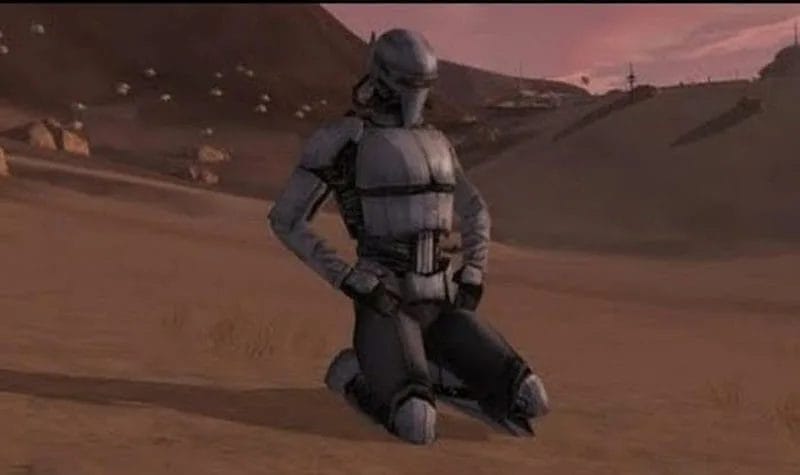
But here’s the truth that resonates deeper than any corporate decree: our experiences were real. The communities we built were genuine. The challenges we overcame, the skills we mastered, the stories we co-authored within that breathtakingly ambitious framework – those are an indelible part of our Star Wars saga. The joy of finally crafting that perfect piece of architecture, the thrill of landing a critical Teras Kasi blow, the camaraderie of a late-night planning session for a new city district – these aren’t just pixels and code; they are formative memories.
Perhaps the true legacy of Star Wars Galaxies isn’t just in its design documents or its influence on subsequent games. It’s in the way it empowered us, its players, to not just consume a beloved universe, but to actively shape it, to leave our own mark on its digital dust. We felt like gods. For those of us who were there, that is a truth more powerful than any official canon. Our names may have faded from the server rosters, but the echoes of the lives we built there still resonate, a testament to a time when the galaxy truly felt like it was… ours.



