Today, we’re delighted to have Michael Sayre, the founder and Director of Design at Infinite Re:Imagine, in the RPG Publisher Spotlight.
Michael is a name many will recognise from the world of Pathfinder roleplaying games. He was formerly the Director of Rules & Lore at Paizo and a prolific author, with his work gracing the covers of books like Guns & Gears, Treasure Vault, War of Immortals and Battlecry!.

About a year ago, Michael spearheaded the colossal effort to remaster Pathfinder Second Edition, guiding the game’s transition away from the Open Game Licence (OGL) and onto the new Open Roleplaying Content (ORC) licence.
However, after successfully leading that project and launching the updated system, a series of personal medical emergencies prompted a significant change in direction. Deciding it was the right time for a new chapter, Michael left Paizo to launch a new brand and game he’d long been discussing with his friends and fellow creators.
An Infinite Re:Imagine interview
At its core, Infinite Re:Imagine is a passion project born from a love for Japanese roleplaying games (JRPGs) and roguelikes. The team behind the game, including Michael, are fans of these genres. They saw an opportunity to take the fundamental design engine of Pathfinder Second Edition and adapt it to better suit the unique mechanics and gameplay loops found in their favourite video games.
Michael told us they were particularly inspired by elements from titles like Legend of Mana, Kingdom Hearts, and Baten Kaitos, along with the roguelike Emberlight. They felt these games had intriguing features that couldn’t be easily replicated using the traditional toolset of a classic fantasy tabletop roleplaying game.
This led them to a deliberate process of deconstruction. They began by taking the Pathfinder engine they knew so well and stripping it down, removing the parts that didn’t fit their vision. Then, they started building new architecture from the ground up, designed specifically to emulate the kind of gameplay loop seen in their inspirations. Even the name, Infinite Re:Imagine, is a direct nod to this process – it’s a play on the colon-separated titles common in JRPGs and reflects their goal of giving gamemasters the tools to create endless adventures for their players.
Michael Sayre on the TTRPG marketplace
I spoke to Michael just as he was coming back from Gen Con. You would expect a battle-hardened veteran of the industry to be there, would you!
I wanted to first dig into some business decisions. I thought we could all learn from them.
Your design diary mentions a decision to be “digital-first” due to fluctuating production costs. How has this approach changed your business strategy, and what has the reaction been from the community?
Right now, doing business in the US and particularly in publishing is… I’m going to say “turbulent”. Between fluctuating tariffs making it near-impossible to accurately assess what the cost of goods will be six months out, the collapse of major distribution networks like Diamond Comic Distributors, and the general disconnect between what people can afford to pay for luxury goods like gaming books vs. what it costs to make a profit on those goods, our early plans to crowdfund a print run have been put on a temporary hiatus in favor of digital distribution via PDF and ongoing work to create VTT support for Foundry and other gaming platforms. It’s early to say how people are reacting to that, but we’re seeing strong support and good sales, so at the minimum it seems like people are okay with not having a print product in hand, at least at this juncture.
The game is built to take characters from level 1 to 20 in about half a year. What was the thinking behind this fast-paced levelling system?
Coming from my position at Paizo, I’ve seen how longform adventures like their Adventure Paths (APs) tend to sell strongly at first, and then dip very sharply with each subsequent release, particularly in 4th, 5th, and 6th releases in their 6-part APs. I’ve also anecdotally noticed that it’s fairly rare for a group to finish an AP before social pressures (school, work, children, military deployment, etc.) force a group apart. I also worked in Paizo’s organized play line for a couple years and have a lot of experience with short-form adventures, and combining those insights and experiences with the idea of roguelite progression brought me, and eventually the rest of the team, to the conclusion that a “One Night, One Level” model would give players the best opportunity to experience everything the game has to offer with a single group, and experience an entire character arc in the length of time that most groups seem to be able to stick together for game nights.
We’re all excited about the upcoming adventure, “The Road Less Traveled.” What can you tell us about it without giving away any spoilers?
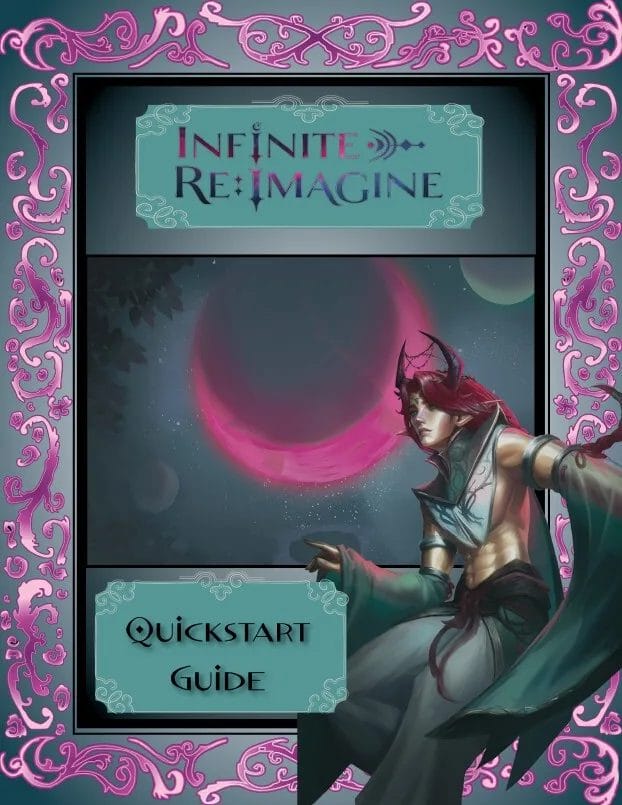
We just released it on our website, with DriveThruRPG and Amazon Kindle product pages in process! This is a 1st-level adventure designed to introduce Dreamers and delvers to our world and the structured play loop of the Infinite Re:Imagine TTRPG. It’s got shady snake-oil salesmen, our signature kobbolin antagonists, and a fight against a pretty nasty boss at the end! It’s really designed to take everything we talk about in the Quickstart Guide and put it into practice so people can get a good feel for what Infinite Re:Imagine really is as a tabletop roleplaying game.
Not doing D&D again

Michael Sayre has certainly seen first-hand how D&D has shaped the hobby. It felt to me that Infinite Re:Imagine was trying hard to go nowhere near the giant in the room.
Michael, you have a background working on Pathfinder, but a design diary mentions purposefully moving away from “D&Disms.” Could you give us an example of a core design decision in Infinite Re:Imagine that breaks from a traditional D&D philosophy?
So, one big thing right out of the gate is that we don’t have spell slots or anything resembling Vancian casting. Our signature “spellcaster”, the sage, has a variety of spellforms they can use at-will and modify with the Aspects that they learn to master.
We also don’t use 6 ability scores, AC, or the classic 3 saves (Fortitude, Reflex, Will). Instead, you have 4 ability modifiers: Body (which covers your strength and toughness), Speed (which covers your agility and manual dexterity), Intellect (your cleverness and ability to learn) and Lucidity (your general awareness and ability to influence the magic of the Dream). Your defenses are Physical Defense (PDEF) and Magical Defense (MDEF), and you have both a rolled modifier (for things like saving against a dragon’s breath attack) and a DC (for when an enemy is targeting you with e.g. a weapon attack.) These are made to be as intuitive as possible and make it easy for the Dreamer to come up with their own monsters and attacks; if it’s an attack from a weapon or a falling rock, use PDEF, and if it’s a fireball or blast from a wand, use MDEF!
In one of your blog posts, you mentioned that you have an inspirations board with SaGa Frontier, Shining Force, Chronicles of Amber, and other names on it. What is a piece of art or music from one of those sources that really captures the vibe of Infinite Re:Imagine?
The SaGa Frontier soundtrack is such a great example of the vibes we wanted to hit with this game. Kenji Ito’s music is so specific and evocative, and the art from the cover of the two twin wizards battling in a dreamscape is one of my favorite pieces of inspirational media. I played that entire album on repeat for a lot of the early IR:I design.
Connections, contacts and big news.
Can you imagine just how well-connected Infinite Re:Imagine and Michael Sayre must be? As always, I wanted to explore that and dig into future plans… we get a little from Michael, but no spoilers!
Your podcast has already featured Jason Bulmahn and discussed Pathfinder 2e. Are there any other people in the tabletop games community you’d like to work with or interview?
Tons! Notably, Owen KC Stephens is one of my favorite people and when his health and schedule allow, I’d love to have him on the show. Back in the day I used to love collecting people attending their first PaizoCon and bring them to whatever part of the hotel Owen was holding court in before prompting him to tell one of his many awesome stories from his time in gaming.
You mentioned on social media that you have some “big announcements” coming in September. What can you tease about what readers can expect?
So, right now the publicly available content for the Infinite Re:Imagine TTRPG consists of the Quickstart Guide (which has 4 classes, 4 ancestries, 4 professions and all the rules to run the game through 3rd level), a couple versions of the character sheet, the 1st-level adventure, and a bunch of merch showcasing the art of our signature artist, Raphael Ferreira Braga. Our goal is keep a steady release of new content including level expansions, new ancestries, new adventures, and VTT support flowing out to our customers, so September is going to be a big month for reveals on that front!
Thank you, Michael!
Infinite Re:Imagine
- Infinite Re:Imagine’s website.
- Infinite Re:Imagine on DriveThruRPG | Amazon.
- Infinite Re:Imagine on Facebook.