The Kickstarter for Liminal Artifact’s Dreadnought: War of the Heretic King is live, funded and describes the new TTRPG as a nobledark finale to the Exquisite Corpse series.
I was able to ask Alex and Nick some questions about the game, especially on this ‘final act’ versus plans for the future. First, though, let’s look at the Kickstarter project that runs until September 30th.
Dreadnought is a rules-light game built on the Apocalypse Engine, but with a unique and terrifying twist. One player takes on the mantle of the Dread Maker, a new type of game master who uses a unique Dread mechanic to build palpable tension and drive the story forward. This isn’t just a game about fighting monsters; it’s a story of endurance where your choices determine whether you overcome your ordeal or succumb to the creeping madness.
The entire system, from an ENNIE-nominated team, is designed to be simple, with no stats and all the core mechanics fitting on a single sheet. This puts the focus squarely on your characters and their unfolding story.
Dread is represented with a creeping die that starts as a d4 and grows as the players encounter increasingly dreadful horrors and events. Players make moves and take action by rolling the challenge dice – 2d8 – trying to roll higher than the dread die. “
Backers get a digital copy of Dreadnought: War of the Heretic King as a thank you for a pledge of $25 or more. However, at $35, there’s the “Hero” deal, which also adds Nolan Locke’s Exquisite Corpse and Inquisitor Kada’s Exquisite Corpse as digital downloads to the rewards.
The hardback for Dreadnought: War of the Heretic King unlocks at $45. The core rules, which are already out and free, are available via the Kickstarter page.
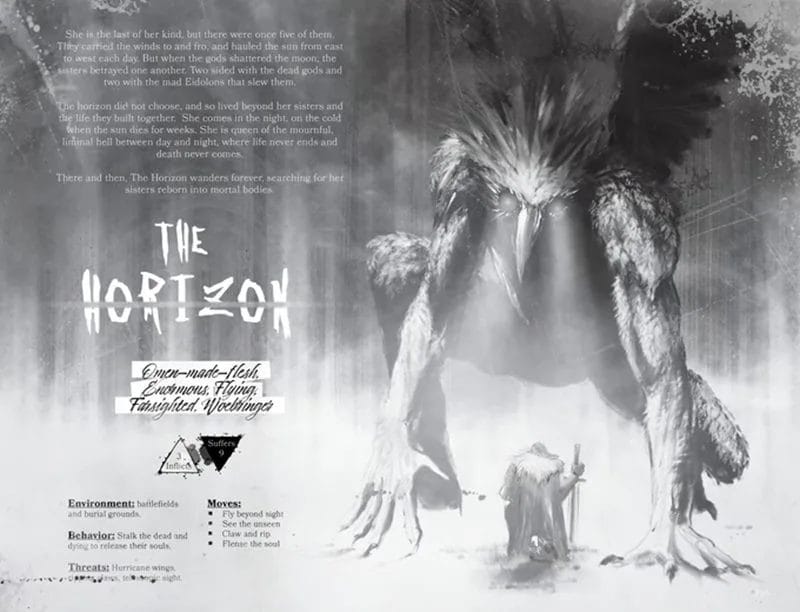
Liminal Artifact interview
You’ve described Dreadnought: War of the Heretic King as “the final act” and the “end and the death” of a series that began with Nolan Locke. Can you tell us more about what this means for the story and the characters, without giving away any spoilers?
When we wrote our first book (Nolan Locke’s Exquisite Corpse), finishing and funding a book was the whole plan. We were interested in this idea of storytelling where the narrator is unreliable and the world is grim. We weren’t looking to the next; we weren’t aware there even was an overarching narrative to consider. Our work leans into the improvisation of TTRPG story building, which inherently means it’s open-ended and prompt-based. Nolan Locke was just the first character we drew. Without knowing, he would become the central narrator for the work that was relatively formless at that time. By the time we finalized the draft of Nolan Locke’s Exquisite Corpse, we had already fallen victim to our own product; or rather, we had defined what we wanted to do, and we were already engaging with it organically. The book poses questions that players and game masters elaborate on to create and design their story. That’s the exquisite corpse of it all. We wrote 10,000 words of open-ended perspectives, goals, and pursuits for a series of characters in the story and depending on who you ask, the world changes from the bottom up. The follow-up — Inquisitor Kada’s Exquisite Corpse was handed to us by Nolan — Kada is the only unelaborated character in Nolan’s version of the world, which was an accident that became an entirely new vision of the world, and between the two things started to take shape. We were moving fast, and those books were published in the same year.
When Nolan was nominated for an ENNIE, Kada was already funded and was in production. We had the beginning of a thought that there would be three voices in the series — enter the Heretic King who is or is not also Nolan Locke, depending on the reader’s interaction with these two system-neutral narrative tools that only ask questions and offer various directions to explore. They require the reader to be an active participant, to coalesce into anything meaningful. So there we were holed up in a cabin outside Indianapolis, draining coffee mugs into the evening and trying to think that this thing that grew out of musing conversations between two dear friends was awesome but potentially rudderless. We started rolling dice and wireframed the bones for our unique system and named it Dreadnought.
We had a suite of narrative tools and a game the world had never seen. It’s worth noting that our audience was and still is relatively small… We were niche, and some loved it, others had no idea what to do with it. So we gave it away online as a veta and spent 2 years designing, refining, and testing all the while thinking “what about the Heretic King.” This is all a long way to say we just kept imagining and asking questions rather than answering them. Dreadnought doesn’t answer those questions but it does give players a way to really get in there and explore them the way we do and once you get in there it gets really exciting, dreadful, and frankly fun.
“End” is a hard word. In more ways than not, Dreadnought: War of the Heretic King complements the series by giving it legs to explore and a fully detailed, if not open to debate, world of interconnected stories to find yourself caught up in. Conflict is inevitable because wherever you started, whichever bit of lore grabbed you, the story has to be told in an inhospitable scene of heroic survival or Heretical betrayal.
The new book embeds the Dreadnought RPG system into the Exquisite Corpse Series. How does this new system enhance the storytelling and gameplay experience for players familiar with the previous books? What makes it a good fit for this particular setting?
Nick: I think we sort of got into that with the last question, but touching back on that initial tone of grim and dreadful, the system puts players firmly in that feeling. It drives home the anxiety (in-game only) of these stories we started and exaggerates the feeling of the books as a whole. In our experience, this game and its mechanics get everyone at the table engaged in contributing to their shared story.
Alex: We looked into a ton of games to learn what would work well and what wouldn’t for this. We cannibalized what we liked, cut what we didn’t need, and stitched it together with the one thing that unifies this whole saga: dread. The trick was to gamify that dread – to make it a driver for players and a grueling punishment for their characters. No one in this saga is righteous or safe. Some are more so than others, but everyone in this world of ours suffers the dread. In book one, it was the sea — book two, the desert. In this one — the final one — it’s the cold. That’s a mix of the two: an arctic desert surrounded by an infinite sea. What was indescribable cosmic horror — soul-deep fear — is now built into the game itself.
You mentioned you’re “creatures of habit” and decided against using a pledge manager for this campaign. Can you walk us through the decision-making process for fulfillment and why you chose to handle it this way for Dreadnought?
Nick: Love the question because the answers are going to reveal a lot about what exactly we (Liminal Artifact) is! It’s worth noting that Alex and I are the entirety of what we do… every word, every image, every layout draft, every order, every fulfilled shipment we touch (literally.) It’s a tremendous amount of personal touch for an indie duo trying to make a splash in the TTRPG space. A space that is extremely community-driven but has a lot of big players. It’s also worth mentioning that we are both designers in our own fields, meaning we have day jobs. I can only speak for myself, but I’ll say that while my job is extremely creative and fulfilling, I wouldn’t hesitate for a second to replace it with what we do here. Opening up a new method of fulfilment at our scale seemed like an incredible obstacle that could get in the way of delivering for our backers. Another peek behind the curtain is that we generally break even. This isn’t a financial endeavor for us so keeping the percentages we pay out allows us to get the job done and deliver quality products. I definitely thought out loud that if we stick to the “hard” way for fulfillment perhaps the world would call our bluff and deliver a funding success that made us regret passing on easy — a problem I’d love to have!
Alex: We make this stuff because we like it. I’ve said this to Nick before, but I’m making it anyway — I can’t help it. There’s a dozen half-baked ideas in my notebook right now. I’m glad to share and thrilled people want it. The break-evens and productizing is the least interesting thing about this for me. Nick’s got a head for it (he’s been helping me with math since 7th grade) but I know we both do this because we genuinely like making this stuff. It’s a challenge. It’s fun. It brings us together and brings strangers together.
You’ve been designing and publishing for a few years now. What’s the biggest lesson you’ve learned since you started with that first book, and how has that influenced the development of Dreadnought?
Nick: Biggest lesson is do it because you love it and you want to share it. More than anything else it’s the folks who love our work that keep us devoting countless hours to making for and sharing with them.
Looking back at the entire series, what would you like players to remember most about the world you’ve created and the stories you’ve told? Remember that; in game, we want you in the liminal space between what is true and what you know. You’re not reading a story, you’re making one.
Alex: The biggest lesson: be ready for people to like your work. Much of this started with drawings I was too ashamed to share and an overstuffed vocabulary left over from grad school. Never in a million years did I think folks from all over the world would like this — would interrogate it, and challenge me on it. We accidentally made something people cherish. That’s a responsibility I take seriously — it wasn’t looked for, but I am proud to have it. Folks’ money is on the line, their interest, but also their trust in us. That’s vital to me.
Now that this series is concluding, what’s next for Liminal Artifact? Are there any new projects or ideas you’re excited to explore in the future?
Nick: Oh most certainly… We may come back and add more to this series but it is likely to be smaller zine type accounts from the bench of characters in the world. The bones of Dreadnought will carry through from a storytelling lense but we’ve already begun adapting and rehashing them into something new… something mysterious…
Alex: Yeah — I can’t help myself. We’ll make more stuff. We’re doing it already. We’ve had the conversation before: do we make Dreadnought or do we make games? I think the answer is both. Right now, we’re ready to stretch into something new and different to challenge ourselves. This game really belongs to everyone else now. If folks want to join in the making of it, please do. And tell me — I want to see it.
Thanks, Alex and Nick!
The estimated delivery for the campaign is January 2026.
Quick Links
- Kickstarter: Dreadnought: War of the Heretic King
- Dreadnought core rules: WeTransfer.



