Jason Bulmahn is the creator of Pathfinder, he’s the Director of Game Design at Paizo but he’s also the founder at Minotaur Games and it’s the latter which has brought Hellfinder to BackerKit.
Hellfinder is a modern hack of Pathfinder 2e, adding Stress, Trauma and contemporary gear. Let’s first watch the pitch for the game and then get to our Q&A with Jason.
Welcome, Agent. Are you ready to confront the darkness that lurks just beneath the surface of our world? Welcome to Hellfinder, a new roleplaying game built upon the core rules engine of Pathfinder 2nd Edition.
While Hellfinder keeps the tactical heart of the game – including proficiencies, the three-action system, and criticals – it plunges characters into a world of modern horror. The game introduces a new way to create characters, a gritty system of Stress and Trauma to heighten the danger, and a full armoury of modern feats, gear, and tools to help PCs survive.
But Hellfinder is more than just rules. It’s a complete campaign experience. The story unfolds through three sealed packets, each one revealing more of the world’s secrets and additional rules for play as you delve deeper into the mystery.
Jason Bulmahn on Hellfinder
Jason, you are synonymous with the high fantasy world of Pathfinder. What was the creative spark that ignited a modern horror project like Hellfinder and lured you into the Bureau’s basement?
My first passion was fantasy, it’s a genre that is warm and familiar, but there is just something exciting about a good horror game. The tension, the atmosphere, the entire vibe at the table is entirely different and when you have a group that buys into the concept, it can be truly terrific. For me, that started with Call of Cthulhu and Chill back in the 90s, but these days I can’t wait to get in another game of Dread or Mothership. When I started dreaming up Hellfinder, I wanted to try and take the game to a darker place. It’s not my first stab at turning Pathfinder into another genre. A few years back I did a game called Hopefinder, which shifted the game into a near future zombie apocalypse. While that game focuses more on survival and has a more hopeful outlook, Hellfinder is about plunging into darkness, being consumed by the nightmares that lurk just beneath the surface. Hellfinder is about willingly stepping into the shadows, in hopes that you might just be able to put an end to it once and for all.
This game has a lot of inspirations for me beyond horror games. The X-Files played a big part in my vision for this game, as did a show called Slow Horses, which is all about misfits trying to get by in a basement agency. The horror elements come from the Hellraiser films, Alien, Event Horizon, The Hidden, and Fallen.
Hellfinder is coming from your own Minotaur Games rather than through Paizo. What does working on an independent project like this allow you to do, creatively or mechanically, that might be different from working within a larger, established brand?
Minotaur Games is my playground, where I can turn an idea into a game in a very short period of time and with the freedom to make sure it comes out the way that I want it to. Make no mistake, I have a lot of flexibility at Paizo to bring my ideas to life, but its a team effort and that means working together to compromise on solutions that work for all the various stakeholders. It’s rewarding work, but it’s not the same as being able to call all the shots. That said, it’s also a lot more risky. Despite my experience and name, it can still be a big struggle to get traction in a crowded RPG market. Hellfinder is doing well by my independent standards, but it’s not the same scale as my work on Pathfinder.
The ‘sealed packet’ approach is a fantastic hook, revealing rules and story as the campaign progresses. What inspired this legacy-style design, and what unique challenges does it present for you as a designer or for the Game Operators running it?
Legacy games were actually a big inspiration for me when it came to the design of Hellfinder. I really enjoy not knowing where the story is going to go and truly being surprised by the direction it might take. At first, I thought about just keeping secrets from the players, waiting until the time is right to introduce new rules and concepts to them, but then I realized that I could keep some info from the GMs as well, to make it a journey of discovery for them as well. Of course, the hard part is how do you properly run a game without spoiling it or invalidating later parts. I have a work around for that built into the narrative based primarily around the locations you explore. Some are just unknown to you (and the GM) at the start. Others change over time. The end result is a dynamic world and story that evolves as you explore it. And the rules evolve too…
As the designer, the hardest part is just making sure I am providing everyone with everything they need to play, from rules, to insight to the content, to the right story beats, all without spoiling what is to come in that next packet. I have to lay a lot of groundwork, all without giving too much indication as to where things are heading and why any of this is happening. At least, not until you are ready to know the truth.
You’re hacking your own creation, Pathfinder Second Edition, for this project. What is it about the PF2E engine that you felt made it a surprisingly great foundation for a modern horror game, a genre it wasn’t initially built for?
I get this question a lot. It’s true, the Pathfinder 2E engine is built for high fantasy, but much of that comes from the character power scaling and how it directly relates to the monster and treasure design rules. But beneath that is a very tidy game engine with a simple proficiency system, an elegant combat engine, and a robust action resolution mechanic that has degrees of success built into the core of the game. So.. if you change the character advancement system and present entirely new monsters based on that system, you can fundamentally alter the pace and feel of the game.
So, for Hellfinder, Agents (the name for characters) are made in a more free form point buy system (as opposed to being tied to a class) and advancement is done only at the right points in the narrative. Agents are far more fragile, with fewer hit points and a Stress system to indicate their mental fatigue. On top of that is a system of Traumas, both physical and mental, that eventually slow down your Agent and make things very difficult for them. With a narrative that is more focused on investigation and exploration, fights are less common but far more memorable. Each one feels life or death.
The BackerKit page is very clear about the intense horror themes and the importance of safety tools. How do you approach designing a game that is genuinely unsettling and full of dread, while also ensuring groups can tailor the experience and play responsibly?
I grappled with this quite a bit early one, because I knew I wanted to reach into some topics that, quite frankly, I find rather unsettling. I knew that if Hellfinder was going to go with sealed packets, and some of that content was only revealed later, I had to give players a heads-up right away that this content could be lurking somewhere later in the game. Nobody wants to be surprised by some content that they find personally challenging and I want folks who play my games to be comfortable and having a good time.. even if that good time is dealing with a twisted and deformed monster that used to be a former colleague.
Looking beyond this initial three-packet campaign, do you envision Hellfinder as a single, contained story, or is this the first step into a larger world for Minotaur Games? Are there already whispers in the C.L.E.A.N. department of future cases for Agents to investigate?
The three packets are the introductory campaign for Hellfinder. The final packet includes guidelines and tips for making further stories set in this world, dealing with the shadowy organizations behind it all, and perhaps even forming something greater to push back at the nightmares that lurk unseen in our world. As for Minotaur Games, that all depends really on how well this campaign turns out. At the very least, if we hit the $50k stretch goal, I am going on a strange road trip, across the US to visit some of the real world sites that are important to the overall story. That alone should inspire several more adventures set in Hellfinder.
Thank you, Jason.
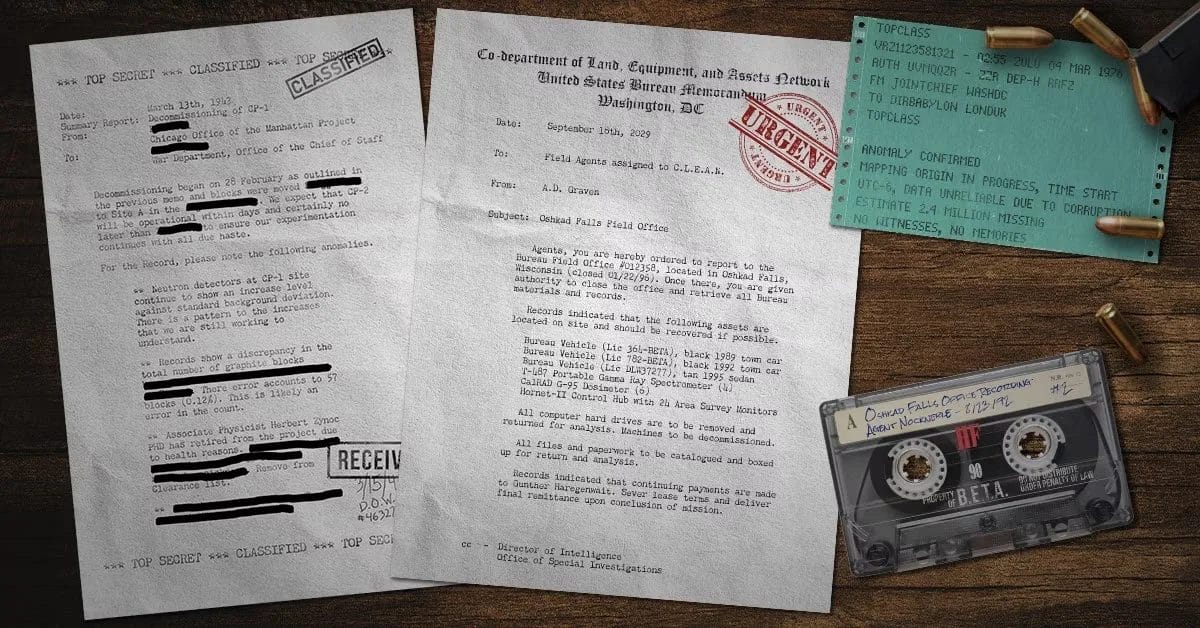
Hellfinder runs until August 20th on BackerKit, and at the time of writing, we’re halfway there to sending Jason on that road trip.
Backers can buy into the add-on store with a $1 pledge, but the whole of Hellfinder in PDF, including digital packets, unlocks at $25.
The print edition of the game, which includes the hole-punched and shrink-wrapped packets, unlocks at $50. Backers who want both physical and digital can pledge $60.
There are higher tiers, and the $110 pledge is popular. At this level, there’s also a ring binder, a pad of Agent sheets, folders and stickers.
Minotaur Games also has a $600 level, which includes a game session with Jason.
Quick Links
- BackerKit: Hellfinder