You are here: Home/Games/Tabletop & RPGs/ An interview with Justin Achilli: The return of “Our Brilliant Ruin” the Downton Abbey meets Arkham Horror TTRPG
An interview with Justin Achilli: The return of “Our Brilliant Ruin” the Downton Abbey meets Arkham Horror TTRPG
I try to save money these years, but last year Studio Hermitage broke through my defences and I found myself moving money through Kickstarter again.
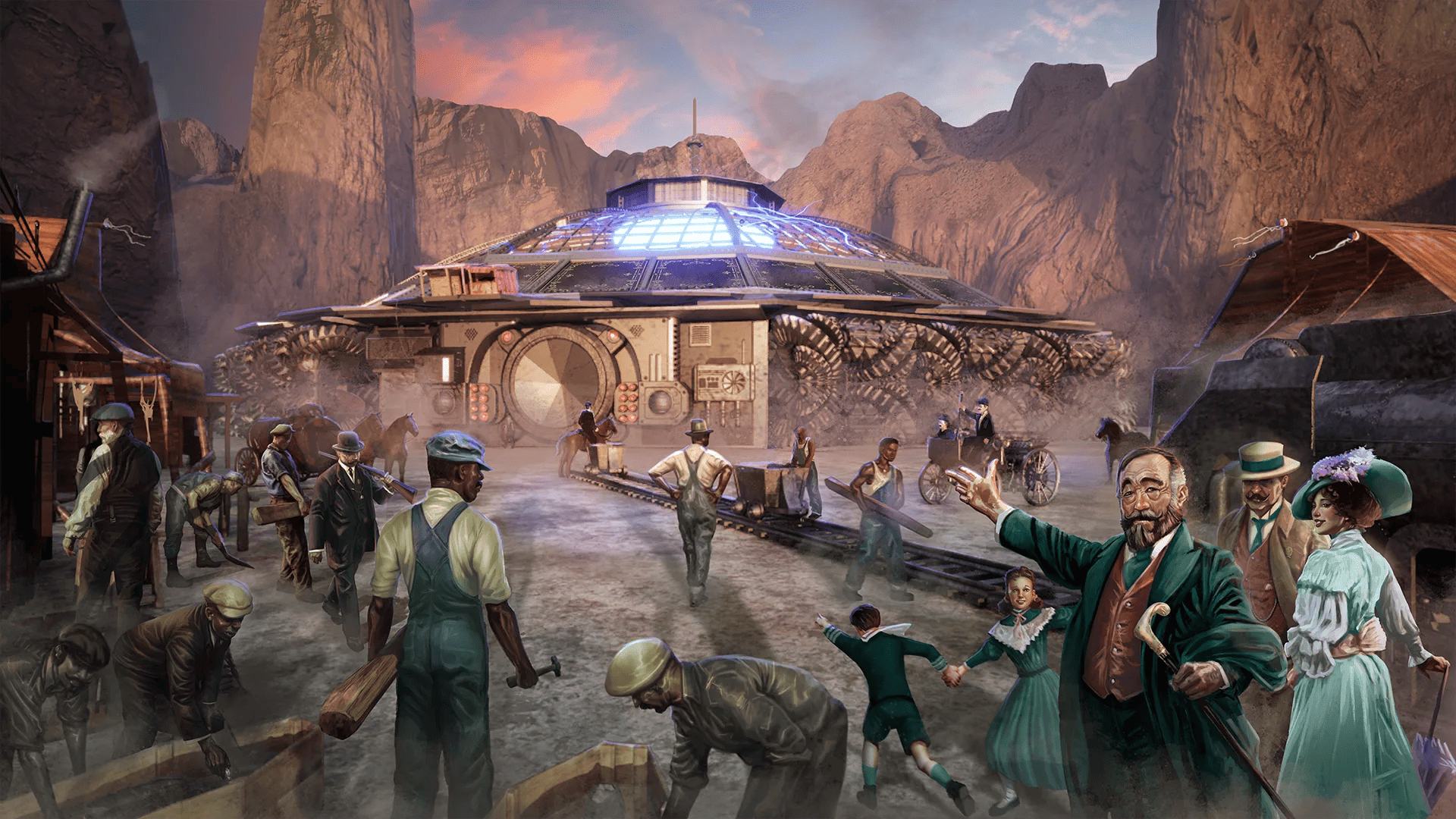
The game in question was Our Brilliant Ruin, a tabletop roleplaying game described as Downton Abbey meets Arkham Horror.
Now, and in Starter Set form, Our Brilliant Ruin is coming back to Kickstarter. It’s a starting point for new players and for those already familiar with the game, the set offers a new venture in Dramark.
Geek Native has fantastic art from the TTRPG to show and an interview with Justin Achilli, Chief Creative Officer & Co-Founder at Studio Hermitage, who has been generous with his time!
An interview with Justin Achilli
Welcome, and thanks for chatting with us! First off, for our readers who might be new to your work, who is Studio Hermitage? We love the name – is there a story behind it?
Studio Hermitage is a project set up by a group of us who have worked together at a variety of places over the years, who want to develop a whole host of entertainment that takes advantage of our backgrounds in digital, tabletop, print, and other forms of entertainment. We’ve worked together in places like Red Storm Entertainment, Funcom, Paradox/ White Wolf, and some of the team have even gone to school together.
The name specifically reflects that we’re an all-remote studio. There’s no office space (and no office space rent!). Everyone gets to make their own workspace where they’re most creative, their own Hermitage.
You’ve assembled an incredible team of industry veterans like Justin Achilli, Rachel J. Wilkinson, and Pam Punzalan. How did this creative supergroup come together to build Our Brilliant Ruin?
When we started staffing up, I had recently talked to Rachel about one of the projects she had done for Vampire (her VTM: Port Saga audio drama), and I knew that with her audio production skills and TTRPG background, we could make multiple different stories in different formats, which is part of our transmedia mission.
I had also worked with Pam during my most recent time on World of Darkness with Paradox and I appreciated the creativity she brought to our projects there (Werewolf and Hunter), so of course I wanted to work with her again.
The concept of Our Brilliant Ruin has been described as “Downton Abbey meets Arkham Horror.” For someone hearing about the game for the first time, could you expand on that fantastic pitch? What makes this world unique?
I had been wanting to do a game with this premise for years, and starting the studio was a chance to make that happen, so I jumped at it.
OBR takes the base of Downton Abbey (fancy estates, lavish Edwardian aesthetics, a sense of the world about to change irreversibly) and leans into those. We push the social conflict more to the foreground, with built-in class struggle among the aristocrats (who own everything but largely squander their responsibility), the truefolk (who keep the world running but often trade comfort for a more just society), and the unbonded (who operate outside the prevailing social order and want to change things, but often ignore the risks of the changes they favor). Each of those factions is playable, and there are also sub-factions like aristocratic families and truefolk guilds that build on the same sort of social structures that the clans, tribes, traditions, etc. that I emphasized in my time with WoD. Players love having in-setting groups they can share values with.
And then, beyond that, to give us another axis of tension, and a common enemy that the human groups can agree (if only for a short while…) to oppose, the Ruin is the external threat. Humanity had a chance to do something about the Ruin, but the Royals and aristocrats with all the resources didn’t take the opportunity and now everyone has to live with the horrors it brings daily (metaphor alert). Ruin can be everything from a pit of darkness in the workshop cellar, befouling everything it touches and slowly growing, or it can be a ravening vampire in the crumbling castle at the edge of the territory. And if your characters are exposed to too much Ruin, they might become the next session’s antagonist…
So when we talk about the key themes and what makes OBR unique, it’s that idea of rust and Ruin with its patina over everything, the intrigue and excess of a society in its end times, and the fact that still, despite it all, it’s cool to look cool. Dress to impress at the party at the end of the world!
About Our Brilliant Ruin and the system
The game is (now) set in the Dramark, a society unravelling under the light of a dead star. It seems to be built on a foundation of class struggle between the aristocrats, truefolk, and unbonded. How does this social tension drive the game forward for the players?
I like to think of it as an ensemble social dynamic. Each of the factions has systemic advantages that let them shine in certain situations, but also social roles that put them in conflict with one another. In general, we assume that a group of players has a common goal for a given story, but different objectives and agendas that exert pressure on how they might achieve it or what happens in the aftermath.
At the end of the day, though, society is what it is, and how the characters follow society’s rules or deviate from them is their decision to make. If your butler literally saved your life, do you continue to treat them as a butler? And what if an overbearing duke berates the butler and expects you to join in with him? Appeasing the duke may have material advantage, but you see the butler every day and they may expect more respect in that relationship.
That’s also part of why there are three factions, and not just servants versus aristocrats. With three factions at play, there’s always an alliance to be forged with one of the other factions against the third… but that’s true for the other factions as well.
For example, one scenario I often run for one-shots has the group of characters assembled at a seasonal fun-fair at an estate that someone’s going to inherit. Two or more of the player characters are among the possible inheritors, so there’s an inherent sense of “It should be my character,” but ultimately, it’s better for the characters to cooperate and keep it out of the hands of the NPC with, um, let’s say more sinister motivations.
Many of the game systems also reward cooperation and collaboration. For example, even though, setting-wise, one character may “own” a given estate, the community property rules assume that everyone in the group has decision-making ability in its progression, so the group grows the estate together toward goals it mutually decides to pursue.
And then you’ve got the external antagonist force of the Ruin complicating everything on top of the social dynamics!
Let’s talk about the system. You’ve created an original d6 dice pool system where only the players roll dice. What was the design philosophy behind that choice, and how do you feel it impacts the storytelling at the table?
In building the system, we wanted 100 percent of the volatility to be on the players, particularly their emotional states and decision-making. When you look at some of the inspirational material, like Downton Abbey and Jane Austen’s period dramas and much Gothic fiction, you find characters acting in torrid throes of emotion – which makes for awesome conflict at a game table, and, often, a lot of consequences that inspire further storytelling. So that’s behind the core resolution mechanic as well as the Passion system, which encourages you to get a bonus now at risk of calamity later.
The gamemaster doesn’t roll dice, though, to help control some of that volatility. A monstrous threat or implacable social superior is always a monstrous threat or implacable social superior. No accidental “Oh, the vampire rolled a one and goes tumbling headfirst down the staircase like a grade-A dope.” Antagonists and other NPCs have consistent, dramatic abilities, and the “swinginess” is in how the players deal with them.
Character creation involves evocative Personality attributes like ‘Decorum’, ‘Audacity’, and ‘Obsession’. How do these emotional drivers mechanically influence how a character interacts with the world?
In systems that use more potential-describing attributes like Strength, Dexterity, Intelligence, etc., you see those characters come to be known as strong, nimble, smart, etc. We wanted that same sort of thing, but with the personality aspects of the characters more than their “capacity.” For example, in Downton Abbey, you don’t care if Thomas is stronger than Alfred, but you know Thomas is more selfish and Alfred is more dutiful.
With that in mind, we built the system to allow for flexible solutions to challenges, and the more you rely on certain attributes, the more the character comes to be known as that type of person. For example, maybe your highest attribute is Ingenuity, so you use that trait to build your most-frequent dice pools. You make the roll and describe the attempt in terms of “how does Ingenuity help you do this?” And succeed or fail, your character’s efforts help to establish them as ingenious therefore (or benevolent, or defiant, or sensitive, etc.). It encourages the player to lean into the character’s personality strengths.
The central threat, the Ruin, is fascinating. It’s a corrosive force that’s vulnerable to alcohol and fire. That feels very specific and thematic! What inspired that particular weakness?
One of the important parts of the setting is that you can’t beat the Ruin overall. However, you can definitely eke out individual victories over Ruined horrors or mitigate the Ruin that has previously claimed an estate or other location. So we needed some way for players to do this, some in-world tool or substance that could turn back the “entropic particulates.”
During development, the stand-in that we needed to figure out for the Ruin was “the Dark,” and the project was codenamed WINEDARK. We always knew that fire would be able to burn back the Ruin/ the Dark (because TTRPG players love setting things on fire, and because fire is a very satisfying video game effect).
Being susceptible to alcohol, though, was a more social element — we knew we were going to have monsters, so being able to look around a party and figure out who secretly wasn’t drinking their wine was “tell,” for example, and being able to “splash” stuff as an AOE action or spray it gave us good alternatives to gunfights and sword-slashing. Plenty of other games focus on fighting the monsters — we wanted ways to outwit and environmentally deter monsters.
About the Kickstarter and future plans
This new Kickstarter focuses on a Starter Set. What prompted the decision to create a dedicated entry point now? What can new players expect to find inside the box?
For many players, ease of entry is a critical part of trying new games. Ours is a world where players and audiences have a billion things all fighting for their entertainment attention. So doing a starter set lets players get a venture up and running without everyone having to read the full book first, and then having the gamemaster need to spend a bunch of time preparing a session beforehand. (Honestly, OBR is a very low-prep game, but every bit you can save people helps.)
In terms of what’s in the set, I love slipcases, so doing a set of books that look good on their own and can occupy a handsome slipcase that itself looks good on the bookshelf while you’re not playing is a value add. One of the games my group has been playing recently is Outcast Silver Raiders, and that’s a great-looking slipcase game.
As to what’s in it, we compartmentalize as much as possible, again for ease of use. There’s a streamlined version of the rules in one book, broken up by topic and more quick-reference organized than the full long-form OBR core rulebook. There’s a starter story or “venture,” in which we put on display all of the core hooks OBR has to offer: social conflict, luxurious estates, horrible Ruined things, and the strange mechanical syllokinetics (one of which malfunctioning is the touchstone event of the story).
Additionally there’s a booklet of handouts, visual aids, pregenerated characters, and other play aids that help everyone visualize the world and help players understand what they’re seeing and what they may discover if they investigate wisely.
Even beyond that, we’re adding some stretch goals and other tools. It’s not a super-tactical game, but character pawns and an area map help people understand, “Oh, I’m near enough to eavesdrop on the conversation” or “wait, we discovered that old photograph where?” Tokens to help keep track of your various tracked attributes. Custom dice. The sorts of goodies that not only make a pleasing game, but fun affordances to use around the table.
You’re also offering a limited “Ruined Edition” of the core rulebook. What makes this edition special, and why did you decide to make it a Kickstarter exclusive?
In our previous crowdfund, we did a limited “Brilliant” edition with a clothbound cover and page-gilding treatment to look like a prestigious, lavish volume that you might find in an esteemed library somewhere in the Dramark.
This time, though, we’re doing the Ruined edition, with a cover bound in the leather from one of the horrors prowling the Dramark’s dangerous places, and an edge treatment for the pages that absorbs more wholesome light, much like the Ruin itself. It’s the dark counterpart to our original limited edition.
Studio Hermitage is described as a “transmedia company,” and the TTRPG is just the “first of many steps” into this world. This is hugely exciting for fans! Can you pull back the curtain a little and tell us what a transmedia future for Our Brilliant Ruin might look like?
Our plan has always been to create worlds in which we can tell many stories, in a variety of formats. That’s pretty much the definition of transmedia, and we already have a lot of those titles in place. The TTRPG was our first title, followed by the audio drama, Clawmoor Heights (which features voice talent from Kate Siegel, Indira Varma, Mark Meer, Byron Mann, and others!). Next we produced a short series of comic books with Dark Horse comics, written by Cullen Bunn and illustrated by Christopher Mitten, with awesome Helen Mask covers. Those are already out and available (and some for free, like the PDF version of the TTRPG and every episode of the audio drama — check out our website).
Obviously, we’re doing the Kickstarter for the Starter Set, as well, and later this year there’s the collected omnibus edition of the comic books, all three in one volume.
We also produce a series of supplements in the form of Whisper, in which we collect excerpts from the in-world “society magazine” of the same name, so you can get a sense for what people in the world might read with their breakfast or buy at the newsstand-tobacconist. Issues one through three of Whisper are out now and issues four and five will be out soon.
Looking beyond this Kickstarter, what is the next big project on the horizon for Studio Hermitage that you can tease for our readers?
The biggest project we’re currently working on is a video game, which is probably no surprise given the pedigree of many of the people at the studio. We’re currently in pre-production, but we hope to have more shareable information on that soon. It’s an independent project, but one that makes a point of pride of being authentic to itself and its fictional world.
Finally, what would you, as a studio, like to be best known for in the tabletop community?
Literary production values, stories of high drama, and kickass art!
Advertising Disclaimer: As an Amazon Associate I earn from qualifying purchases. Geek Native also earns money through DriveThruRPG and Skimlinks. Find out how.
To provide the best experiences, we and our partners use technologies like cookies to store and/or access device information. Consenting to these technologies will allow us and our partners to process personal data such as browsing behavior or unique IDs on this site and show (non-) personalized ads. Not consenting or withdrawing consent, may adversely affect certain features and functions.
Click below to consent to the above or make granular choices. Your choices will be applied to this site only. You can change your settings at any time, including withdrawing your consent, by using the toggles on the Cookie Policy, or by clicking on the manage consent button at the bottom of the screen.
Functional
Always active
The technical storage or access is strictly necessary for the legitimate purpose of enabling the use of a specific service explicitly requested by the subscriber or user, or for the sole purpose of carrying out the transmission of a communication over an electronic communications network.
Preferences
The technical storage or access is necessary for the legitimate purpose of storing preferences that are not requested by the subscriber or user.
Statistics
The technical storage or access that is used exclusively for statistical purposes.The technical storage or access that is used exclusively for anonymous statistical purposes. Without a subpoena, voluntary compliance on the part of your Internet Service Provider, or additional records from a third party, information stored or retrieved for this purpose alone cannot usually be used to identify you.
Marketing
The technical storage or access is required to create user profiles to send advertising, or to track the user on a website or across several websites for similar marketing purposes.